
Call Center Outsourcing
Cost Calculator
See what a support team really costs in 18 countries, and how that compares to running it in-house.
How much does call center outsourcing cost?
Anywhere from $6 to $40 an hour, fully loaded. Most of that spread is simply where the agent sits, which is why three vendors can quote the same team three different ways. Vendors also price by the hour, per seat or per ticket, so the first job is converting every quote onto the same axis.
Compare costs by country
The same 20-agent team can cost three times as much in Ohio as in Manila. The calculator prices your team in 18 markets at once, then lets you add your own in-house rate or a peak season to see what actually changes.
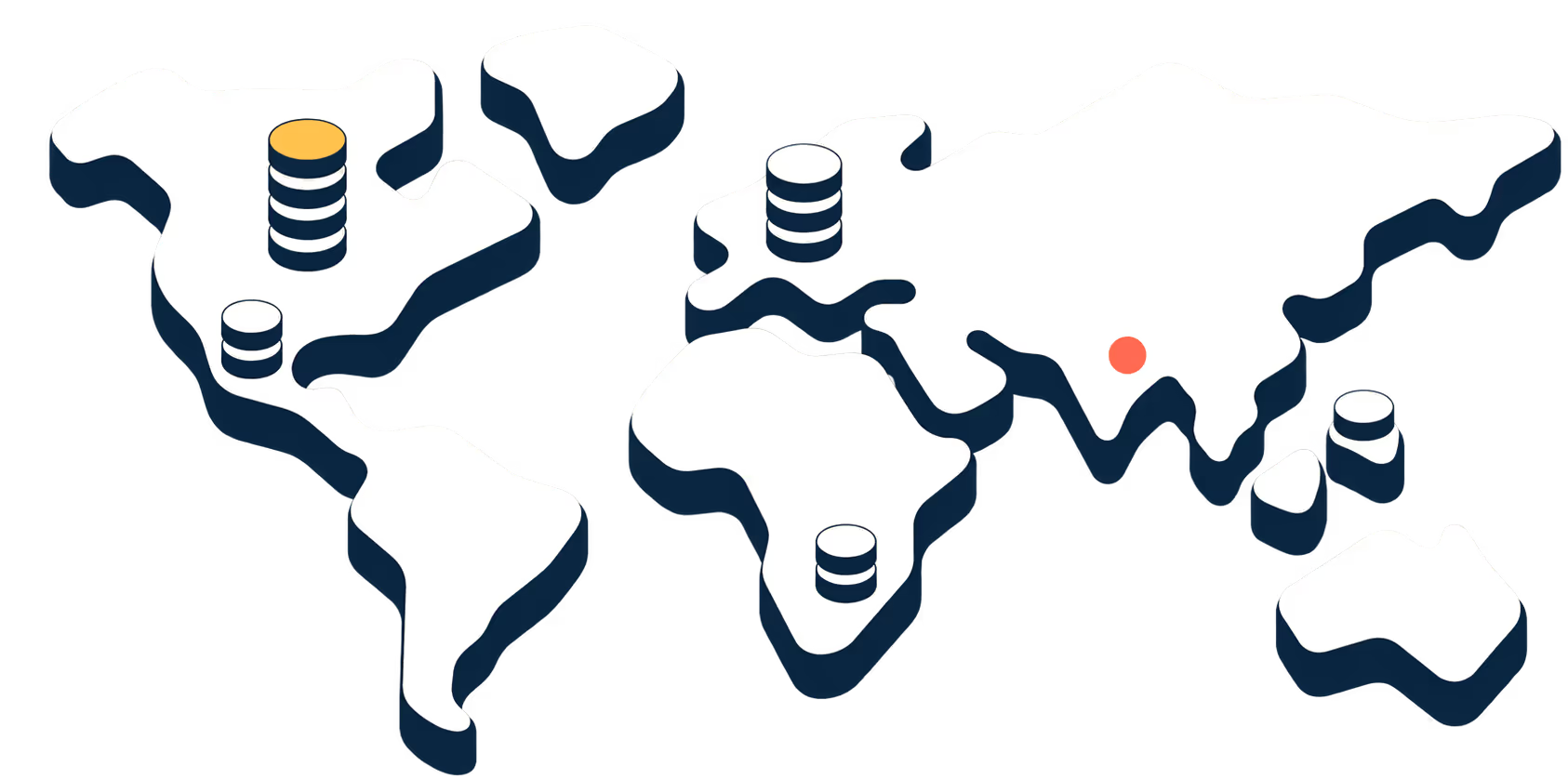
Where the work gets done
Onshore
Native English and full timezone overlap. Worth the premium for brand-sensitive or regulated work.
Nearshore
Near-native English and mostly overlapping hours. The usual pick when your team needs to talk to theirs daily.
Offshore
Cheapest to run and fastest to scale. You give up timezone overlap, so it often carries tier-1 volume.
What you're paying for
The agent's pay is only 20 to 40% of what you're billed. The rest is the four layers above it, and a quote that skips any of them looks 30 to 50% cheaper than it is.
Then budget for what sits outside the rate: transition and setup, ramp, and knowledge transfer. Together they add 10 to 20% to year one.
Before you run the numbers
How accurate is the estimate?
Country rates come from the sources below and reflect what established vendors actually charge. Real quotes usually land within ±20% of a country's mid figure. Inside that range, complexity moves the number most, with Tier 1 inbound at the low end and Tier 3 technical or multilingual work at the top, and voice costs more than chat or email at the same skill level. If a quote sits far outside the range, the spec you sent is probably doing something unusual.
What hidden costs am I leaving out if I run this in-house?
The calculator compares your hourly figure as you enter it, so if you type wages alone you are leaving out four things. Attrition: 40% annual turnover at roughly $10–15K per replacement, per SHRM and CallForce data. Recruiting. Agent tooling: $150–250 per seat per month for CCaaS, WFM, QA and knowledge base. Supervision and QA: roughly 20% of base labor. Together they add 30 to 40% to a wage rate, so a $22 agent is closer to $30 fully loaded. Enter the loaded figure and the comparison is honest.
What sits outside the vendor's rate?
Three things, and they need their own line in year one. Transition and setup runs 5 to 15% of the first-year contract. Ramp takes 3 to 6 months, and you pay the full rate for partial output the whole way. Knowledge transfer is the time your own team spends training and calibrating the vendor, and almost nobody budgets it. Together they add 10 to 20% to year one.
Is BPO actually worth it versus building in-house?
Depends on what you're solving for. If it's cost and your volume is stable, BPO usually wins by 40–60% in regions like the Philippines or Colombia. If it's hiring speed or peak scaling, BPO wins by more, since vendors can stand up 50 agents in 4 weeks where you'd take 4 months. If it's brand-sensitive judgment on high-stakes tickets, keep that in-house and let a BPO carry tier-1 volume. The in-house versus outsourced decision comes down to which constraint is loudest.
I've run the numbers. What should I do next?
Three steps, in order. Send a one-page spec to two or three vendors and check their quotes against the calculator's range. Then build a shortlist; a weighted scorecard for evaluating BPO vendors lays out the diagnostic questions and the red flags. Then run a paid 90-day pilot before signing anything long; 90 days is enough to see whether quality holds. Our call center outsourcing engagements cover that whole process if you'd rather hand it off.
Sources
Every rate and benchmark in this calculator is sourced. Spot something wrong or out of date? Email hello@rethinkcx.com and we will fix it.
- 01TALK-Q — Global Analysis of Real Call Center Labor Costs 2025
Original 2025 cost-per-hour analysis across 12+ countries. Primary anchor for the country rate ranges.
- 02Crescendo.ai — Outsourced Call Center Pricing Guide 2026
Tier-by-tier pricing ladder feeding the complexity multipliers (Tier 1 / 2 / 3).
- 03HiveDesk — BPO Pricing Guide 2026
Regional rate benchmarks used to triangulate India, Philippines, and LATAM ranges.
- 04Insignia Resources — Call Center Turnover Rates 2026
Industry attrition averages — the 30–45% range behind the 40% benchmark.
- 05SHRM — The Real Costs of Recruitment
Source of the $4,683 cost-per-hire benchmark used in the hidden-costs model.
- 06CallForce Global — Call Center Attrition Cost Analysis
Supports the $10K–$20K replacement-hire range when productivity loss is included.
- 07AVOXI — Call Center Attrition Statistics
Secondary attrition source. Confirms remote/virtual centers run 15–20 pp lower than on-site.
- 08Site Selection Group — Comparing Nearshore / Offshore Labor Costs
Cross-region cost comparison feeding the Costa Rica, Colombia, and South Africa rows.
- 09CloudTalk — Call Center Benchmarks 2026
Industry-standard 60–80% occupancy figure used to back-of-envelope contacts-per-agent math.
Want a precise quote?
The calculator gets you close. Book a free consultation and we'll price your actual volumes, channels and coverage.
Book a free 15-min consultation