

What is BPO? The short answer
Business process outsourcing (BPO) is the practice of contracting an external vendor to run a specific business function. Customer support, payroll, accounting, IT, HR: any process that's important but not central to your competitive advantage can be a candidate. The vendor handles execution; the company keeps strategic ownership and focuses internal resources on the work that actually differentiates the business. BPO splits into three tiers: front-office (customer-facing), back-office (internal operations), and knowledge process outsourcing (judgment-heavy analytical work).
That's the definition. The harder question I get asked when consulting with founders and CX leaders isn't what is BPO but should we use it, for what, and how do we set it up so it doesn't blow up six months later. This guide covers both. The definition piece is short. The decision piece is the rest.
Why I'm writing this
I run a CX consultancy and I've spent the last decade either running CX teams (Mejuri, Canada Goose) or advising other CX leaders on how to structure their support operations. A meaningful share of that advisory work involves BPO decisions: when to outsource, what to outsource, who to vendor with, how to structure the contract, what KPIs to enforce. I've seen the partnerships that work and the partnerships that quietly bleed customers for two quarters before anyone notices.
Most explanations of BPO stop at the taxonomy. Knowing that back-office work includes payroll doesn't help you decide anything. What actually determines whether an outsourcing relationship works is a set of questions the category rarely addresses: which process to hand over first, what the vendor's own economics do to your quality in month four, and what a fair rate looks like once you've loaded in the costs nobody quotes. That's what this guide is built around.
The history
BPO as a category emerged in the 1980s when US and European companies started outsourcing manufacturing to lower-cost countries. The term solidified in the 1990s as Indian and Filipino call centers built scale, English fluency, and operational maturity faster than the rest of the world. By the 2000s the model expanded beyond customer service into back-office work (finance, HR, IT). The 2010s added cloud-delivered KPO and specialized AI/analytics outsourcing.
What's changed in the last five years: the economics of pure labor arbitrage are weakening. Wages in traditional offshore regions have risen, AI is automating the most repeatable work, and the most successful BPO partnerships now sell capability (specialized AI implementation, advanced analytics, vertical expertise) more than they sell labor cost reduction. If you're evaluating BPO purely on $/hour you're optimizing on a metric the industry stopped competing on a decade ago.
Types of BPO: front-office, back-office, KPO
The cleanest taxonomy uses two axes: function and location. By function there are three tiers.
Front-office BPO: customer-facing work
Front-office BPO is customer-facing work: support across voice, chat, email and social, plus sales, marketing operations and technical assistance. It carries brand risk the other two tiers don't, which is why it usually belongs second in the outsourcing order rather than first.
Back-office BPO: internal operations
Back-office BPO is the internal operations a customer never sees: payroll, accounting, AP/AR, HR administration, data entry, IT infrastructure, document processing. The two behave differently enough in practice that they get their own comparison below.
Knowledge process outsourcing (KPO)
The third tier is knowledge process outsourcing (KPO): higher-skill, judgment-driven work like market research, legal contract review, financial analysis, R&D support, data science, and IP research. Smaller than the other two but growing fast as AI tooling makes specialized analytical capacity available globally. KPO commands higher rates and needs more specialized vendor selection, because you're buying expertise rather than throughput. Grand View Research puts finance and accounting alone at over 21% of BPO revenue, which is a useful corrective to the assumption that BPO means call centers.
BPO delivery models: onshore, nearshore, offshore
The second axis is geography — where the work is actually delivered from.
| Model | Definition | Best for | Typical cost vs onshore |
|---|---|---|---|
| Onshore BPO | Vendor in same country as buyer | Regulated industries, complex products, premium brand voice | 100% (baseline) |
| Nearshore BPO | Vendor in neighboring country, similar timezone | US buyers needing real-time collaboration, Spanish bilingual | 40-60% of onshore |
| Offshore BPO | Vendor in distant country, different timezone | Cost-sensitive volume work, 24/7 coverage, mature support functions | 15-30% of onshore |
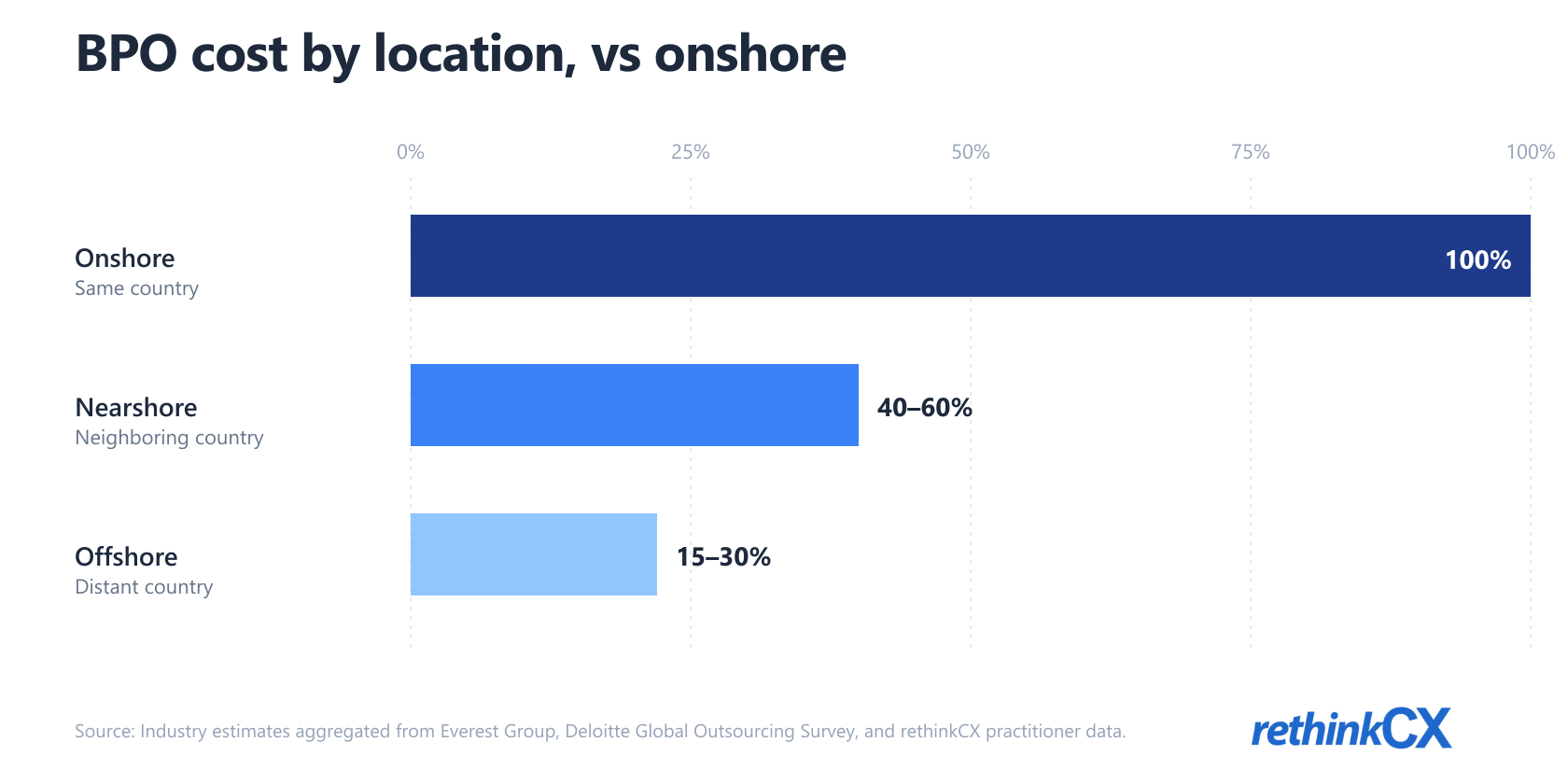
Those are live figures from the BPO cost calculator for one scenario. Change the seat count, the channel mix, or the operating hours and the ranking moves with them.
The country-by-country detail behind each tier covers language quality, infrastructure maturity, regulatory landscape, and the operational realities that determine which tier is actually a fit. That geographic resolution is what most pricing tables flatten away; the fully-loaded rate for each country puts the cost dimension back on it.
Front-office vs back-office BPO: what actually differs
The front-office/back-office split gets taught as a filing system, which makes it sound like a distinction that only matters to whoever writes the org chart. It isn't. The two categories fail differently, and that difference should drive the order in which you outsource.
The real difference is what a mistake costs you. A back-office error produces a rework queue. Someone keyed a claim wrong, it gets caught in exception handling, it gets fixed. The damage is contained and measurable. A front-office error produces a customer who tells other people about it. The vendor's under-trained agent gives a confidently wrong answer on a billing question and you find out about it through a churn cohort two quarters later. Same vendor, same contract, wildly different blast radius.
That asymmetry has three practical consequences.
Back-office work offshores cleanly; front-office work often doesn't. Non-voice, non-customer-facing processing moves to a distant timezone without much of a quality penalty because accent, cultural register, and real-time judgment aren't load-bearing. The moment the work is a live customer conversation, all three become load-bearing at once, and the nearshore premium starts earning its keep. It's common for the same company to run voice in one country and back-office in another for exactly this reason.
Back-office unit economics are usually better. The work is more standardized, so it's more automatable, more measurable, and easier for a vendor to run consistently. In the engagements I see, back-office support work like data entry, claims and exception handling frequently produces better cost-per-output than voice does, which is the opposite of where most buyers' attention goes. It also remains the original BPO category and one of its strongest performing segments, even though the industry's marketing has moved on to more strategic-sounding work. The four-phase arc of how the category got here explains why the boardroom narrative and the revenue keep drifting apart.
So outsource back-office first. This is the sequencing mistake I see most often, and it runs in a predictable direction: founders outsource customer support because that's the queue that hurts, while payroll, AP/AR, and basic IT stay in-house because nobody's screaming about them. That's backwards on risk. The unglamorous internal processes are where a vendor can prove itself without anything customer-facing riding on the outcome, and they're often where the better unit economics were sitting the whole time.
The measurement changes too, and contracts get written badly when this is missed. Back-office performance is throughput and accuracy: units processed, error rate, turnaround time, exception volume. Front-office performance is CSAT, FCR, first response time, and QA score. Writing a front-office SLA around throughput is how you end up with a vendor optimizing for tickets closed per hour, which is exactly the behavior that produces fast, wrong answers.
| Front-office | Back-office | |
|---|---|---|
| Cost of an error | Churned customer | Rework queue |
| Offshores cleanly? | Documented tier-1 only | Yes |
| Measured by | CSAT, FCR, FRT | Throughput, accuracy |
| Outsource it | Second | First |
Is BPO the same as a call center?
Common question. Short answer: call centers are a type of BPO, not the whole category.
When you hear "BPO" in a US/European business context the speaker often means "outsourced call center" because that's the most visible front-office variety. When you hear "BPO" in India or the Philippines it usually refers to the broader industry including back-office and KPO. The market data supports the wider reading: finance and accounting alone accounts for over a fifth of global BPO revenue, and onshore delivery (not the offshore call centers the term evokes) held more than 45% of the market in 2024. Call centers are a large, visible slice of BPO. They are nowhere near all of it.
For founders evaluating outsourcing, the practical implication is: don't think "do we want a call center." Think "which specific business processes are candidates for outsourcing, and what's the best vendor type for each." A single company often uses different vendors for customer support (call-center BPO) and payroll (back-office BPO) and tax research (KPO). They're three different vendor selection conversations.
The buyer-side signals that specifically point at call center outsourcing include volume thresholds, multilingual gaps, and the seasonal-staffing math. They're different enough from the signals that suggest payroll or KPO outsourcing that they warrant their own diagnostic.
Outsourcing customer service: when it pays back, and when it backfires
The single most-searched buyer-side framing of BPO is "outsourcing customer service" — the customer-support use case specifically, separate from the broader BPO category. The economics and risks differ enough from other BPO use cases that CX outsourcing in 2026 is its own discipline rather than a special case of generic BPO selection: cost models behave differently, AI integration matters more, and nearshore-vs-offshore tradeoffs reshuffle when the workload is customer-facing.
When outsourcing customer service pays back:
- Volume that swings 30%+ seasonally. retail Q4 ramp, tax-season fintech surge, travel-season hospitality. The fixed cost of an in-house team sized for peak is hard to justify when 30% of seats are unstaffed for nine months. Vendors flex headcount up and down on 30-60 day notice cycles; internal teams cannot.
- Operations that need 24/7 coverage but don't have the headcount density to staff three shifts internally. Two timezone handoffs at a nearshore or offshore vendor produce a 24-hour follow-the-sun model at a fraction of the cost of three internal shifts.
- Multilingual support requirements that exceed the languages you can hire in your home market. Manila and Cape Town vendors run 8-15 languages on a single floor; replicating that internally is a hiring problem, not a budget problem.
- Tier-1 support volume. password resets, order status, return processing, basic account questions. These workflows are documented, scriptable, and don't carry brand-defining risk if a less-tenured agent handles them.
When outsourcing customer service backfires:
- Brand-defining customer interactions. the high-value purchase, the upset detractor, the renewal conversation. Outsourced agents can be excellent but they're operating at a brand-distance the customer often perceives. Top-of-funnel and high-emotion interactions usually stay in-house even at otherwise heavily-outsourced operations.
- Workflows that aren't documented yet. pre-launch products, fast-changing policies, customer issues whose resolution path requires judgment from someone who knows the business. Don't outsource what you can't document; the vendor will improvise and the improvisation will damage CX.
- Operations under 30 seats of total volume. the overhead of vendor management, SLAs, QA calibration, and knowledge-base maintenance often eats the cost savings at small scale. Hire a team lead instead and revisit at 50+ seats.
- Hypergrowth periods where the product is changing weekly. vendor agents trained on last quarter's product confidently answer questions wrong about this quarter's product. The training lag is the killer at hypergrowth scale, not the cost. We watched this exact pattern at Mejuri during the 2020-2022 ramp; outsourcing tier-1 looked attractive on paper and produced a CSAT drop the in-house team had to spend two quarters recovering from.
The hybrid model I see working most often: keep tier-1 high-volume workflows internal during the first six months of a new product, document everything as the workflows stabilize, then outsource tier-1 once the documentation is real. Keep tier-2 (escalations, edge cases, brand-defining moments) in-house permanently. Use the vendor for surge volume even if you keep tier-1 baseline internal. This is more operationally complex than full-outsource or full-in-house but produces better CX outcomes than either pure model.
The buyer-side mistake I see most often is treating outsourcing customer service as a binary cost decision — "we'll outsource everything to save 60%." The teams that do this almost always rebuild a partial in-house operation 12-18 months later because the CX degradation showed up in retention, and retention costs more than the headcount the outsource saved. The teams that get it right treat the outsource decision as a workflow-by-workflow question, not a function-level one.
Sequencing which workflows to outsource first, structuring the vendor diligence, and running the transition itself is what the call center outsourcing advisory we offer is built around. The framework above is the buyer's-own version; the engagement is when you want a partner running the diligence alongside you.
How does BPO actually work? The 6-step BPO framework
The textbook process (identify needs, select vendor, sign SLA, transition, monitor) is correct but underdescribes what actually happens. The version I'd give a founder asking how this works in practice:
Step 1: stabilize the in-house process before you outsource it. This is the step every BPO guide skips and every failed BPO partnership traces back to. If you can't write a one-page SOP that explains how you handle the top 10 most common cases (with templates, escalation rules, and what success looks like), don't outsource the work. The vendor inherits whatever mess you hand them. A bad in-house process becomes a worse outsourced process — only now the bad signals are happening in someone else's office.
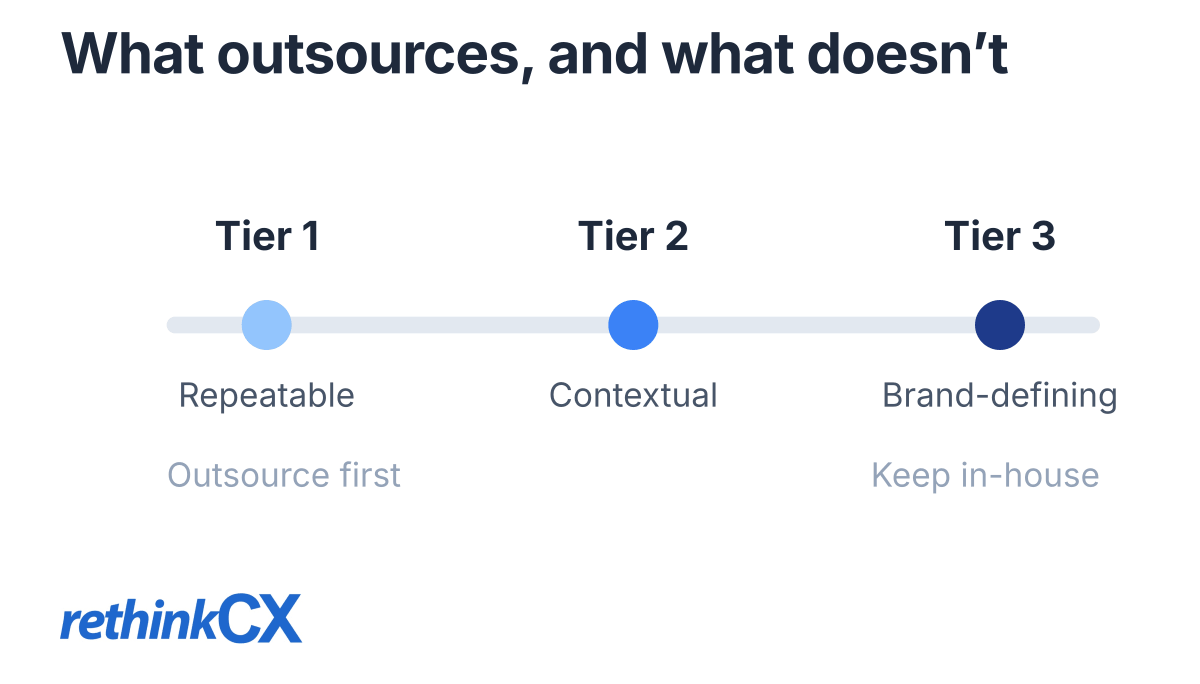
Step 2: define the scope tightly. Pick one function, one tier, one SLA target. Don't try to outsource your full inbound queue on day one. Outsource Tier 1 (predictable, repeatable, low-judgment) first; reserve Tier 2 (some product context, some judgment) for after 90 days of clean Tier 1 work; keep Tier 3 (escalations, complaints, churn-risk, product feedback) in-house probably forever. The same logic applies in non-customer-support contexts — start with the simplest, most documented slice.
Step 3: vendor selection. Get 3-5 vendors on a shortlist. Ask each for sample weekly reports from a similar-size client (redacted). Reference call 2 customers each (the references are obviously their best, but the texture of the answers matters). The full BPO vendor selection framework covers the diligence questions vendors won't volunteer: the failure-mode catalog, the red-flag scorecard, and the reference-customer angles the vendor doesn't want you exploring.
Step 4: contract structure. Pricing model matters more than headline rate. Per-hour, per-agent, per-ticket, per-output and hybrid each create different incentives. Per-ticket without quality gates incentivizes the vendor to close tickets fast at the cost of resolution quality. Per-agent with productivity floors aligns incentives better. Most startup-stage relationships end up on a hybrid: base block of agent hours plus per-ticket overflow. Our BPO pricing models guide covers each model in operational detail, including the buyer-side management overhead that vendors never quote.
Step 5: pilot, don't commit. Start with 2-4 agents on the smallest tier-1 contact slice for 60-90 days. Measure CSAT, FRT, FCR, and QA scores against your in-house baseline. If the pilot hits within 5 points of baseline by week 8, scale. If not, address it before scaling. "We just need a bit more time" stretches into quarter two and you've burned half a year.
Step 6: ongoing management. Weekly business reviews, joint problem-solving on escalation patterns, quarterly SOP refreshes. The vendor relationships that work look like internal team relationships. The ones that fail look like a quarterly invoice review. Maintaining quality past the launch honeymoon is its own discipline: the SLA architecture, the QA cadence, the ramp-staging through inevitable rough patches. The outsourcing-without-losing-quality playbook walks each of those in operational detail.
Industries that use BPO (and why each one uses it)
Different industries outsource for different reasons. The use-case matters because the vendor selection conversation changes accordingly.
Ecommerce and DTC retail. Customer support outsourcing for tier-1 volume, returns processing, social media moderation. Driver: variable seasonal volume, expensive to staff peaks in-house. The brands I've worked with in this space (Mejuri, mid-market DTC clients) typically run a hybrid: small in-house team for brand-defining moments, BPO for tier-1 volume during sales events and holiday peaks. The ecommerce-specific outsourcing playbook walks the operational decisions that recur across this category (Q4 seat planning, the returns-processing split, the social-moderation outsourcing pattern). They're different enough from generic CS outsourcing to deserve their own framework.
Hospitality. Reservations, guest support, back-office accounting. Driver: 24/7 coverage requirement, multilingual support, predictable transactional contact mix. Hospitality is one of the cleanest industries for BPO because the contact patterns are well-understood and SOPs translate cleanly across vendors.
Healthcare. Medical billing, claims processing, patient scheduling, IT/EMR support. Driver: compliance complexity (HIPAA in US), specialized administrative work that hospital staff are too expensive to do. Healthcare BPO has the highest compliance stakes; vendor selection here weighs SOC 2 / HITRUST / HIPAA certifications heavily. The healthcare-specific outsourcing playbook goes deeper on the compliance-architecture questions that come up in vendor diligence: audit-trail demands, BAA structure, and the data-residency tradeoffs that aren't in generic BPO RFPs.
Financial services. AP/AR processing, claims, KYC/AML compliance research, contact center for retail banking. Driver: high transaction volume, regulatory expertise, scalable processing capacity. Often KPO-leaning given the analytical complexity.
Technology and SaaS. Tier-1 technical support, content moderation, data labeling for ML training, QA testing. Driver: scaling support faster than engineering can absorb, specialized data labeling capacity. SaaS is also where modern BPO arrangements look most like internal team extensions; vendors embed in customer Slack, attend product launches, share roadmaps.
Startups (any industry). Specifically the function pattern: outsource what you can document, keep what you can't. Founders typically over-outsource the wrong work (tier 3 / customer-facing brand-defining moments) and under-outsource the right work (back-office processes, payroll, basic IT). The startup-stage outsourcing decision tree covers the seed-to-Series-A specifics: which BPOs even take startup volume, what contract shapes work at that scale, and the bootstrapping mode of pre-50-customer companies. Larger frameworks treat these as edge cases, but they actually drive most early-stage outsourcing decisions.
Benefits of BPO
The pitch deck version of BPO benefits says "cost savings, scalability, expertise, focus on core, 24/7 coverage." All of those are real. Here's how I'd actually rank them from most to least important based on what moves outcomes for the brands I've worked with.
Most valuable: capacity for predictable peaks and 24/7 coverage. If your support volume triples during a Black Friday weekend or you need overnight coverage your in-house team can't sustainably provide, BPO is the cleanest solution. Hiring full-time staff for these patterns wastes 60-80% of their hours.
High value: access to operational maturity you don't have in-house. A good BPO vendor has run thousands of similar engagements. Their SOPs, QA processes, training infrastructure, and reporting cadences are mature in ways yours aren't if you're a smaller team. Buying that maturity is often more valuable than buying the labor itself.
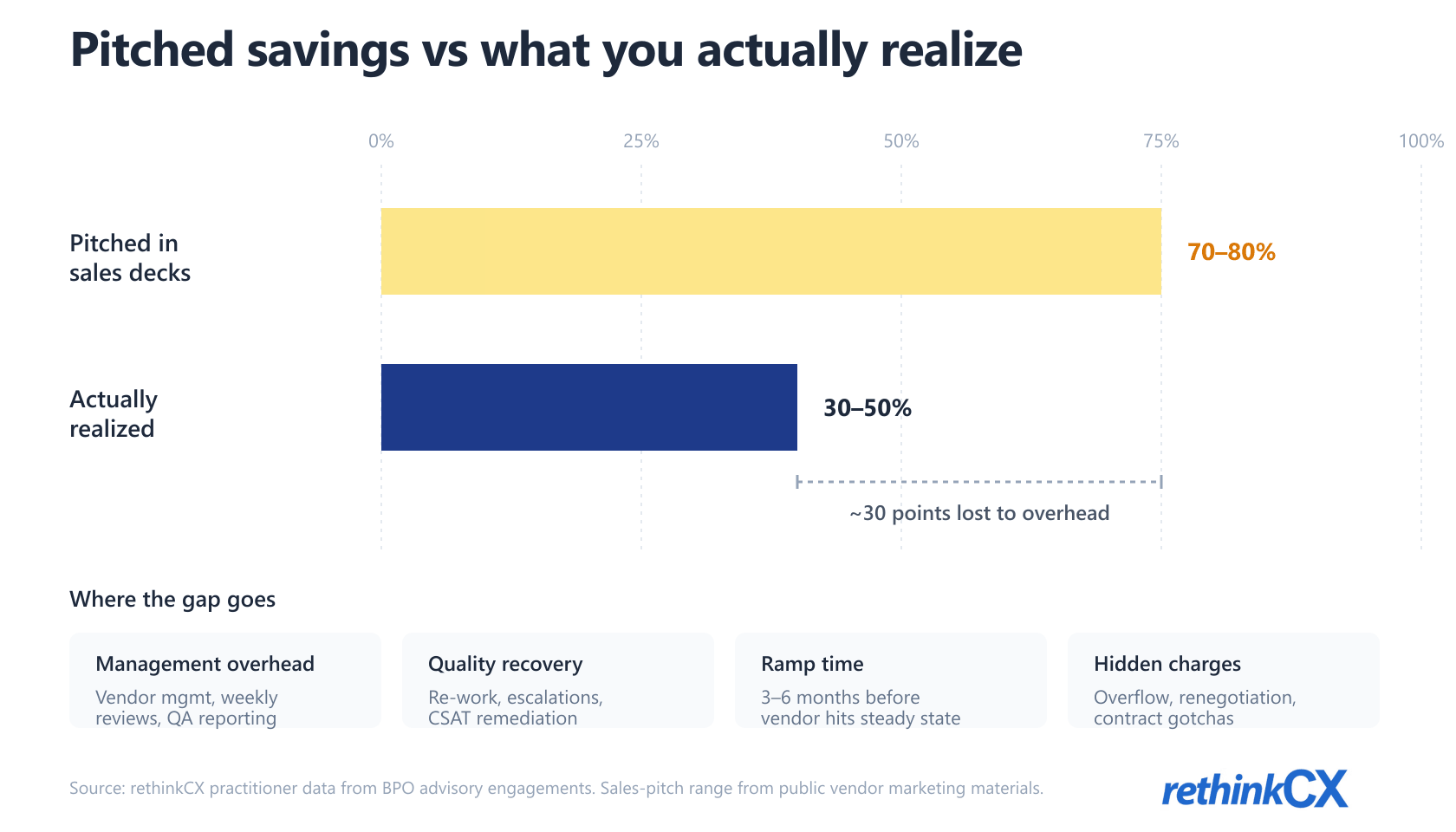
Real but commonly overstated: cost savings. Yes, offshore agents cost less per hour. But after you account for management overhead, QA, ramp time, and the operational discipline you have to build to make it work, the savings we actually see realized in advisory work land around 30-50%, against the 70-80% a sales deck implies. Those are our engagement numbers rather than a published benchmark, and the gap between the two is consistent enough that I'd treat any vendor quoting the higher figure as quoting a rate rather than a result. Cost savings also disappear quickly if you optimize for the wrong vendor and pay for quality recovery later.
Real but situational: focus on core. True if your in-house team is small enough that the work being outsourced was genuinely distracting them from higher-value work. Less true at scale, where outsourcing creates its own management burden.
Often oversold: 24/7 expertise. Vendors will sell deep expertise in your industry. Sometimes true, often more aspirational than real. The depth of expertise matters most for technical support and KPO; for tier-1 customer support, "expertise" is largely about good SOPs and tooling.
For the cost angle specifically, the 4 cost-saving secrets of call center outsourcing covers the tactical playbook, and our call center outsourcing cost calculator runs fully-loaded rates across 18 countries for a specific scenario.
Risks of BPO
Quality drift. Most common failure mode. The vendor delivers good work for the first 90 days, then quality slowly degrades as agent attrition compounds and your engagement isn't the vendor's biggest priority anymore. Mitigation: weekly QA sampling, quarterly recalibration, SOP refreshes.
Vendor lock-in. You build dependency on the vendor's tooling, knowledge, and process documentation. Switching costs become real. Mitigation: maintain in-house ownership of the SOPs and the data; don't let the vendor become the system of record for your customer interactions.
Data security and compliance. Higher stakes for healthcare (HIPAA), financial services (PCI-DSS, SOX), EU customers (GDPR), and California customers (CCPA). Mitigation: certifications check at vendor selection, security clauses in MSA, regular audits. Treat this as a launch gate, not a checklist item.
Communication friction. Timezone gaps, accent challenges, cultural differences in feedback delivery. Less of a problem than 10 years ago in mature offshore regions but still real. Mitigation: dedicated client contact at vendor (not a rotating account manager), shared Slack/Teams channel, weekly synchronous reviews.
Hidden costs. Overflow charges, contract renegotiation fees, transition costs if you switch vendors. Mitigation: detailed pricing matrix in the original contract, contingency budget of 15-20% above contracted rate.
Loss of customer feedback signal. This is the underrated risk. Customer-facing conversations contain product feedback, churn signals, edge cases. If you outsource them all, you sever the most important customer research feedback loop in the company. Mitigation: keep tier 3 (complaints, escalations, churn-risk) in-house; have the vendor flag and escalate themes weekly even on outsourced contacts.
The operational discipline that prevents most of these risks lives in two places: the training and onboarding shape for outsourced agents catches the quality issues before launch, and the SLA-and-QA architecture that protects quality from drifting after launch catches the slow-decay that shows up around month four. Teams that skip either ship a vendor relationship that looks fine on the launch dashboard and degrades under contact.
The BPO business model: how vendors actually make money
Buyers spend their diligence understanding what they're purchasing and almost none of it understanding what the vendor is selling. That's backwards. A BPO's own economics predict the behavior you'll get in month four far more reliably than the rate card does, and they're not hard to read once you know where to look.
A BPO sells capacity at a margin. On a fully-loaded seat that margin typically runs 25-40%. Everything else about how the relationship behaves follows from protecting it.
Utilization is the whole game. The vendor sizes your contract off a formula: forecast contacts multiplied by average handle time, divided by productive hours times an occupancy target. We anchor against roughly 80% occupancy with 30% shrinkage, using the vertical's standard handle time. An idle seat destroys the vendor's margin. A seat run above the occupancy target destroys your quality, because occupancy is the same dial as agent burnout. When a vendor pushes hard for committed volume rather than flexible capacity, that's not a negotiating posture, it's the economics talking. They need the utilization floor.
Year-one pricing is deliberately thin. The vendor wants the logo and the reference, so the first-year rate is often close to cost. Margin gets recovered in years two and three through scope creep, change-order pricing, and SLA exception fees. Build an 8-12% annual escalation into any multi-year total-cost model, and read the change-order clause more carefully than the headline rate. The rate is the part they expect you to negotiate. The change-order terms are the part they expect you not to read.
This is why quality drifts around month four. It isn't bad faith and it usually isn't incompetence. Frontline attrition in this industry runs 30-50% a year for inbound voice in the operations we benchmark, and each replacement carries real recruiting and ramp cost the vendor absorbs inside a fixed rate. Your best agents get rotated onto the newest logo, because that account is the one at risk. Your account, now stable and past its honeymoon, inherits the replacements. The launch cohort you were delighted with was never the steady-state cohort. Anyone who has watched a strong pilot decay into a mediocre quarter has watched this specific mechanism, not a mysterious loss of vendor commitment.
The pricing model you choose reassigns the risk. Per-hour puts volume risk on you. Per-ticket puts it on the vendor and quietly rewards them for closing fast, which is why per-ticket without a quality gate reliably inflates resolution rates while resolution quality falls. Per-agent with productivity floors sits in the middle. Outcome-based pricing aligns best and is hardest to get signed, because you're asking the vendor to take on risk they can't fully control. The operational detail on each model covers where each one breaks down and the buyer-side management overhead none of them quote.
Three things follow from all this when you're at the table. Ask what occupancy they're modeling: a vendor planning for 90% is planning to burn agents. Ask what happens to your account when they sign a client twice your size, and listen for whether the answer is a process or a reassurance. And weigh where their margin sits, because a vendor steering you toward the option that pays them less is telling you something a pitch deck cannot. That last signal is one I trust structurally: rethinkCX gets paid by the provider on vendor-neutral matching, so I've watched a lot of salespeople choose between the honest recommendation and the profitable one.
The buyer-side conclusion isn't that vendor margin is a problem to be squeezed. A vendor working at an unsustainable rate delivers unsustainable quality, and you pay for it later in recovery work. The conclusion is that you should know which lever the vendor is pulling and when, so the relationship's inevitable pressure points don't arrive as surprises.
BPO market in 2026: what's actually changing
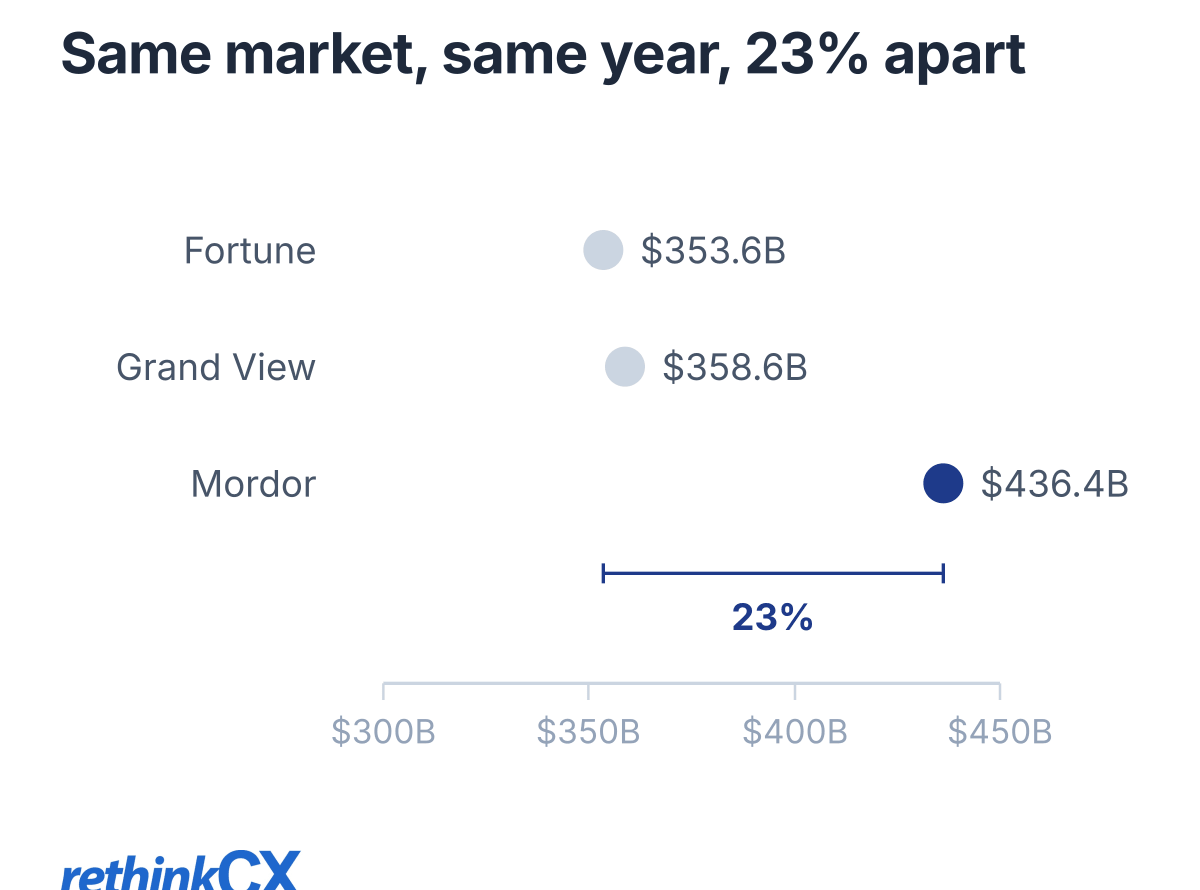
Start with a caveat about the market-size numbers themselves, because most articles quote one figure as if it settles the question. It doesn't. Published 2026 estimates for the global BPO market run from $353.6B (Fortune Business Insights) to $358.6B (Grand View Research) to $436.4B (Mordor Intelligence). That's a 23% spread on the same market in the same year. The firms diverge because they count different work, some folding in IT outsourcing and some treating it separately, and because they refresh on different cycles. Treat any single headline number as a scope decision rather than a measurement, and don't build a business case on one.
Where they agree is direction and slope. Grand View Research projects the market reaching $525.23 billion by 2030, at a 9.8% CAGR from 2025, with Asia Pacific growing fastest at around 11%. Mordor's slower 7.39% and Fortune's 9.7% bracket it from either side. Nobody publishes a decline. A category supposedly being eliminated by automation is compounding somewhere between 7% and 10% a year, which is the number that should actually inform your planning horizon.
The more useful signal is one the market reports don't capture: rates are rising at the source. The fully-loaded seat rates we see in live RFPs are trending 5-10% higher year over year, and the Philippines and Mexico labor markets are tightening fast. If you're building a multi-year model on the assumption that offshore labor gets cheaper in real terms, that assumption is already expired.
A few real shifts worth understanding.
AI is restructuring the work, not eliminating BPO. The widely-predicted "AI will replace call centers" framing has not played out. What we see in deployments is closer to a third of routine query volume absorbed by chatbots and agent-assist, with human agents concentrating on the higher-judgment remainder. The BPO industry has adapted by selling agent-AI hybrid models. The vendors that resisted AI integration are losing share; the ones that built it natively are growing. How conversational AI and human agents divide the queue is one of the better operational lenses on what the hybrid model looks like at run-time, beyond the slide-deck version.
Specialty over scale. A decade ago BPO competed on $/hour. In 2026 the competitive premium is on industry specialization (healthcare BPO that knows HIPAA cold; SaaS BPO that integrates natively with your tech stack; ecommerce BPO that understands D2C operational rhythms). General-purpose vendors are getting compressed.
Nearshore growth. Latin America, Eastern Europe, and South Africa are taking share from traditional Philippines/India offshore. Driver: timezone alignment with US/EU markets matters more in real-time-collaboration-heavy work, and the per-hour cost gap has narrowed.
ESG and sustainability scrutiny. Larger buyers (Fortune 500, regulated industries) are increasingly building ESG criteria into vendor selection. For mid-market buyers this matters less, but it's worth noting.
Modern BPS framing. Some vendors are rebranding from "BPO" to "BPS" (Business Process Services) to escape the cost-arbitrage connotations. The work hasn't fundamentally changed; the marketing has.
These five shifts compound rather than cancel each other out. The year-by-year detail on the broader BPO trends list covers the wider canvas of what's moving, and the operational implications for buyers show up clearest in the technology shifts reshaping call center outsourcing, where the AI-vs-human split actually lands at run-time.
How to choose a BPO provider (the diligence I actually run)
Here's the diligence I work through when I'm helping a client evaluate BPO partners. It's not exhaustive but it catches most failure modes.
Scope clarity first. Before you talk to vendors, document: which process, what volume, which SLA, which channels, which compliance requirements, what reporting you need. If you can't define this in two pages, you're not ready to vendor-select yet.
Get 3-5 vendors on the shortlist. Anything fewer and you don't have leverage; anything more and you're spending more time vendor-managing than process-stabilizing.
The four diagnostic questions per vendor:
- "Walk me through your QA process. How many tickets per agent per week get reviewed and by whom?" Good answer: specific number (4-10% sample), defined rubric, weekly calibration. Bad answer: vague "we have a QA team."
- "What's your average tenure for tier-1 agents? What's your monthly attrition?" Good answer: 12+ months tenure, sub-10% monthly attrition. Bad answer: avoidance.
- "How do you handle ticket volume that exceeds the contracted block?" Good answer: clear overflow pricing, named escalation contact. Bad answer: "we'll figure it out."
- "Show me a sample weekly report from a similar-sized client." Good answer: clean reporting on volume, FRT, CSAT, escalation rate, top contact reasons. Bad answer: "we'll build something for you."
Reference calls. Always 2 minimum. Ask: "what surprised you in the first 90 days?" "What did the vendor get wrong, and how did they handle being told?" "What would you negotiate differently?" The texture of answers matters more than whether the customer is happy in aggregate.
Red flags. No defined onboarding process. Pricing structure that disincentivizes quality (pure per-ticket, no quality gates). Refusal to start with a small pilot. No transition or offboarding clause. Sales team promising specific FRT/CSAT numbers without seeing your tickets first.
Real-world: what the partnerships that work look like
The BPO partnerships I've seen succeed share a few patterns:
They started small. Pilot with 2-4 agents on a single tier-1 contact type. Prove the partnership on a narrow scope before scaling.
The buyer invested in their own SOPs first. The single best predictor of vendor success is the quality of the documentation the founder hands over on day one. Vendors are not going to build your operational rigor for you.
They kept tier 3 in-house. Complaints, churn-risk conversations, product feedback (the contacts that teach you about your business) stayed with the in-house team. Cost savings from outsourcing those don't show up on the P&L for a quarter; the lost retention from doing them badly does.
They treated the vendor as a team, not a vendor. Weekly syncs, real feedback loops, joint problem-solving, shared KPIs. The relationship looks like an internal team relationship. The ones that fail look like a quarterly invoice review.
They tracked cost per output, not cost per agent. A vendor at $400/agent/month doing 30 tickets/agent/day is more expensive per ticket than a vendor at $1,000/agent/month doing 90 tickets/agent/day. The cheap-per-agent option is often the expensive-per-ticket option.
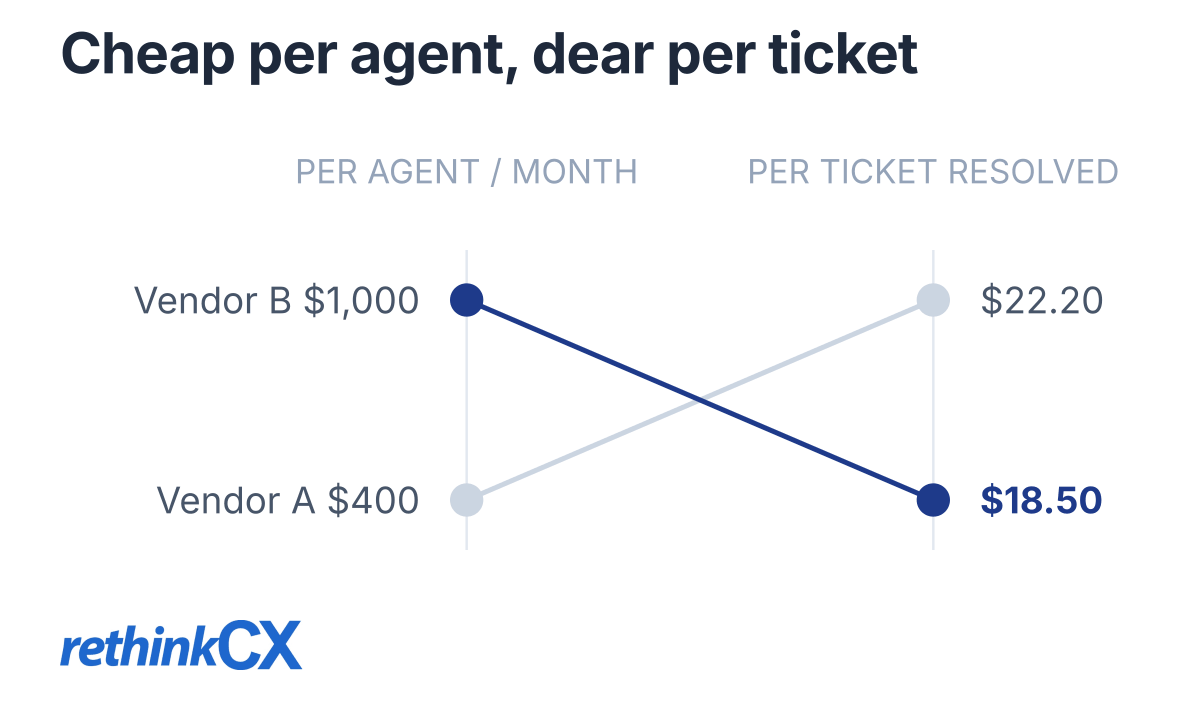
The shift from cost-per-agent to cost-per-output isn't just a math change. It's the same framing shift the entire BPO category has been making for two decades. The evolution from cost-cutting to strategic advantage covers the four-phase arc that got the industry here, and turning a call center from cost center into profit center covers the operational discipline at the destination of that arc, where the best vendor relationships actually end up.
In-house vs outsourced: how to actually decide
The framework I use with clients:
| Function characteristic | Lean in-house | Lean outsourced |
|---|---|---|
| Strategic / brand-defining | ✓ | |
| Highly variable volume (peaks/troughs) | ✓ | |
| Requires deep product knowledge | ✓ | |
| Repeatable, well-documented | ✓ | |
| 24/7 coverage required | ✓ | |
| High compliance stakes | (depends; onshore BPO can work) | |
| Customer feedback signal | ✓ | |
| Pure transactional volume | ✓ |
If a function has 4+ "outsourced" indicators, it's a strong candidate. If it has 4+ "in-house" indicators, keep it. Most functions are mixed; that's where the hybrid model comes from. The full in-house-vs-outsourced playbook covers the volume-threshold math (where each model wins around the 25-seat and 100-seat breakpoints) and the routing-layer architecture that makes hybrid actually work at run-time.
Future of BPO beyond 2026
A few directions worth tracking, with my take on each:
Hyper-automation. AI + RPA + ML stacked into end-to-end process automation. Real and growing. The implication for buyers: the work that's most valuable to outsource is increasingly the work that requires judgment, not the work that's easily automated. Your tier-1 outsourcing volume will shrink; your tier-2 outsourcing value will grow.
Vertical specialization. General-purpose BPO vendors will keep losing share to vendors that go deep in healthcare, fintech, ecommerce, SaaS, public sector. If you're choosing a vendor, prefer the one that knows your industry's compliance and operational rhythms.
Modern fractional models. A growing class of fractional CX leadership and fractional ops services that sit between full BPO and in-house. Useful for early-stage companies whose volume doesn't yet justify a permanent senior hire but whose CX stakes still need senior judgment.
Continued nearshore growth. Particularly Latin America for US buyers. Timezone alignment matters more in modern collaborative work patterns.
Pricing model evolution. More outcome-based and shared-savings models. Less pure FTE-based. The vendors that will win the next decade are the ones that align their pricing with their customers' business outcomes rather than their hours billed.
When BPO is the wrong call
The honest version. BPO is the wrong call when:
- You haven't documented or stabilized the in-house process. Outsourcing accelerates whatever process you give it. A bad process gets worse.
- The work is your strategic moat. Don't outsource the thing customers buy you for.
- The volume is too low to justify vendor management overhead. Below ~$50K annual spend or 5 FTE-hours/week, the management cost dominates the savings.
- The function requires constant collaboration with internal stakeholders that the vendor can't reasonably attend.
- You're outsourcing because the team is tired, not because you've done the operational analysis. Tired teams need process and tools, not necessarily different people.
If any of those apply, fix the underlying issue first. Don't pay a vendor to inherit your problems.
The point
BPO is a tool, not a strategy. The companies that get it right know exactly what problem they're solving with it (capacity, coverage, expertise, or all three), document the work first, pilot before scaling, structure the contract for aligned incentives, and keep the work that teaches them about their business in-house. The companies that get it wrong outsource because they're tired, pick the cheapest option, and discover six months later that nobody owns the customer relationship anymore.
The 2026 version of BPO looks different from the 2010 version. AI is restructuring the work, vertical specialization is replacing general-purpose scale, nearshore is taking offshore share, and the smart vendors are selling capability rather than labor. The diligence framework hasn't changed: clear scope, smart vendor selection, aligned pricing, pilot first, and treat the relationship as a team relationship. Get those right and BPO is one of the highest-impact operational moves a company can make. Get them wrong and it's an expensive way to learn what you should have built in-house.
The sibling guides that round out the operational picture sit alongside this one rather than below it. Scaling a call center with BPO covers the volume-ramp mechanics this pillar treats at a higher level, and BPO locations covers the nearshore-vs-offshore-vs-onshore geography tradeoffs at unit-economic resolution. On the operational-KPI side, response-time architecture is the dimension most BPO contracts get measured against in the first 90 days. And because retention is the financial truth metric for whether outsourcing is working at all, the customer churn pillar is the outcome-side companion to this one.
When you're ready to evaluate vendors directly, the outsourcing advisory we offer handles the matching and diligence, and the BPO cost & savings calculator gives you a clean baseline for what your specific scenario should run. For buyers earlier in the journey, still working through whether BPO fits at all, the free Call Center Outsourcing Playbook is the foundational primer, covering the "is this right for us" decisions this pillar treats as already worked through.