

The short answer
A customer experience strategy is the operational plan that ties customer needs to the work your company actually does. It covers how you understand customers, design their journeys, measure their experience, deliver service across touchpoints, and hold the rest of the business accountable for the outcome. The strategies that work treat CX as a P&L line; the strategies that fail treat it as a vibe. Underneath all of it sits the single most direct cause of customer loyalty, which the strategy either honors or doesn't.
This guide is the practitioner version of "how to build a CX strategy." I've spent the last decade either running CX teams (Mejuri, Canada Goose) or advising other CX leaders, and I'd say roughly 70% of the strategies I see in the field share the same handful of structural problems. This guide covers what a real strategy looks like, the five pillars that have to be in place, what fails most often, and how the bar shifted in 2026.
A note on framing: the dominant CX strategy framework in the industry is KPMG's "six pillars of customer experience" (integrity, resolution, expectations, time and effort, personalization, empathy). Those are pillars of customer perception — what a great experience feels like to the customer. This guide names a different set: pillars of execution — the operating capabilities a company needs to actually deliver those perceptions. Both frames are useful. Most strategy decks I audit describe the perception pillars and skip the execution ones, which is a large part of why they fail.
Why CX strategy matters now (and what changed)
The industry context is bleak. According to Forrester's 2024 US Customer Experience Index, CX quality in the US hit an all-time low after declining for an unprecedented third consecutive year, with 39% of brands and 10 industry averages dropping in 2024 alone. Only 3% of companies qualify as "customer-obsessed." Forrester's 2025 CX Index reported another all-time low. The bar to ship a credible CX strategy is rising; the average is falling. Three shifts explain why.
AI is past the novelty stage. In 2023 the conversation was "should we add a chatbot." In 2026 the conversation is "where does AI add value vs where does human judgment matter more, and how do we instrument the difference." The brands winning at AI-augmented CX are the ones that figured out the where-not-just-the-whether question.
Cross-functional ownership replaced single-team CX. The old CX org chart had a Director of CX who owned the survey program, the call center, and a dotted line to product. That model is dead in companies that take CX seriously. Modern CX is distributed: product owns in-product experience, marketing owns acquisition experience, support owns post-purchase, ops owns delivery. A strategic owner sets the unifying cadence on top.
Action cadence is the new differentiator. Insight without operational change is theater. The leaders moving retention are the ones who wired CX data into 30-day operational responses. The laggards are still running quarterly NPS reviews and wondering why nothing improves.
If your strategy doesn't address these three shifts, it's a 2022 strategy. The bar moved. The wider 2026 CX trends picture covers the macro forces these three shifts emerge from (agentic AI, retention as the dominant ROI metric, the decline of dashboard-only programs); the rest of this guide stays at strategy-execution level.
The five pillars of a real CX strategy
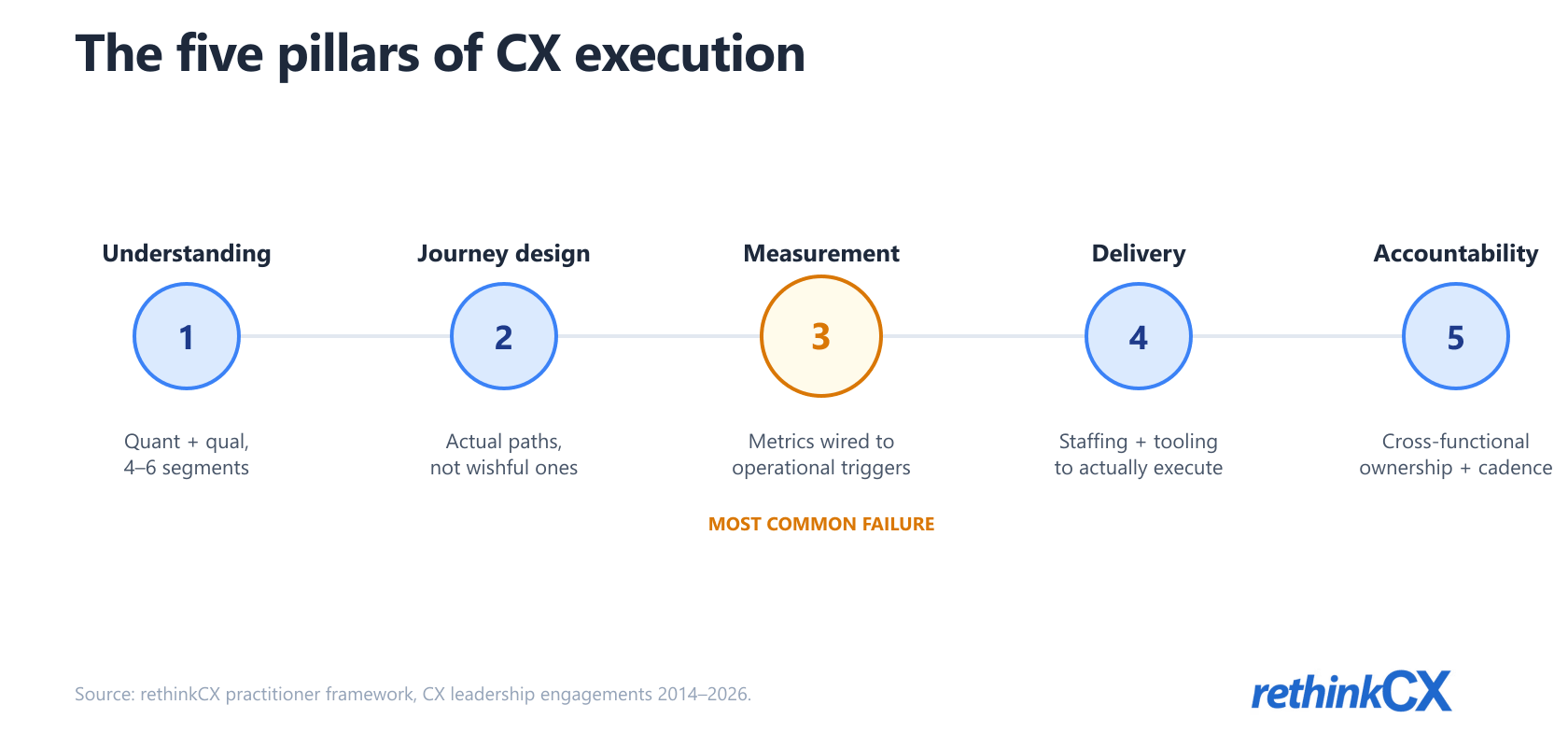
A complete CX strategy has five pillars. Most strategies I audit have 2-3 in place. The gaps determine the failure mode.
Pillar 1: Customer understanding
You cannot design experiences for customers you don't understand. Customer understanding has three layers:
Quantitative: behavioral data from your product analytics, support tickets, transaction records, web analytics. Who does what, when, with what outcome. This is the table-stakes layer; most companies have it but underuse it.
Qualitative: customer interviews, support ticket reading, win/loss conversations, NPS verbatims, in-product session recordings. The texture of why customers do what they do. This is the layer most companies short-change because it doesn't scale linearly with effort.
Synthesis: segmentation that maps the quant + qual into a small number of useful customer archetypes you can design for. Not 27 personas. 4-6 actionable segments. The synthesis layer is where most VoC programs die: they generate the data but never produce the synthesis the business can act on. The Voice of the Customer programs that work are designed around the synthesis step from day one, not bolted on after the survey infrastructure is live. For the consulting side of standing one up, our Voice of Customer consulting covers the operating model.
Pillar 2: Journey design
A customer journey is the sequence of interactions a customer has with your brand from first awareness through advocacy or churn. Journey design is the discipline of:
- Mapping the journeys customers actually take (not the ones you wish they took)
- Identifying the friction points and emotional valleys at each stage
- Designing the operational changes that smooth or redesign those moments
- Treating it as a continuous practice, not a one-time workshop
Most journey-mapping work I see fails because it stops at the workshop output. The map gets printed, hung in a meeting room, and never operationalized. The strategies that work treat the journey map as the source-of-truth for prioritization. Every product, marketing, or ops decision asks "where does this fit on the journey, and is it improving or degrading the experience at that stage?" The step-by-step mechanics live in our customer journey mapping guide, and the digital-first variant in digital customer journey optimization.
Pillar 3: Measurement (with operational triggers)
The measurement layer is where most CX strategies break down. Companies stand up dashboards, run NPS programs, share quarterly reports, and the customer experience doesn't improve because the measurement isn't wired to anything. McKinsey's research on the future of CX puts this bluntly: "customer surveys cannot be the chief tool for designing and delivering better experiences" because they capture a narrow responding sample and don't trigger swift action. The winning systems are predictive and operationally wired, not retrospective and reporting-driven.
A working measurement system has four properties:
- A focused metric portfolio. Not 30 metrics. 4-6 that you actually act on. NPS for relationship health, CSAT for transactional moments, CES for friction in specific journeys, retention/churn for revenue truth, CLV for long-term value.
- Segmented reporting. Aggregate NPS hides everything. Segment by tier, behavior, lifecycle stage, support history, channel. The segments where the metric drops are the segments where the action belongs.
- Operational triggers. Each metric is wired to a defined response. If NPS in a segment drops 5+ points, X happens within 7 days. If CSAT on a specific support flow falls below threshold, Y happens. If predictive churn signals fire on a customer cohort, Z happens. Without triggers the metric is decoration.
- Closed feedback loop. Whatever response gets triggered gets measured for impact, and the response itself gets refined over time.
The metric stack itself is covered in 22 customer service KPIs to track. For how the individual scores differ and which one to make your primary signal, our CSAT vs NPS vs CES comparison covers definitions, decision matrix, and the failure mode each metric devolves into when run badly. For the framing of how those scores fit together, see the three dimensions of customer experience.
Pillar 4: Delivery
Strategy without delivery capacity is fiction. The delivery pillar covers whether you have the support staffing, product engineering, ops infrastructure, and tooling to execute the experience your strategy describes.
The diagnostic question: if a customer files a complaint that exposes a real product defect, how many days until it reaches the engineering team in a form they can act on? In companies with strong delivery, days. In companies with weak delivery, never.
Common delivery gaps that strangle good strategies:
- Support team understaffed or under-tooled. The response-time architecture it degrades is the symptom that shows up first in the dashboard
- Product engineering capacity not allocated to CX-driven backlog
- Ops processes (returns, fulfillment, escalations) that themselves create the bad experiences the strategy is trying to fix
- Outsourced support partners that aren't held to the strategy's quality bar. The SLA-and-QA architecture that protects quality post-launch is the discipline that's missing when this gap appears
Delivery is the pillar that strategy decks underweight. It's the unglamorous one. It's also the one that determines whether the strategy is real.
Pillar 5: Cross-functional accountability
CX is no longer one team's job. The 2026 model has CX distributed across functions with a strategic owner setting the cadence:
- Product owns in-product experience (onboarding flows, core feature usability, in-app messaging, account self-service)
- Marketing owns acquisition and brand experience (the promise the brand makes that the rest of the org has to deliver against)
- Support owns post-purchase service experience (response time, resolution quality, escalation handling)
- Ops owns delivery quality (fulfillment, returns, account changes, billing accuracy)
- CXO / VP CX owns the cross-functional cadence: the meetings, the unified metric reporting, the conflict resolution when functions trade off CX for other priorities
The hybrid model works because CX is genuinely cross-functional, but the cross-functional teams need a strategic owner to maintain coherence. Pure centralization fails (the CX team can't actually own product UX). Pure decentralization fails (no one owns the integrated experience). The strategic-owner role itself is hard to staff well. Credible CX certifications are one of the more reliable filters for individual practitioner depth at the senior level, and the credentialing landscape is worth understanding before you write the job description.
Digital customer experience strategy
A digital customer experience strategy is the same five-pillar framework applied to the journey segments that happen through screens — website, app, email, chat, in-product, social — rather than in person or on the phone. The difference is not the underlying capability set; the difference is the data fidelity and the failure modes. The handoff layer between those channels is where most digital programs underbuild. Omnichannel customer service in 2026 covers the channel-integration discipline that turns five disconnected channels into one journey, and the failure modes it doesn't address are exactly what this pillar tries to eliminate.
What changes when CX goes digital-first:
- Instrumentation is dense. You can see every page view, click, scroll depth, and abandonment moment. Most companies underuse the data because they treat it as marketing analytics rather than CX evidence.
- The journey is non-linear. Customers move across devices and channels in the same task. Session-based analytics miss most of what matters. The data model has to be customer-centric, not session-centric.
- Friction is invisible by default. A customer who quietly closes the tab during checkout does not file a complaint. Without behavioral analytics + session recordings + structured exit-intent surveys, the friction never surfaces.
- The bar for personalization is higher. Customers expect digital experiences shaped by their prior behavior; generic flows feel lazy in a way that they didn't 5 years ago.
- Speed is the visible currency. A 3-second page load is a CX failure even if the customer never says so. Performance is part of the experience strategy.
The digital CX strategies that work treat the website, app, and product as primary CX surfaces — not as marketing assets the CX team has no input on. The strategies that fail leave product UX and marketing UX outside the CX strategy and then wonder why the friction shows up in support volume two months later. The journey-mapping mechanics applied specifically to digital surfaces cover the instrumentation density and non-linear cross-device accounting that physical-world mapping doesn't need. That layer is what most strategies miss when they treat digital as an afterthought.
B2B vs B2C customer experience strategy
The five pillars are the same. Four operational details differ enough that copy-pasting a B2C playbook into a B2B context usually breaks.
Journey length. B2C journeys often resolve inside one session or one week. B2B journeys run 3-18 months from first touch to closed-won, then continue for the life of the contract. Journey design has to handle that time scale; quarterly NPS is a worse fit for B2B than monthly health scores plus QBR-driven verbatim review.
Multiple buyers per account. A B2C journey is one human. A B2B journey is 6-10 humans inside the buying organization (per the standard enterprise-software research) — economic buyer, champion, technical evaluator, end users, procurement, legal. Segmentation has to operate at both the account level and the persona level inside the account, or the strategy misses the people who actually block renewals.
Customer success owns more of the post-sale journey. In B2B, customer success is usually a distinct function with revenue responsibility (renewals + expansion), not a subset of support. Cross-functional accountability has to include CS explicitly. B2B retention specifics — the contract dynamics, the multi-stakeholder churn signals, the QBR cadence — live in our customer churn guide.
Voice of customer is qualitative-weighted. B2C VoC scales on quantitative survey volume; B2B VoC depends on win/loss interviews, executive sponsor conversations, and ticket-pattern analysis from a smaller customer base where every account matters. A B2B CX strategy with only quantitative VoC is undersampling the segment it most needs to understand.
The journey-stage difference between buyer journey and customer journey is one of the operational distinctions B2B CX strategies routinely conflate. The pre-purchase buying motion and the post-purchase usage journey have different leverage points, different metrics, and different functional ownership inside the company.
Customer experience strategy examples
A few real operating patterns from brands that are recognizably good at this, with what they specifically do, not the marketing version:
Mejuri (DTC fine jewelry). When I helped build out CX at Mejuri, the operating cadence was 14-day cycles on most insight-to-action loops. The fitting-shipping-returns friction loop got reviewed weekly; product flagged returns patterns to design inside 7 days; the "best customer experience" measurement was repeat purchase rate, not NPS. The lesson: short cycles + retention as the truth metric + cross-functional ownership of the fitting/sizing experience (which was the silent #1 churn driver in fine jewelry DTC).
Canada Goose (premium apparel). The CX strategy explicitly differentiated the in-store, e-commerce, and post-purchase service experiences but unified them on one set of customer signals. The premium positioning meant service touchpoints were budgeted differently than mass-market apparel; the strategy named what the brand promise required operationally rather than treating service as a cost center.
Sephora (beauty retail). The Beauty Insider loyalty program is the visible part; the operational CX strategy underneath is the use of purchase history + skincare profile + in-app behavioral data to feed both in-store associates (clienteling apps) and digital personalization. Cross-channel data fluency is the moat. The lesson: a loyalty program without operational data integration is a discount scheme.
Apple (premium tech). The strategy is staffing-led. Genius Bar is overstaffed by industry standards on purpose; the experience cost is treated as marketing spend. Most companies cannot copy the cost structure; the transferable lesson is that delivery capacity is the strategy, not a constraint on the strategy.
Patagonia (outdoor apparel + activism). The CX strategy is brand-anchored: repair-don't-replace, lifetime warranty, anti-consumption marketing. The operational implication is that the support team is empowered to honor warranties broadly. The lesson: when the brand promise is specific and operational, CX gets easier because the team has a decision rule for ambiguous cases.
The common pattern across all five is unspectacular: a small, specific operational rule that is actually enforced. The brands without good CX strategies usually have ambitious aspirations and no decision rules — strategies that read well in slides but do not change how a Tuesday afternoon support ticket gets resolved.
The 30-day action cadence (the new bar)
Here's the 2026 differentiator: how fast does CX insight turn into operational change? McKinsey's "next best experience" research frames speed as the dominant variable in modern CX: predictive systems and the operational tempo to act on them in near real time, not month-old dashboards. Quarterly review cycles are not slower versions of the same thing; they are a different (and losing) discipline.
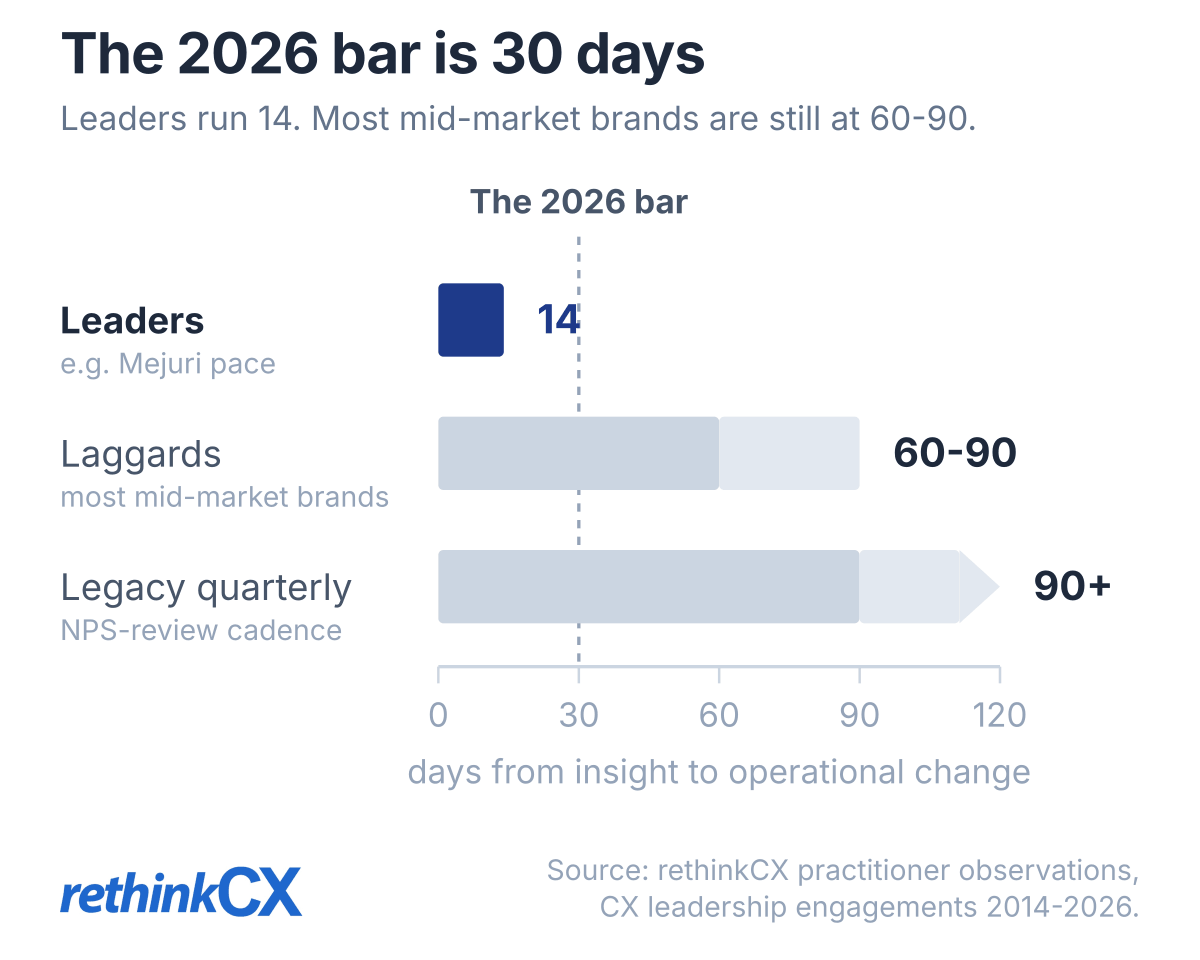
The strategies that move retention have a 30-day or shorter cycle:
- Week 1: insight surfaces (NPS drop, support ticket pattern, journey friction)
- Week 1-2: root cause diagnosed (cross-functional rather than CX team alone)
- Week 2-3: response designed and approved
- Week 3-4: response shipped
- Week 4+: impact measured, response refined
Quarterly cycles are too slow. The customer who left in February doesn't care that you'll address it in May.
The operational requirements to support the 30-day cadence:
- Weekly cross-functional CX review (45 min, owners from each function)
- Real-time-ish metric infrastructure (not month-old dashboards)
- Pre-authorized response budget (small response teams have spending authority below a defined threshold without escalation)
- Clear decision rights ("CX owns this decision; Product owns that one")
Brands like Mejuri, where I helped build the CX function, ran a 14-day cycle on most operational responses. Most of the brands I now consult with are running 60-90 day cycles. The bar is dropping fast and the gap to the leaders is widening.
How to build a CX strategy: a 12-month framework
For founders or leaders standing this up for the first time, the order matters. Don't try to do all five pillars at once. Use our CX maturity assessment as a starting-point template — it takes about 10 minutes, scores you on each of the five pillars, and surfaces which phase below to start in if you're not green-fielding.
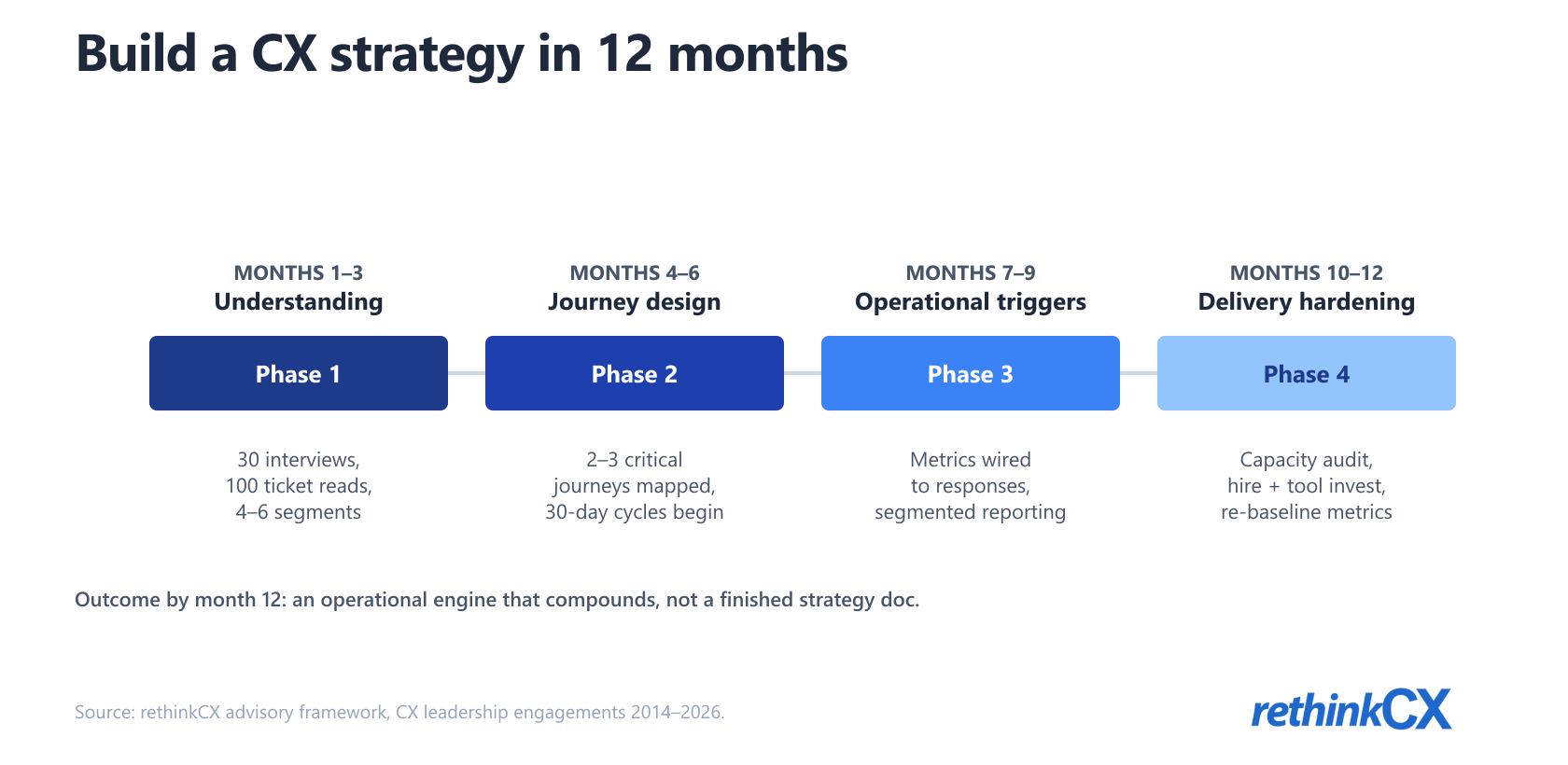
Phase 1 (Months 1-3): Customer understanding + measurement basics
- Interview 30 customers (mix of happy, churning, churned)
- Stand up NPS or CSAT survey (one, not both initially)
- Read 100 support tickets (the texture matters more than aggregate categories)
- Synthesize 4-6 customer segments
- Establish baseline retention and churn metrics by segment
Phase 2 (Months 4-6): Journey design
- Map 2-3 critical journeys (typically: onboarding, support resolution, renewal/repurchase)
- Identify top 3 friction points per journey
- Stand up the cross-functional review cadence (weekly)
- Begin the 30-day action cycle on the highest-impact friction points
Phase 3 (Months 7-9): Operational triggers
- Wire each measurement metric to a defined operational response
- Build the segmented reporting that makes triggers fire correctly
- Establish pre-authorized response authority across functions
Phase 4 (Months 10-12): Delivery hardening
- Audit delivery capacity gaps surfaced by Phase 2-3
- Make explicit hire/tool/process investments
- Re-baseline metrics post-investment
Year 2 onwards: Refinement, segment expansion, deeper integration with product/marketing strategy.
Most of the brands that get this right don't have a "perfect" strategy at month 12. They have an operational engine that compounds. The brands that try to design the perfect strategy in advance and then implement it usually never finish implementing.
Where most CX strategies fail
The failure modes I see most often, in rough frequency order:
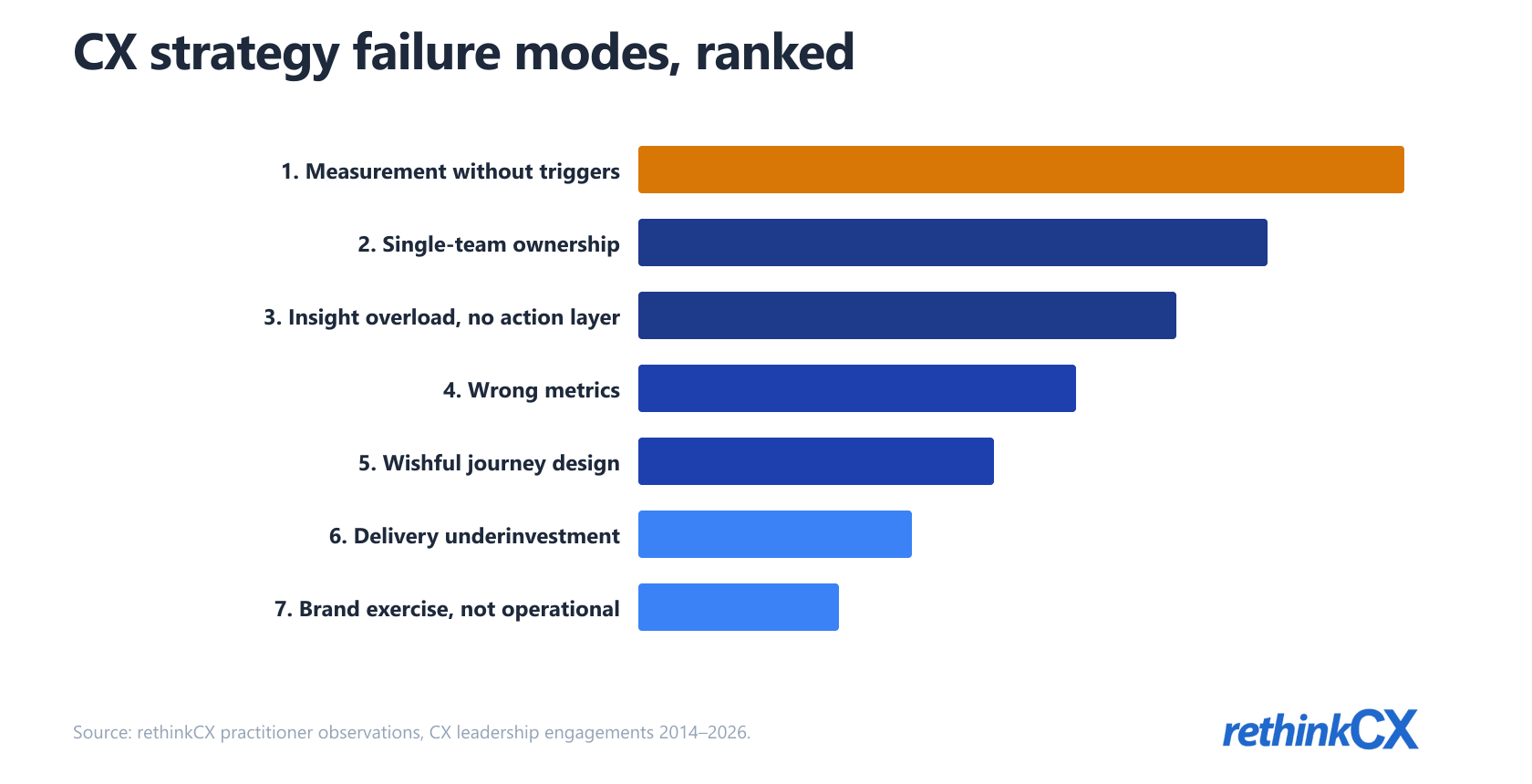
1. Measurement without triggers. Most common. NPS dashboard exists, no one is held accountable for moving the number, nothing changes. Symptoms: quarterly NPS reviews, "we should investigate" outcomes, no follow-up tracking.
2. Single-team ownership. CX team gets blamed for the experience but doesn't have authority over product, marketing, or ops. The strategy can't be executed because the levers don't belong to the team being measured. Symptoms: VP of CX without seat at executive team, no cross-functional reporting line, CX backlog perpetually deprioritized vs feature backlog.
3. Insight overload, action vacuum. Sophisticated VoC program generating exhaustive customer feedback. No mechanism to translate it into operational change. Symptoms: extensive insight reports, executives "considering" findings for months, customer-facing situation unchanged.
4. Wrong metrics. Tracking metrics that don't tie to financial outcomes. Symptoms: high NPS, declining retention. Or: high CSAT, declining repeat purchase. Disconnects between satisfaction metrics and revenue metrics that nobody investigates.
5. Designing for the wishful customer journey. Strategy describes the journey you wish customers took. Customers actually do something different. Friction sits in the gap between the two. Symptoms: customer behavior in analytics doesn't match the journey map; teams point to the map as evidence of problem solved when the data says otherwise.
6. Delivery underinvestment. Strategy describes premium experiences the support/ops/product capacity can't deliver. The strategy works on paper and fails in practice. Symptoms: ambitious experience design; operational reality of bad response times, broken returns, painful account changes.
7. CX as a brand exercise, not an operational one. Strategy doc that reads like a marketing manifesto rather than an operational plan. No KPIs, no owners, no calendar. Symptoms: strategy that doesn't change what teams do day-to-day.
If 2+ of these resonate, your strategy probably has structural problems that no amount of incremental tuning will fix.
There's a measurement cousin to failure mode 7 worth naming here. A strategy also stalls when the feedback program feeding it produces accurate findings that nobody has the authority to act on, which is a question of where pressure travels rather than where the program reports. Voice of customer analytics covers that failure and the operating model that avoids it.
What I'd do differently if I were starting today
A short set of customer experience strategy best practices, drawn from patterns I've seen across brands at every stage:
Start with retention, not satisfaction. Retention is the financial truth. Satisfaction is the leading indicator. Companies that anchor strategy in retention metrics make harder, more useful investment choices than companies that anchor in NPS.
Pick the wrong journey to map first. I'd start with the journey that's failing financially (high churn, low repeat, slow growth) rather than the journey that looks best for a workshop. Strategy work compounds by solving real problems, not by demonstrating methodology.
Hire a CX leader earlier than feels comfortable. Companies under $20M in revenue often think they don't need a CX leader. By the time they realize they do, the bad patterns are entrenched. Fractional CX leadership at the $5-10M stage pays back fast and avoids the full-time hire before the org can support it.
Build action triggers before dashboards. Reverse the typical order. Decide what operational responses you want to be able to fire, then build only the metrics needed to fire them. This avoids the dashboard-sprawl trap.
Measure response time, not response thoughtfulness. When CX insight surfaces a problem, the time-to-operational-change matters more than the elegance of the solution. Ship the rough fix in week 2, refine in month 2. Don't wait for the perfect solution; the customer is gone by then.
How CX strategy ties to retention and churn
The point of CX strategy is retention. Everything in this framework (understanding, journey design, measurement, delivery, accountability) is in service of keeping more of the customers you acquired.
The math: a 5% increase in retention typically lifts profit 25-95% across most consumer business models, a finding from Reichheld and Sasser's "Zero Defections" in HBR that has been validated repeatedly in the 35 years since. The CX investment that moves retention 2-3 points typically has the highest ROI of any operational investment a consumer-facing company can make.
The operational side of how CX strategy connects to retention is covered in our customer churn guide; the psychology and program design that turns retained customers into repeat buyers lives in our customer loyalty guide. For the consulting side of building these capabilities, our call center strategy service covers the operating model.
Common questions I hear from CX leaders
"Our NPS is high but retention is dropping. What's wrong?" NPS is a relationship survey filled out by customers who chose to respond. Retention is the population truth. If they're diverging, the responding population is selecting for satisfaction (your happy customers respond, your unhappy ones leave silently). Fix: response-rate audit, segmented NPS, predictive churn modeling that catches the silent-leavers earlier.
"How do we get product to prioritize CX-driven backlog?" Cross-functional ownership at the executive level. If the VP of Product reports CX outcomes alongside feature outcomes, prioritization shifts. If CX is a "nice to have" item brought to product by an outside team, it loses every time.
"What's the right CX team size?" Less about size, more about authority and cadence. A 3-person CX team with cross-functional authority and a 2-week action cycle outperforms a 12-person CX team with quarterly review cycles and no operational levers.
"How do we handle CX during periods of cost-cutting?" This is the moment most CX programs collapse. The retention math argues for the opposite. When budget tightens, retention investment becomes more valuable per dollar, not less. The CX teams that survive cost-cutting cycles are the ones that quantified their P&L impact in advance.
The point
A real customer experience strategy is an operational engine, not a slide deck. It has five pillars (understanding, journey design, measurement, delivery, accountability), it operates on a 30-day action cadence, it ties to retention and CLV as the financial truth metrics, and it lives across the company rather than inside a single team.
The strategies that fail share recognizable patterns: measurement without triggers, single-team ownership, insight overload without action, wrong metrics, wishful journey design, delivery underinvestment, brand-exercise-not-operational-plan. Most strategies have 2+ of these.
The 2026 differentiator is action cadence. The leaders moved from quarterly review cycles to 30-day operational responses. The laggards are still optimizing their dashboards and wondering why retention isn't moving.