

Forrester names the three dimensions of CX as Ease, Effectiveness, and Emotion. The framework is solid; the naming, in my experience running CX at Mejuri and watching teams interpret it, gets in the way. "Ease" sounds like a frontend problem (it isn't, it's an end-to-end operational problem), and "Effectiveness" sounds like a measurement problem (it isn't, it's whether the customer got what they came for). What I have actually found maps cleaner is Success, Effort, and Emotion. Same three things Forrester identified. Different words that prompt the right operational conversations on a CX team. This post is the practitioner's translation of the Forrester model and where each dimension actually breaks in production. The framing question is not whether CX pays, which every vendor study answers yes to; it is which of the three dimensions your team is currently underweighting. Forrester's own answer to which one carries the most weight is unambiguous: emotion is the strongest predictor of customer loyalty, advocacy and retention, and the hardest of the three to improve.
Success is whether the customer accomplished what they came to do. Effort is how much work it took. Emotion is how they felt about the experience. Most CX teams I have worked with overweight one and underweight the other two, usually because their measurement system rewards one. (If your CSAT survey only asks "how satisfied," you measure Emotion. If it asks "did you accomplish your goal," you measure Success. Most surveys hit one and miss the other two.) Run our CX maturity assessment to get a baseline read on which of the three you are currently optimizing for. For the broader picture, see our complete CX strategy framework, and for the operational service side, our customer journey mapping page.
Success: Achieving Customer Goals
In the context of customer experience, Success refers to how well a business enables customers to achieve their intended goals. Whether it’s completing a purchase, resolving an issue, accessing a service, or even gaining knowledge, customers expect outcomes that meet their needs efficiently and effectively. Forrester calls this dimension effectiveness and defines it the same way: did the customer get what they came for. It is foundational because it addresses the customer's primary reason for engaging at all, and because it is the one dimension a customer will not trade away. Nobody forgives a pleasant, effortless interaction that failed to solve their problem.
Enhancing Satisfaction Through Success
Enabling Success enhances customer satisfaction by ensuring interactions are purposeful and effective. Businesses must deeply understand customer intent and design processes that deliver results with precision. For example, an ecommerce platform can streamline its checkout with saved payment methods and one-click ordering so the purchase completes rather than stalling at the payment step. Clear communication, intuitive design, and reliable support are key to achieving this. Additionally, providing real-time updates—like order tracking—ensures transparency, further boosting satisfaction by keeping customers informed at every step.
Examples of Successful Interactions
Consider a financial services firm that helps a customer open a new account in under 10 minutes through a mobile app, with real-time chat support available to address any questions, as discussed in our financial services customer experience insights. Another example is a hospitality brand that ensures a guest’s special requests, like a room upgrade or early check-in, are met upon arrival, boosting satisfaction and creating a sense of trust. A third example is a SaaS company offering a free trial with guided onboarding, helping users achieve their goal—like setting up a project—inside the first session rather than the first week. These interactions demonstrate how focusing on Success builds trust, encourages repeat engagement, and fosters long-term loyalty across diverse industries.
Effort: Minimizing Customer Workload
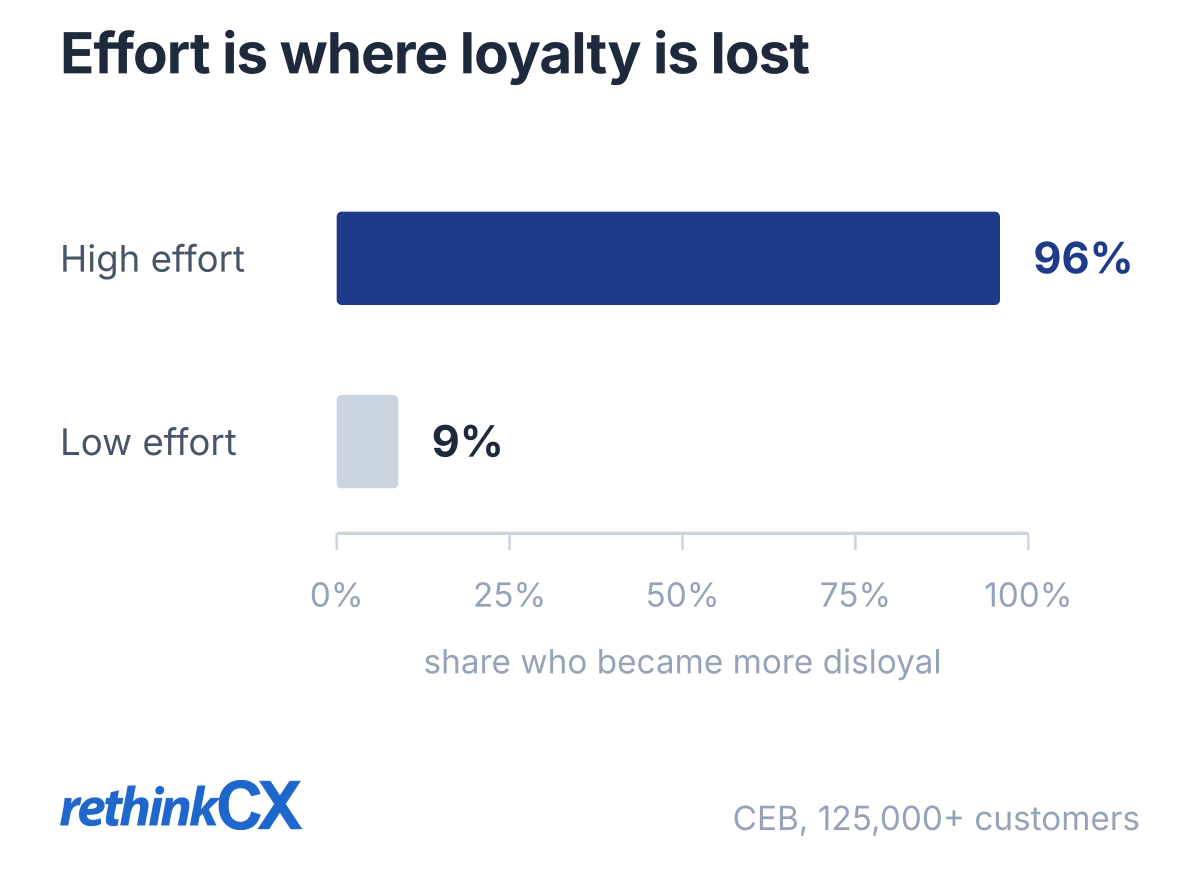
The Effort dimension of customer experience measures how easy it is for customers to interact with a business. High-effort experiences—such as navigating complex menus, enduring long wait times, or filling out repetitive forms—frustrate customers, often leading to churn. In contrast, low-effort experiences drive satisfaction and loyalty. This is the dimension with the hardest evidence behind it. CEB, now part of Gartner, studied more than 125,000 customers and found that 96% of people who had a high-effort service interaction became more disloyal, against just 9% of those who had a low-effort one — the research published as The Effortless Experience and first reported in Harvard Business Review. Effort is not a satisfaction lever. It is the mechanism by which you lose people.
Strategies to Reduce Customer Effort
To minimize Effort, businesses can streamline processes, leverage technology, and prioritize user-friendly design. CEB's own list of what customers experience as high effort is the most useful place to start, because every item on it is something you can go and count this week: switching channels to get one problem solved, repeating information already given, being transferred, receiving generic service, and having to make contact again. Implementing self-service options like AI-driven chatbots or comprehensive knowledge bases lets customers resolve issues without triggering any of those. Simplifying navigation on websites or apps, offering proactive support (e.g., notifying customers of a delayed shipment before they ask), and reducing steps in processes—like enabling one-click purchases—also help significantly. A healthcare provider might use an AI-driven appointment system to let patients book, reschedule, or cancel in seconds, as explored in our healthcare customer experience page. Additionally, integrating omnichannel support ensures customers can switch between channels—like chat to phone—without repeating information, a strategy detailed in our omnichannel customer service guide.
Impact on Customer Retention
Low-effort experiences have a profound impact on customer retention, and the asymmetry in CEB's numbers is the part worth sitting with: reducing effort does not just improve things a little, it removes the single largest cause of churn in the service channel. For example, an ecommerce company that offers a no-hassle return process, with pre-filled labels and free shipping, can reduce churn by ensuring customers feel supported without excessive effort, a strategy highlighted in our ecommerce customer experience guide. The counterintuitive version of the same move is the cancellation flow: making it easy to leave, while offering alternatives on the way out, tends to retain more people than a flow built to obstruct them, because an obstructive cancellation is a textbook high-effort interaction aimed at exactly the customer you are trying to keep.
Emotion: Building Positive Feelings
The Emotion dimension of customer experience is the feeling the customer is left with at the end of the interaction. In practice it tends to override the functional outcome, which is why a technically successful interaction can still produce a churned customer. Forrester's CX Index treats emotion as one of three quality components and finds it the strongest predictor of loyalty, advocacy and retention of the three, as well as the hardest to shift. Their loyalty research puts numbers on what a single emotion is worth: when customers feel appreciated, 76% say they will keep their business with the brand, 80% that they will spend more, and 87% that they will recommend it.
How Emotions Influence Perceptions
Emotional responses can override rational evaluations, making them a pivotal factor in CX. A negative experience, like a rude support agent, can overshadow a functional success, while a delightful interaction—like a personalized thank-you note—can create lasting loyalty. Forrester names feeling appreciated, happy and valued as the three emotions that bind customers to brands, which is why "did we solve it" and "how did we make them feel" so often diverge. A customer who feels valued or understood is more likely to forgive minor issues, whereas a lack of emotional connection can lead to churn even if the interaction was technically successful. Emotion is also the dimension no score captures on its own — it lives in the open-ended verbatims, which is what voice of customer analytics exists to read at scale.
Methods to Foster Positive Emotional Connections
To foster positive Emotion, brands can personalize interactions, train staff to show empathy, and celebrate customer milestones. For example, a hospitality brand might surprise a guest with a birthday gift or a handwritten welcome note, creating a memorable experience, as noted in our hospitality customer experience page. Using AI to tailor recommendations—like suggesting products based on past purchases—or sending heartfelt follow-ups after a purchase also builds emotional bonds. Worth a caveat, though: CEB's effort research found that trying to delight customers produced almost no loyalty gain over simply meeting their expectations, so treat moments of delight as a top-up on a low-effort experience rather than a substitute for one. Training teams to handle complaints with empathy, ensuring customers feel heard, further strengthens emotional connections, enhancing loyalty in industries like retail, per our customer loyalty guide.

Integrating the Three Dimensions
A successful customer experience strategy in 2026 requires balancing Success, Effort, and Emotion. Focusing on one dimension at the expense of others creates an incomplete experience—delivering a successful outcome (Success) means little if it’s high-effort (Effort) or leaves customers feeling unvalued (Emotion). The two research bases point in usefully different directions here. Effort is where you stop losing people, so it is the cheaper and faster of the two to act on. Emotion is where you start winning them, and Forrester is explicit that it is the hardest of the three to move. Sequence accordingly: fix effort first because it is measurable and mechanical, then invest in emotion because that is what compounds.
Creating a Holistic CX Strategy
To integrate the dimensions, map the customer journey to identify touchpoints where Success, Effort, and Emotion can be optimized. Use data to understand customer goals, streamline processes with technology, and train teams to deliver empathetic service. For example, a financial services firm can combine a quick loan approval process (Success), a user-friendly app (Effort), and personalized support (Emotion) to create a holistic CX, as discussed in our CX strategy framework.
Conclusion
The Success-Effort-Emotion model is the same three things Forrester identified in the CX Index, the methodology behind its CX certification, named in language that actually maps to where the operational gaps usually live. The honest take from running CX functions: most teams have one of the three dimensions roughly handled and the other two they cannot even measure properly — usually because their NPS software was configured to ask one question and never revisited. The work is figuring out which two are weak before you decide what to invest in. For a guided second pass, our call center strategy services are built around this exact diagnostic.