
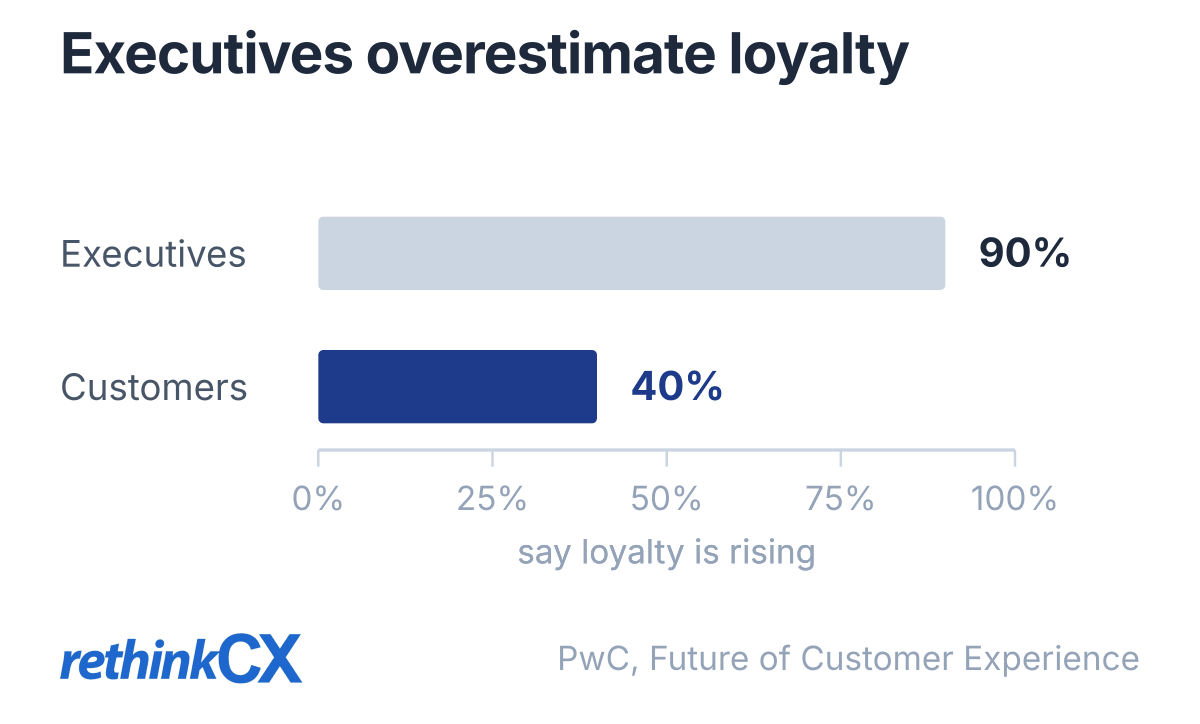
PwC's 2025 Customer Experience Survey calls it the loyalty illusion: nine of ten executives think their customers are getting more loyal; only four of ten customers agree. That gap is the actual subject of this guide. The companies that close it have a different operational shape than the ones that just keep ramping points-program spend. (For the broader strategic context where loyalty fits, see our foundational CX strategy guide.)
The short answer
Customer loyalty is the willingness to choose your brand again when given a free choice. It's distinct from retention (whether the customer stays — often a function of switching costs) and distinct from satisfaction (whether the customer is happy this transaction — doesn't predict next transaction). Loyalty has three observable layers — behavioral, emotional, and advocacy — and most loyalty programs target only the cheapest of the three.
The 2026 version of this work is shaped by two forces. First, customers can verify your operational quality faster than ever (reviews, social, AI shopping assistants), so loyalty built on operational excellence compounds and loyalty built on switching friction erodes. Second, the AI-personalization layer means everyone can do the basic personalization that used to be a differentiator, so the bar moves up. Discounts plus a points program are no longer a strategy.
What loyalty actually means (the three layers)
Loyalty isn't one thing. It's three observable behaviors that look superficially similar but require different operational investments to produce.
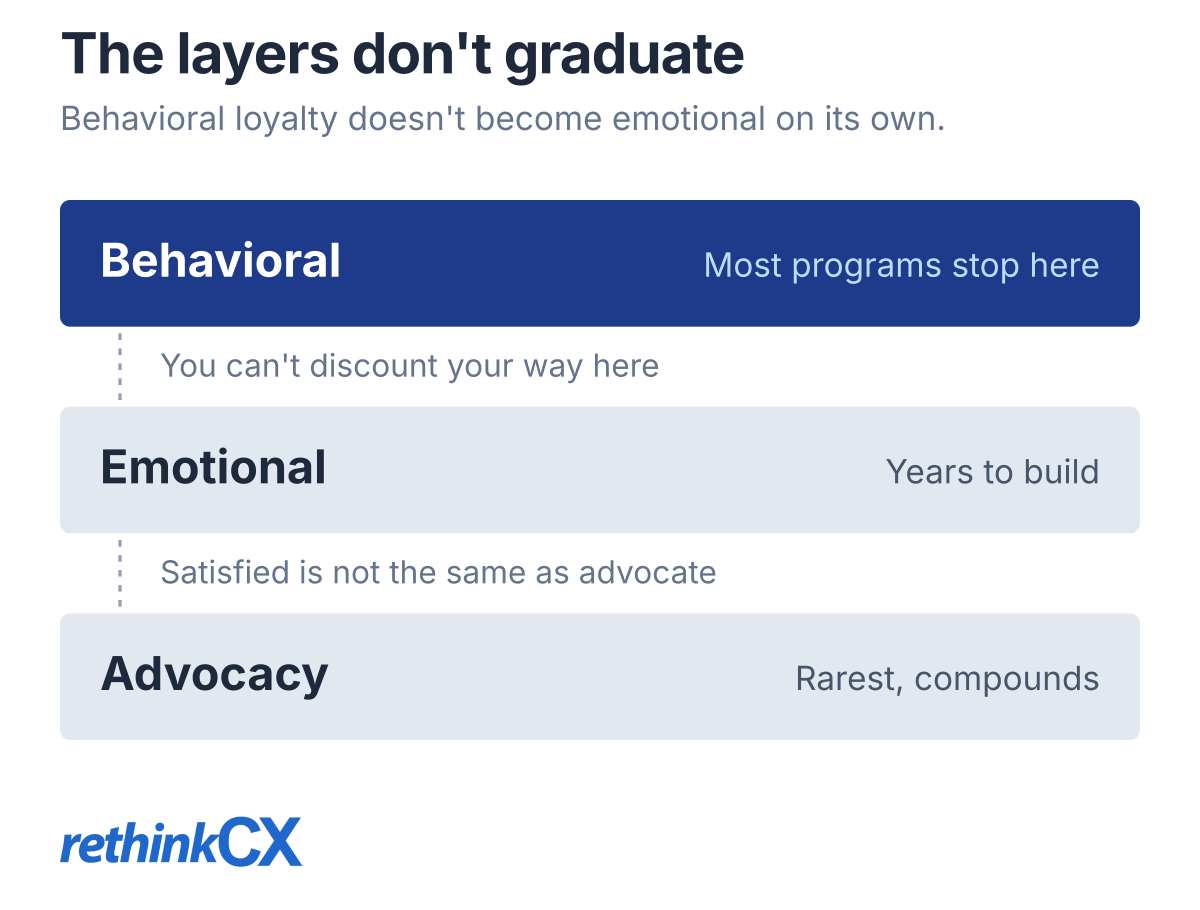
Behavioral loyalty is repeat purchase. The customer comes back. This is the easiest layer to influence with discounts and convenience, and it's the layer most "loyalty programs" actually target. It's also the most fragile — behavioral loyalty churns the second a competitor shows up with a better deal or a more frictionless product.
Emotional loyalty is brand affinity. The customer prefers you even when a cheaper or more convenient option exists. This layer takes years to build and minutes to break. It comes from product quality, service consistency, and operational follow-through over time. You can't discount your way to emotional loyalty; you build it through the work you do every day before, during, and after the transaction.
Advocacy is the customer actively recommending you to others. This is where loyalty compounds — an advocate is a free customer-acquisition channel — but it's also the rarest. Most companies have a small fraction of their base in this layer and miscount the size of the cohort because they conflate "satisfied" with "advocate." NPS — and the NPS software that runs it at scale — is the standard measurement for this; do the work to act on it and you can operationalize NPS to drive actual recovery interventions instead of just reporting on it.
The mistake most teams make is treating these as a hierarchy — assuming behavioral loyalty graduates into emotional loyalty graduates into advocacy. It doesn't, automatically. A discount-driven repeat buyer can stay in behavioral loyalty forever without ever moving to emotional. The transition requires intentional operational investment in the things that produce the deeper layers — and in my experience, most teams skip that investment because the behavioral-loyalty metrics already look fine. The deeper version of the question, what single thing most directly causes customer loyalty, has a sharper answer than the layer model alone provides.
The psychology that actually drives loyalty
Five principles do most of the work. The strongest loyalty programs use multiple of them simultaneously; the weakest use only one (usually the simplest, which is reciprocity-via-discount).
Loss aversion. Daniel Kahneman's foundational finding: people feel losses about twice as strongly as equivalent gains. Loyalty programs that frame benefits as "what you'll lose if you stop engaging" outperform ones that frame the same benefits as "what you can gain by engaging more." Tier programs (United Premier, Sephora Rouge) work because losing tier status next year hurts more than the equivalent value of points would have rewarded.
Reciprocity. When a brand does something unexpectedly generous, the customer feels a real obligation to reciprocate. This is why an unprompted upgrade or a hand-written thank-you produces loyalty far above its cash cost. The mechanic only works when the gesture is genuine and unexpected; programmatic "Happy Birthday — here's 10% off" emails get parsed as marketing and produce nothing.
Goal gradient effect. Motivation increases as you approach a reward. Punch-card programs work because the closer you are to the free coffee, the harder it pulls you back. Tier-up mechanics ("250 more points to reach Gold") work the same way. The implication for design: never let a customer's progress reset to zero unless you absolutely have to. The reset is what kills the engagement.
Social proof. We trust what people like us do. UGC, reviews, "people also bought" feeds, and visible community activity all leverage this. Brands with strong organic social proof are working with a structural advantage that loyalty mechanics can amplify but can't manufacture from nothing.
Identity. The deepest form of loyalty. People stay loyal to brands that match how they see themselves — or more precisely, how they want others to see them. Apple, Patagonia, Canada Goose, Tesla. Identity loyalty is the hardest to build and the most defensible once you have it. The brands that build it spend a generation getting the brand position right; the loyalty program is downstream of the brand work.
The takeaway: loyalty psychology isn't a bag of tactics. It's a small set of well-documented mechanics that compound when used together and that fail when retrofitted onto a brand experience that doesn't already produce the underlying preference.
What actually drives repeat business in 2026
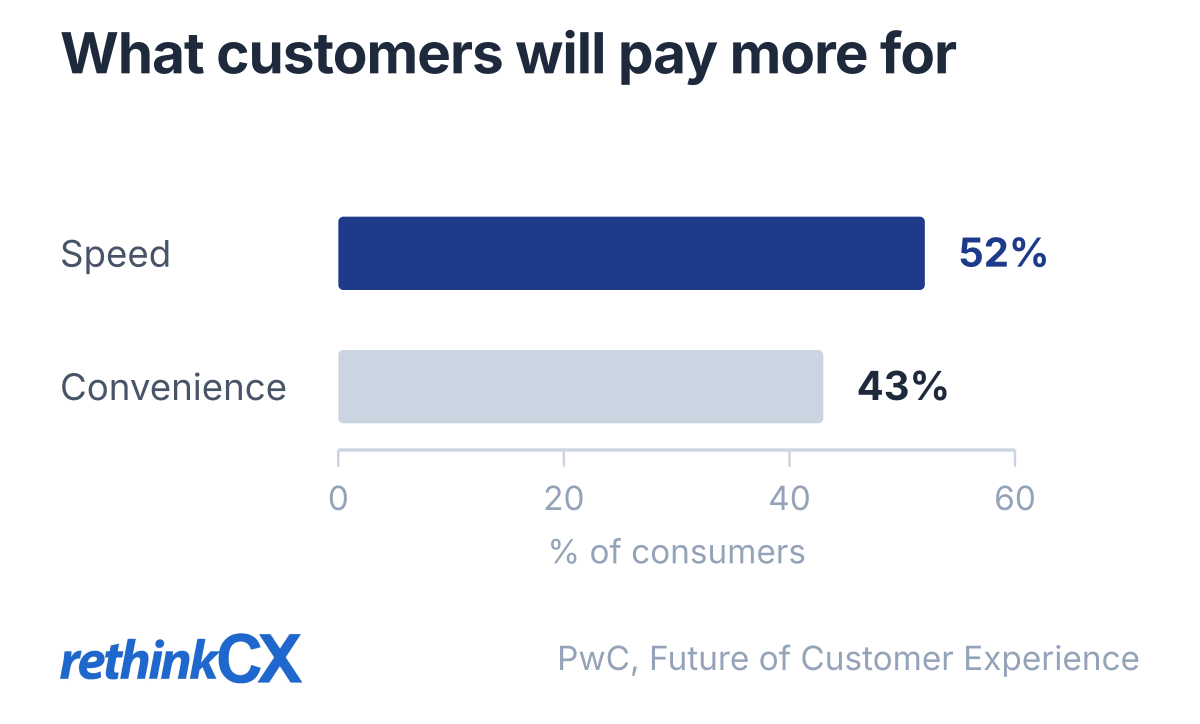
Per PwC's 2018 Future of Customer Experience survey, customers will pay up to a 16% price premium for products and services from brands they perceive as delivering better experiences — but most companies don't get the premium because they don't deliver experiences that customers perceive as differentially better. PwC found that 73% of consumers say a good experience is key to brand loyalty, while 43% will pay more for greater convenience and 52% will pay more for speed and efficiency. These numbers map cleanly to operational levers: response time, friction reduction, channel availability.
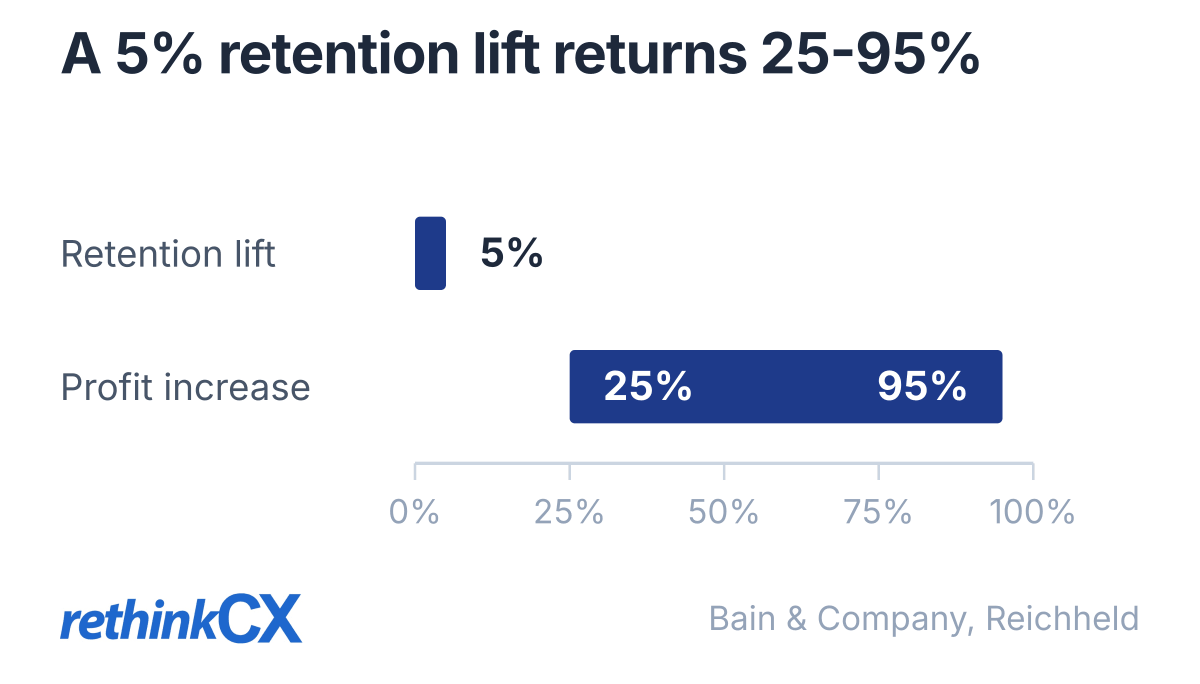
Bain's foundational finding (Frederick Reichheld, originally) is the math behind it: a 5% increase in customer retention can boost profits by 25-95%. The mechanism is simple — a retained customer costs nothing to acquire (you already paid that cost), gradually buys more across categories, and refers others. The compound math is why Bain calls retention the highest-leverage growth lever in most businesses.
The honest counterweight: not every retained customer is a loyal customer. Some are retained because switching is hard. Some are retained because the alternative is worse, not because you're better. The math compounds for the genuinely loyal cohort — the cohort whose loyalty is durable enough to survive a competitor showing up with a real alternative. Measure that cohort separately and you'll find your loyalty program is probably moving the wrong number.
Where loyalty programs actually fail
The most common failure isn't a program that gets the mechanics wrong; it's a program that's bolted onto a service experience that creates friction. The points work; the friction wins. The customer gets a 200-point bonus and then waits 18 minutes for a callback to resolve a billing question. The friction is what they remember. Effort is one of the three dimensions customers actually judge you on, and it outranks the reward mechanic every time.
I've watched this pattern at multiple operations. Loyalty program goes live, NPS doesn't move, the marketing team blames the program design and adds tiers or gamification. Six months later the same NPS, the same customer churn, just a more expensive program. The actual problem was the service operation, which the loyalty program was never going to fix.
The honest test for any existing loyalty program: would your customers have bought from you anyway? If the program is rewarding behavior the customers already demonstrated without it, you're paying for habit. If the program is changing behavior — getting customers to come back sooner, expand into new categories, refer others at higher rates — you're paying for actual lift.
The Mejuri version of this lesson: when I was working CX during the hypergrowth period, the ops team built a points program that rewarded repeat purchase. The behavioral metric moved; cohort revenue did not. Customers who would have come back anyway accumulated points; customers who wouldn't have come back didn't engage with the program. The program was discounting existing demand, not creating new demand. Killing it and reinvesting the budget into faster service response did more for retention than the program ever did.
Eight strategies that move the loyalty needle
The strategies that actually compound. Ranked roughly by leverage in my experience.
1. Service recovery as a loyalty mechanic. The customer who had a problem and was made whole becomes more loyal than the customer who never had a problem. Track recovery NPS separately from baseline NPS and invest in the recovery workflow specifically. (Our VoC programs guide covers the operational side of building this loop.)
2. Operational consistency, every channel, every time. Inconsistent service across channels is the single biggest loyalty killer in my experience. The customer doesn't see channels — they see your brand. (Our omnichannel customer service guide has the operational depth on how to deliver this for real.)
3. Tier-based status programs (when status matters in your category). Status-tier programs work in airlines, hotels, beauty, premium fashion. They don't work in commodity categories where status doesn't translate to social currency. Match the mechanic to whether your customers want to be seen as belonging to your brand.
4. Genuine reciprocity (not programmatic gifting). The unexpected upgrade, the unprompted refund, the personal note from a real human. These produce loyalty out of proportion to their cost. The moment you systematize them, they stop working.
5. Personalization that respects customer effort. Personalization that gets it right the first time is loyalty-positive. Personalization that gets it wrong (recommending products the customer already returned, addressing them by the wrong name) is loyalty-negative. The bar is high. (See our AI-driven personalization guide.)
6. Feedback loops that visibly close. Customers tell you something, you change it, you tell them you changed it. The "you told us, we listened, here's what changed" communication is rare and disproportionately loyalty-positive when you do it. Most teams collect feedback and never close the loop visibly to the customer who provided it.
7. Community and identity reinforcement. Customer communities (forums, Discord, branded events) work in categories where customers want to belong to a tribe. They don't work in transactional categories. If your customers don't already want to identify with the brand, building a community won't manufacture that desire.
8. Loyalty rewards that change behavior rather than reward existing behavior. The honest test from earlier: would they have done this anyway? Reward the new behavior you want; the old behavior they already had doesn't need a discount.
How to measure loyalty
Single-metric loyalty dashboards lie. The triangulation that works:
- Repeat purchase rate (the floor — observable in your data)
- Customer lifetime value (CLV) (the financial truth — segment by acquisition cohort and watch the slope, not the average)
- NPS, segmented (advocacy intent — meaningless as an aggregate; meaningful when segmented by tenure, channel, recovery vs non-recovery)
- Share of wallet / share of category (your share of the customer's spend in your category — survey-based, requires asking)
- Recovery NPS (the cohort that had a problem and was made whole — usually your highest-loyalty segment)
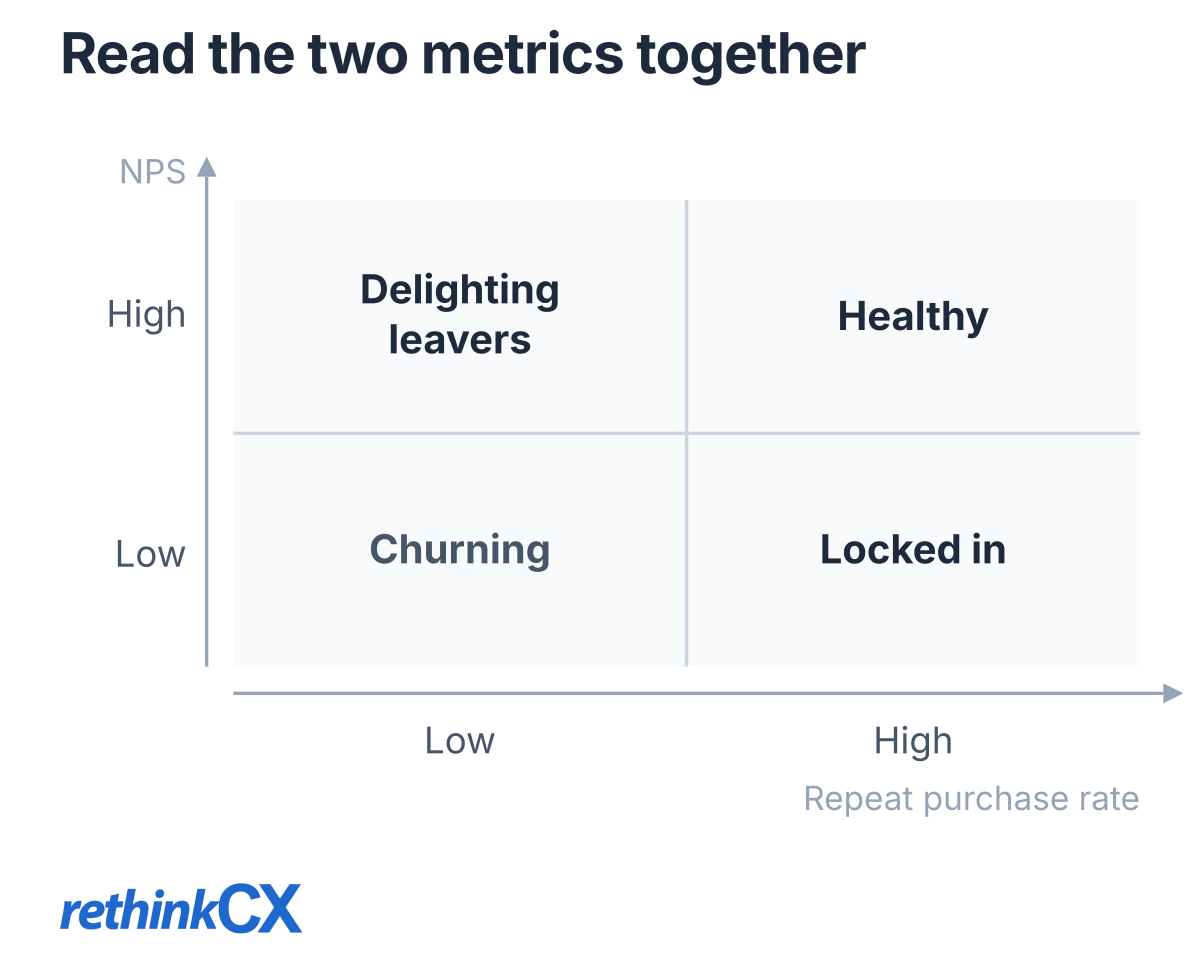
The combination matters more than any single metric. High NPS with falling repeat rate usually means you're delighting the customers who already left. High repeat rate with falling NPS usually means you're keeping customers via lock-in or habit, which churns when an alternative arrives. Watch the relationships between metrics, not the metrics themselves.
For the deeper measurement methodology, our 22 customer service KPIs guide covers the metric architecture, and our CSAT vs NPS vs CES comparison covers the measurement-design choices that change what each metric actually tells you.
Industry takes
Retail / DTC. Sephora Beauty Insider is the canonical strong-tier program — it works because beauty buyers genuinely value status (early product access, birthday gifts, the Rouge tier as social currency). Most DTC brands try to copy the structure and find their customers don't care about the status component, because their category doesn't carry the same identity weight. Match the mechanic to the category.
Hospitality. Hilton Honors and Marriott Bonvoy work because business travelers stay frequently enough to perceive the tier benefits as real and they get to use them in front of colleagues. The mechanic only works at high stay frequency. For occasional leisure travelers, the same program produces minimal loyalty.
Premium fashion (Canada Goose-adjacent). Loyalty in this category is identity-driven, not points-driven. The repeat-purchase cycle is multi-year. The loyalty program, if any, exists to maintain the brand relationship between purchases — VIP previews of new collections, early sale access, repair-and-restore service. Discounting in this category actively damages identity loyalty.
Subscription / SaaS. Loyalty here is mostly about perceived value-per-month versus the alternative. The "loyalty" mechanic that works isn't a points program — it's making sure the customer is getting more value out of the product over time, which is product and onboarding work, not marketing. (Our subscription CX guide covers this in more depth.)
Healthcare / financial services. Trust is the loyalty currency in regulated categories. Programs work when they reinforce trust signals (security, accuracy, transparency); they fail when they introduce friction or feel like marketing pressure on a serious relationship.
The loyalty mechanic that fits depends on the category — the tier program that compounds in beauty fails in commodity retail, the points cadence that works in coffee doesn't fit luxury fashion. Customer experience strategy examples by category cover how the operating priorities differ and what the operational mechanics look like outside the points-program framing.
Customer loyalty programs examples: eight that work, and why
The industry takes above are framed by category. This section is the programs themselves — eight named loyalty programs that have produced real incremental retention, with the mechanic that makes each one work. The point of looking at them side by side is not to copy any one of them but to recognize which mechanic suits which category, because copying the wrong mechanic for your category is the most common reason loyalty programs fail.
Sephora Beauty Insider. Tiered structure (Insider, VIB, Rouge) with non-linear benefits — birthday gifts and early access at low tiers, dedicated hotline and Rouge-only events at the top tier. Works because beauty buyers genuinely value status; the Rouge tier is social currency. The mechanic is the goal-gradient (motivation increases as you near the next tier) plus identity (being a "Rouge" is who someone is, not just what they spend).
Starbucks Rewards. Stars-per-dollar with mobile-first redemption, double-star days, and tier benefits at higher spend. Works because the purchase frequency is high enough for the gamification to feel responsive — the customer sees their stars accumulate within the same week they earn them. At low purchase frequency the same mechanic produces no felt momentum, which is why most retail brands that copy this fail.
Amazon Prime. Paid membership ($139/year US) bundling shipping, video, music, and grocery benefits. The mechanic is value bundling plus loss aversion — once a customer is paying for Prime, every non-Amazon purchase feels like an unused benefit. Prime is the most-cited modern loyalty program because it inverted the model; the customer pays the brand, not the other way around. Works in any category where the brand can credibly bundle multiple high-frequency value streams.
The North Face XPLR Pass. Free membership giving points, member-only experiences (gear testing trips, athlete events), and early access to new products. The mechanic is identity-aligned experiences rather than discount accumulation. Works because outdoor buyers self-identify with the brand; experiences reinforce the identity. A discount-led version of this program would actively damage the brand.
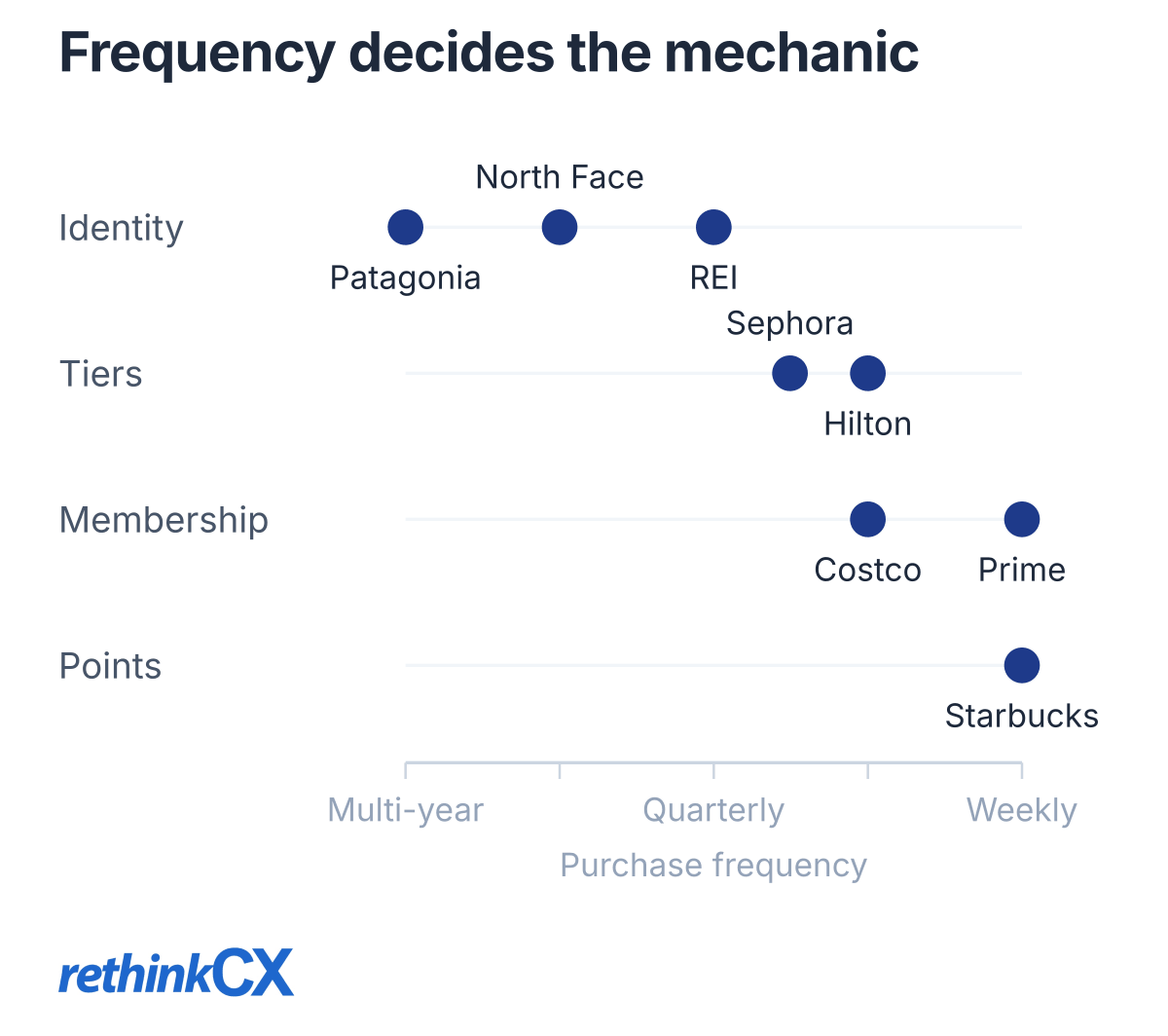
REI Co-op membership. $30 lifetime fee buys a member dividend, early sale access, and equity-style ownership framing. The mechanic is identity plus reciprocity — the dividend feels like the company sharing its success with members. The real lift is the framing: "co-op member" carries different psychological weight than "loyalty program member." Few brands could credibly claim co-op status; the ones that can should.
Hilton Honors. Multi-tier program (Member through Diamond) where status carries operational benefits — room upgrades, lounge access, late checkout. Works because business travelers stay frequently enough to perceive the tier benefits as real and use them in front of colleagues. The visible-status component is what makes the program work; without that, the same point math produces minimal loyalty in occasional travelers.
Costco membership. $65/year for the right to shop, with executive tier ($130) returning 2% cashback. Functionally a paid membership program more than a points program, but operationally the strongest loyalty mechanic in retail — Costco's renewal rate sits north of 90%. Works because the membership pays for itself within a few visits, which makes lapsing feel like leaving money on the table. Loss aversion plus value bundling at scale.
Patagonia Worn Wear. Trade-in and resale program for used gear, plus repair-for-life on most products. No points, no tiers — the program is the brand promise materialized as an operational service. Works because Patagonia's buyer self-identifies as a values-driven consumer; the program reinforces the identity rather than transacting against it. Identity-driven loyalty in premium and mission-aligned categories looks like this, not like a punch card.
The pattern across all eight: each program's mechanic matches its category. Tiered status works in identity-rich and frequent-use categories. Paid membership works when the brand can bundle multiple value streams. Identity-aligned experiences and services work in premium and values-driven categories. Points work where purchase frequency is high enough for the gamification to feel responsive. The brands that get loyalty wrong almost always picked a mechanic that fit the brand they wished they were rather than the category they actually compete in.
What I'd do differently
If I were running loyalty strategy at a mid-market brand fresh tomorrow, three things I would do differently from the typical project shape.
First, I would audit the service operation before designing any loyalty mechanics. The order is service quality first, loyalty layer second. Programs built on top of a friction-heavy service experience reward the customers you already had and discount the churn that was already happening. That audit is usually a journey map rather than a survey, because the friction lives between the touchpoints rather than inside any one of them. It takes 6-8 weeks and saves a year of program rebuilds.
Second, I would invest disproportionately in service recovery — both the operational capacity to recover customers from failures and the measurement to track that cohort's loyalty separately. The "made whole after a problem" cohort is consistently the highest-loyalty segment in operations I've run. Most teams underinvest because the lagging metric (problem-free interactions) doesn't reward the recovery work. Recovery capacity is also a hiring problem before it is a design problem, which is why teams that need it before the next peak often build it with an outsourced support team instead of a headcount request.
Third, I would treat the loyalty program as one of several loyalty drivers, not the loyalty driver. The program competes with and complements service quality, brand identity work, and the customer's actual product experience. Optimizing the program in isolation is the most common failure pattern; integrating it into a broader retention investment is what actually moves the cohort metrics.
Where this fits commercially
A loyalty rebuild sits on three things that have to already work: a service operation that resolves problems, a measurement setup that catches the ones it misses, and a recovery workflow with somebody's name attached. The CX maturity assessment scores all three, which is worth knowing before the rebuild rather than after it stalls. For the deeper VoC operational design that closes the feedback loops loyalty depends on, our voice of customer service is where most of this work gets sequenced. And for the broader strategic frame, our call center strategy advisory covers the operational changes that make loyalty work compounding rather than discount-funded.
The point
Customer loyalty in 2026 is mostly an operational question dressed up as a marketing one. The companies that have it earn it by doing the underlying work on service quality, operational consistency, recovery capacity, and feedback loops that visibly close. The companies that don't usually have invested in points programs and tiered discounts on top of an unfixed service experience.
PwC's "loyalty illusion" finding — nine in ten executives think customers are getting more loyal, four in ten customers agree — is the gap most teams need to close. The closing isn't a program. It's a discipline of measuring loyalty honestly (segmented, multi-metric, recovery-aware), investing in the operational drivers that produce the deeper layers, and being willing to kill loyalty program spend when the math says it's discounting demand you already had.
Bain's old finding still holds: a 5% retention lift produces 25-95% profit lift. The math hasn't changed in twenty years. The operating discipline behind it usually has — for the worse, in the operations I've seen most often. The 2026 work is mostly about getting back to the basics that make the math compound.