

Most VoC programs I've evaluated don't actually run as programs. They run as quarterly survey deployments with a slide deck attached. The data capture is fine; the operational follow-through is missing. This guide is the operator version — what an actual program looks like, what makes it work, and where I've watched the most expensive ones quietly fail. (For the broader strategic context where VoC fits, see our foundational CX strategy guide. Before instrumenting VoC at all, the right move is knowing where your CX operation actually sits, which clarifies the feedback channels that will earn operational attention before you build them.)
The short answer
A Voice of the Customer program is a structured operating cadence — capture feedback across channels, group it into themes, route findings to the teams who can act on them, close the loop with customers, and translate the patterns into roadmap changes within a 30-day window.
The reason most VoC programs underdeliver isn't the technology. It's that the operational discipline isn't built into the program from day one. Teams instrument the surveys, build the dashboards, deliver the quarterly report, and then watch the program decay because nothing in the operational rhythm actually changed as a result of what was learned. Across the programs I've audited, the ones that act on customer feedback rather than just collect it see 20-30% higher customer lifetime value on the segments they engage. The conditional matters — the lift comes from acting, not capturing.
What a VoC program actually is (and isn't)
A VoC program is the operational layer that converts customer signals into business decisions. It's the discipline of doing something with what customers tell you, structured so the doing happens reliably rather than occasionally.
It is not a survey tool, a sentiment dashboard, or a quarterly report. Those are inputs to a VoC program at best; they are not the program. The single most common mistake I've watched teams make: standing up Qualtrics or Medallia, setting up a quarterly NPS survey, and calling that a VoC program. It's a survey deployment. Picking the NPS tool itself is the narrower decision underneath; the program is the operational rhythm wrapped around it.
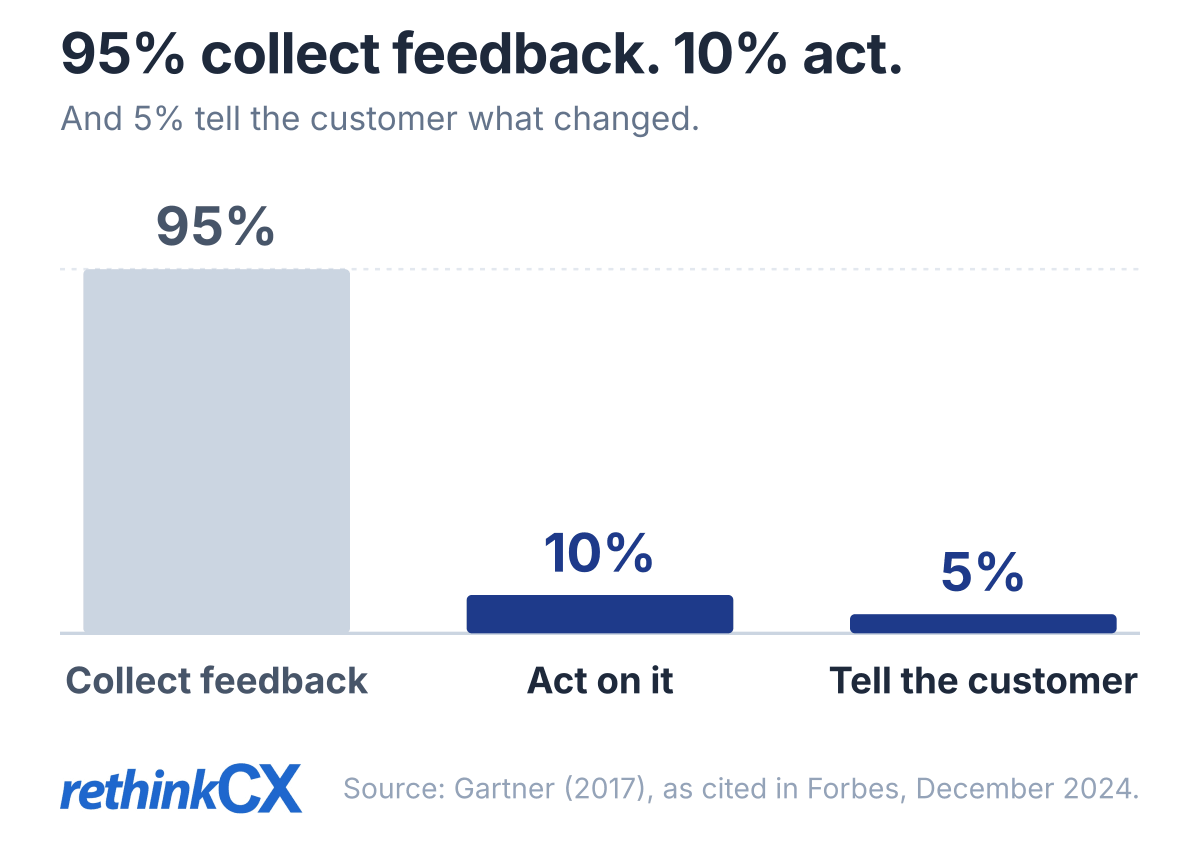
Gartner sized the gap between the two: 95% of companies collect customer feedback, roughly 10% act on it to change a process, and 5% tell the customer what changed. Capture is not the scarce thing.
The framework most leading practitioners use looks like this:
Listen — capture feedback across structured channels (NPS, CSAT, CES surveys), unstructured channels (support transcripts, reviews, social media, sales notes), and behavioral signals (product analytics, churn data).
Analyze — group findings into themes that map to operational owners. The bar isn't sentiment scoring; it's whether a frontline team can act on the analysis output without having to translate it themselves.
Act — route findings to the right team with the authority and tooling to make changes within a defined timeframe. Most programs fail here because they treat the act phase as someone else's responsibility.
Close the loop — both back to customers (who told you something) and forward to the operation (who needs to change something). Open loops decay credibility in both directions.
The cycle is continuous. Quarterly cadence is too slow for 2026; the leaders are running 30-day cycles end-to-end and the laggards are still building the dashboards.
How to design a voice of the customer program
A voice of the customer program is the operating cadence wrapped around feedback capture, not the capture itself. The design decisions made in the first six weeks determine whether the program ships actionable change in month four or quietly becomes a quarterly slide deck. The mistake teams make is starting the design at the technology layer; the right starting point is the operating rhythm.
Five design decisions to make before any tooling gets selected:
1. Define the cadence. What is the meeting where findings turn into decisions? Who attends? Who has the authority to ship a change? Without this defined, the program never produces operational outcomes regardless of how good the data layer is. A 30-day cycle — weekly review, monthly action shipping — is what separates leaders from laggards in 2026. Quarterly is too slow; weekly action without monthly aggregation is too noisy.
2. Pick the operational owner. A voice of the customer program needs a single accountable owner with authority across functions. CX teams typically lack the authority over product or marketing. The right owner is usually a CCO or VP of Operations whose remit explicitly spans the customer-facing functions. Without that authority the program produces findings nobody acts on. The two voice of the customer programs I have seen ship the most operational change both reported into the COO, not the CMO or the head of CX.
3. Decide the scope. Are you running one voice of the customer program covering all customer segments and journeys, or multiple programs covering different ones? At enterprise scale most teams need 2-4 programs (one per major segment or business unit) running on shared infrastructure. At mid-market scale one program is usually right. Decide before instrumenting, because the data architecture differs and migrating from one to many later is more expensive than starting in the right shape.
4. Define the feedback loop completion criteria. What does "we closed the loop" actually mean in your program? Two layers have to be specified — back to the customer (acknowledge, communicate the change) and forward to the operation (theme routed, action taken, impact measured). Programs that have only one of these decay quickly. Programs that have neither are dashboards. Write the criteria into the program charter; do not leave it implicit.
5. Set the success metric upfront. What number does the voice of the customer program have to move within 12 months for it to be considered worth the investment? CLV on the targeted segments, churn on the targeted journeys, retention on the targeted cohorts — pick one and instrument the measurement before the program runs, not after. The programs I have watched survive past year two are the ones that could point at a number that moved because of the program; the ones that died couldn't.
The mistake worth avoiding most aggressively: skipping the design phase and starting with the survey tool. The technology stack matters about half as much as the operating rhythm, and the technology stack is easier to change later than the rhythm is. Most failed voice of the customer programs I have audited had decent tooling and no rhythm. The reverse — strong rhythm on rough tooling — has a better track record of producing actual operational change.
Five components every VoC program needs
The architecture that compounds. Skip any one and the program decays.
1. Cross-channel capture (beyond just surveys)
Surveys are the most-cited VoC channel and the least-representative. Survey-takers are systematically not the same population as your full customer base — they over-index on highly engaged or highly upset segments. A program built on surveys alone misses the silent middle, which is usually the largest cohort.
The five capture channels every mature VoC program runs:
- Structured surveys (NPS, CSAT, CES at defined touchpoints)
- Support interaction transcripts (chat, email, voice — the goldmine most programs ignore)
- Social media and review platforms (Yelp, Google Reviews, App Store, Trustpilot, sector-specific)
- Sales and account-management conversations (CRM notes, deal-loss interviews, renewal conversations)
- Behavioral signals from your product (in-app usage patterns, feature adoption, churn precursors)
The unsolicited channels (support transcripts, reviews, social) are usually where the most actionable themes live because customers there aren't filtered through a survey instrument that pre-shapes what they can say.
2. Theme-grouping analysis (not just sentiment scoring)
The output that operational teams can act on is a small list of recurring themes with specific examples, not a sentiment score with a percentage attached. "Sentiment is 72% positive this quarter" tells nobody anything they can do something about. "Customers in the activation flow are confused about the difference between the trial and the paid tier — here are 12 examples in their own words" tells the activation team exactly what to fix.
The discipline: every analysis output ends with named themes, example quotes, frequency, and an operational owner. AI tools (Qualtrics XM Discover, Medallia, Chattermill, internal LLM-based analysis) can do the heavy lifting on theme extraction. The judgment call about which themes matter is still human work. A useful first cut is whether a theme is about success, effort or emotion, because those three fail for different reasons and route to different owners. What that layer actually does, and the data conditions it needs before any of it produces a usable theme, is the subject of voice of customer analytics.
3. Action-routing to the team that can act
The fastest way to break a VoC program is to route findings to a team that can't actually do anything about them. CX team can't fix product bugs; product team can't fix support training; support team can't fix billing system errors. The program design has to map themes to the team with both the authority and the tooling to make the change.
The mechanic that works: a routing matrix built into the analysis layer. Each theme gets tagged with a primary owner. Themes go directly to that owner's queue with context, examples, and a decision-by date. The owner either ships a change, declines with reasoning, or escalates. No theme dies in committee.
4. Customer-facing closed loop
When a customer takes the time to give feedback, they are entering an implicit contract: I tell you something, you do something with it, you tell me what you did. Programs that break the third part of that contract erode trust faster than no program at all — because now the customer knows you ignored them.
The effect is measurable. In a Marketing Science study of TripAdvisor hotels, properties that started responding to reviews went on to receive 12% more reviews and saw their ratings rise by 0.12 stars on average. Responding changed what customers did next, not just how they felt about it.
Two layers of closed loop:
- Individual response — every detractor response, every detailed survey comment, every escalated complaint gets a personal acknowledgment within 5-7 days. Not a templated "thanks for your feedback"; a specific response that reflects what they said. Handled well this is also the cheapest loyalty mechanic available, since the cohort that had a problem and was made whole is consistently the most loyal segment I have measured.
- Aggregate communication — when a theme drives an operational change, communicate the change back to the affected segment publicly. "You told us X; here's what we shipped." The brands doing this well compound trust at a rate that competitors can't match by buying more software.
5. Operational review cadence
The forcing function that keeps the program alive. Weekly or bi-weekly review where the VoC team meets with operational leaders to walk through the active themes, the actions in flight, and the results from changes shipped in the last cycle. Without this cadence, the program quietly becomes a dashboard nobody opens.
The review has to produce decisions, not just discussion. Each theme exits the meeting with an owner, a next action, and a date. The minutes get distributed. The next meeting starts with "what changed since last time on theme X."
What VoC differs from NPS, CSAT, and survey tools
The distinction that most coverage gets wrong.
NPS, CSAT, CES are metrics. Single numbers from single surveys at single moments. They measure something narrow; they don't structure how the organization responds to what they measure.
Survey tools (SurveyMonkey, Qualtrics, Typeform) are infrastructure. They deploy surveys, collect responses, surface basic sentiment. They are necessary but nowhere close to sufficient for a VoC program.
A VoC program is the operating model wrapped around the metrics and the tools. It defines who looks at what, what gets acted on, who acts, when the loop closes, and how findings connect to the company's roadmap. It uses metrics and tools as inputs but is itself a discipline, not a deliverable.
Most teams that say "we have VoC" actually have NPS plus a survey tool. The gap between that and a real VoC program is the gap between having data and having insight that drives change.
What I've watched go wrong
Three patterns from the buy side that get repeated.
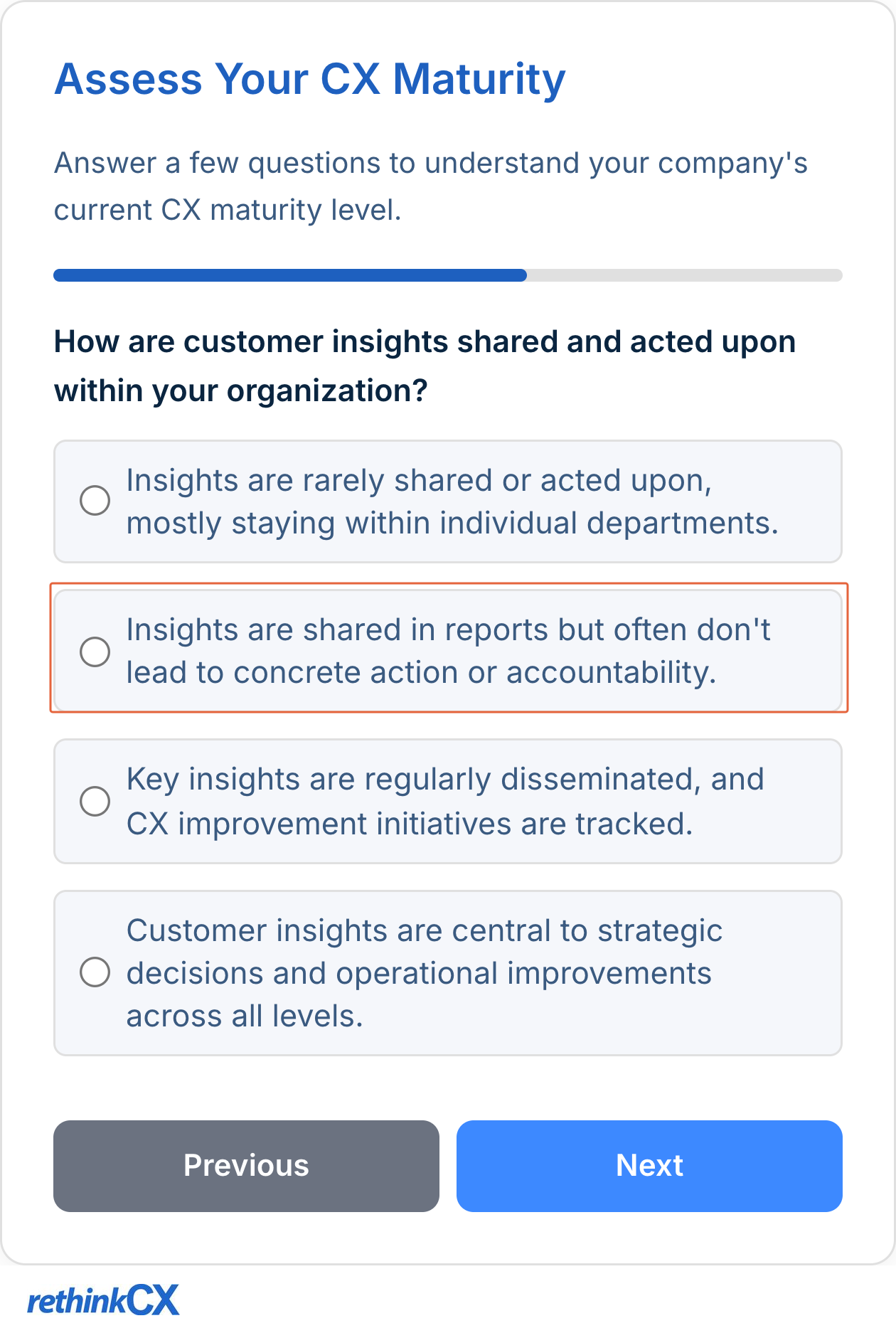
Building the dashboard before defining the operational rhythm. Teams stand up an expensive analytics platform, build beautiful dashboards, and discover six months later that nobody's looking at them because the operational decisions never got tied to the data. The fix: define the operating cadence first, then build the minimum dashboard that supports it. Most VoC dashboards over-build for theoretical use cases that never materialize. Our CX maturity assessment scores insight-to-action as its own dimension, and the boxed answer below is the one most teams pick.
Treating VoC as a CX team responsibility. When VoC sits inside the CX team only, findings stop at the CX team's authority boundary. Product, engineering, sales, finance, marketing — all of them generate or are affected by VoC themes, and none of them act on findings they don't own. The VoC program has to be cross-functional from day one, with executive sponsorship outside the CX function.
Underinvesting in the closed-loop response. The program design budgets generously for capture and analysis and underbudgets for response. The capture and analysis are easy to scale; the response is the bottleneck and the part where customer trust is built or broken. Reverse the budget allocation — pay people to respond personally to detractors and detailed comments. The ROI is dramatically higher than another analysis tool. Who those people report to matters less than that they exist, and plenty of programs staff the closed loop with an outsourced response team rather than wait on internal headcount that never gets approved.
How to deploy (the order I'd run it)
-
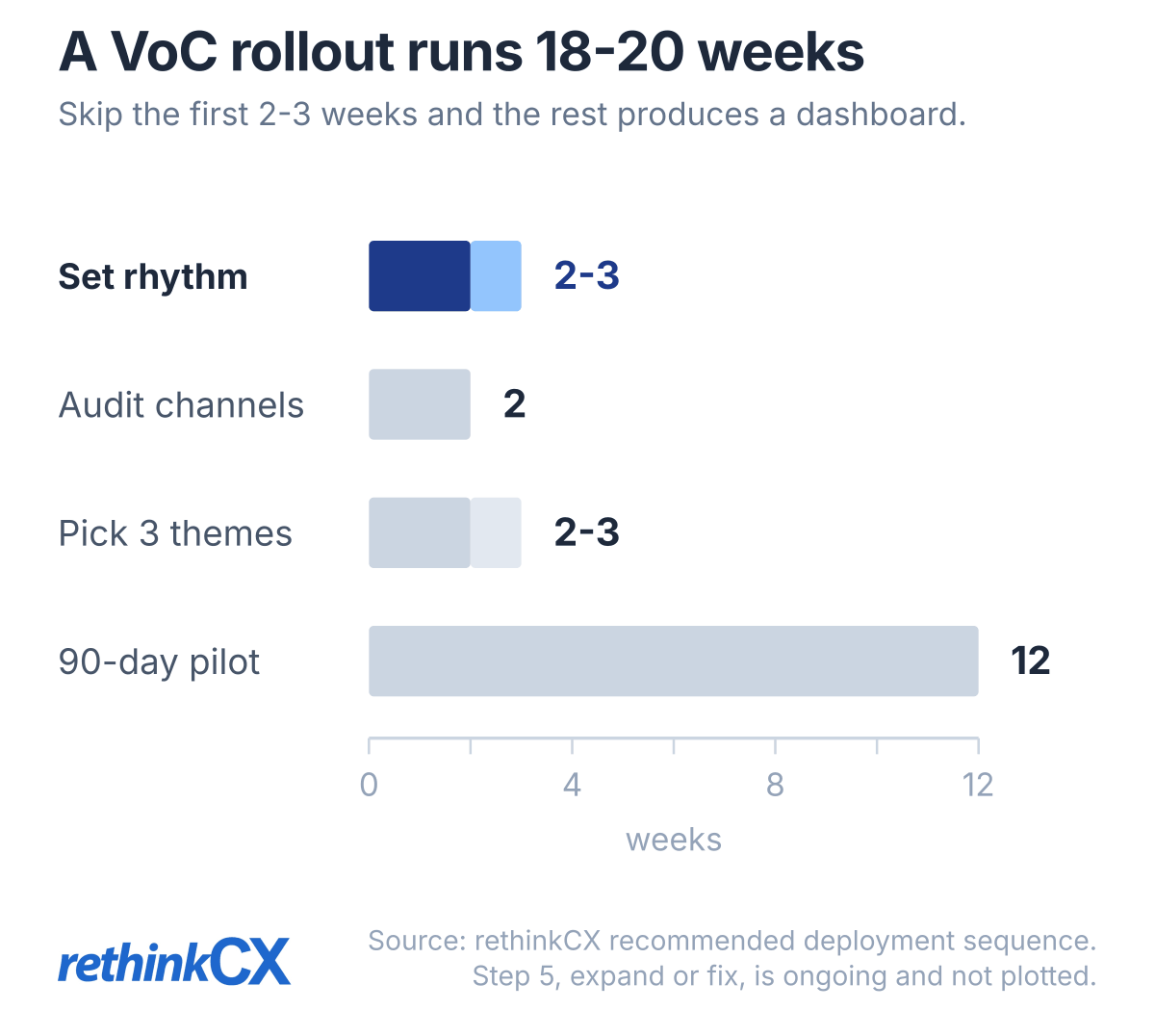
Define the operating rhythm first (2-3 weeks). What's the review cadence? Who attends? Who decides? Don't buy tools or instrument anything until this is documented and committed.
-
Audit existing capture channels (2 weeks). What feedback are you already collecting that nobody's looking at? In most operations there's already a support-transcript archive, an inactive survey deployment, and a review-monitoring tool that produced nothing actionable. Inventory before you add.
-
Pick three pilot themes (2-3 weeks). Themes you're confident exist (frontline teams already know what they are) and that have a clear operational owner. Don't try to instrument the whole program; pilot the operating rhythm on three themes first.
-
Run the operating cadence for 90 days (12 weeks). Weekly review, action routing, closed-loop response, monthly aggregate communication. Track whether themes actually move from raised → actioned → closed within the cycle.
-
Expand or fix (ongoing). Programs that successfully ship operational changes during the 90-day pilot earn the right to expand scope. Programs that stalled need the operating rhythm fixed before adding more themes — adding more themes to a broken cadence makes it worse, not better.
End to end that is 18 to 20 weeks before the program runs at steady state, and the 90-day pilot is about two-thirds of it. The first 2-3 weeks are the shortest step and the one teams skip.
For the analysis tooling specifically, the leading platforms in 2026 — Qualtrics XM Discover, Medallia, Chattermill, Thematic, AskNicely — all do the AI-powered theme extraction competently. The differentiator between platforms is integration depth with your existing CRM and help-desk, not the analysis quality. Pick the one that integrates cleanly with your stack rather than the one with the most impressive demo.
Where this fits in 2026
The operational gap between leading and lagging CX organizations is mostly about action cadence. In the programs I've audited, the leaders run 30-day cycles from feedback to operational change; the laggards are still on a quarterly rhythm, which in practice means 90 days or worse. VoC programs are the operational mechanism that makes the 30-day cycle possible. Without the program structure, the cadence reverts to whatever fits the quarterly review schedule. Ron Dutta of FLIP frames this the same way from the operator seat — in our conversation on what's actually changing in CX, his core argument is that the team closing the loop on customer feedback in 2 weeks beats the team with the best dashboards every time.
The teams that get VoC right in 2026 will compound a measurable retention advantage that competitors without the discipline can't match by buying more software. The teams that treat it as a survey tool will keep producing reports nobody acts on, and watch their CSAT and NPS curves slowly diverge from their actual operational reality.
What to do with the operationalized data
Once a VoC program is producing actionable themes, the next layer is connecting those themes to the leading-indicator metrics that predict revenue impact. NPS detractor responses, in particular, are the highest-leverage signal for predicting churn before it shows up in renewal data — for the operational walkthrough on turning detractor responses into recovery interventions, see Genuics' Loop guide on NPS analysis and the closed-loop case management workflow that connects feedback back to the team that can act on it.
Where this fits commercially
If you want a structured way to assess where your VoC program sits today — capture coverage, analysis maturity, action routing, closed-loop discipline — the diagnostic above flags the gaps before you instrument more software. For the deeper program design work, our voice of customer service is where most of these programs get architected, and our call center strategy advisory covers the operational rhythm changes that turn VoC findings into reliable action.
The point
A Voice of the Customer program is the operating discipline of doing something with what customers tell you, structured so the doing happens reliably. The technology choices are secondary; the operating rhythm is the actual program. Most teams have the technology and not the rhythm, which is why most programs underdeliver.
Build the rhythm first. Pilot it on three themes. Prove the operating model works before scaling. Close the loop both directions — back to customers, forward to operations. The 20-30% CLV lift that mature VoC programs earn doesn't come from the survey tool; it comes from being one of the few organizations that actually acts on what its customers tell it.