
I've watched a lot of AI projects fail in customer service over the last five years. Chatbots that loop. Sentiment scoring that flags polite customers as angry and angry customers as fine. Predictive routing that confidently sends the wrong call to the wrong queue. AI co-pilots are the one category that has consistently moved real numbers for me — without degrading the customer-side experience that the other AI categories quietly damaged.
This guide is the practitioner version. What a co-pilot is, what it actually moves, where the vendor pitches don't match the operational reality, and the order I'd run a deployment if I were starting fresh tomorrow. Co-pilots are one of several AI categories worth deploying in customer experience. The broader AI-in-CX framework covers which categories deliver where; this guide stays at the co-pilot layer specifically.
The short answer
An AI co-pilot is a real-time agent assistant. It listens to the call (or reads the chat), pulls context from your CRM and knowledge base, and surfaces suggested responses, customer history, sentiment signals, and next-best-action recommendations to the agent during the interaction. The agent stays in control; the AI works invisibly behind them. The customer never knows it's there — and that's the point.
This is structurally different from a chatbot (which replaces the agent for routine interactions) and from an autonomous AI agent (which handles complete interactions without a human in the loop). Co-pilots are the keep-the-human, accelerate-the-human pattern. The customer-facing side — chatbots, agentic AI, voice AI — is a separate deployment question with a separate playbook; we cover customer-facing conversational AI end-to-end in its own guide. In a contact center where most interactions still benefit from a human handling them, co-pilots are the AI category that pays back fastest.
What a co-pilot actually is (and isn't)
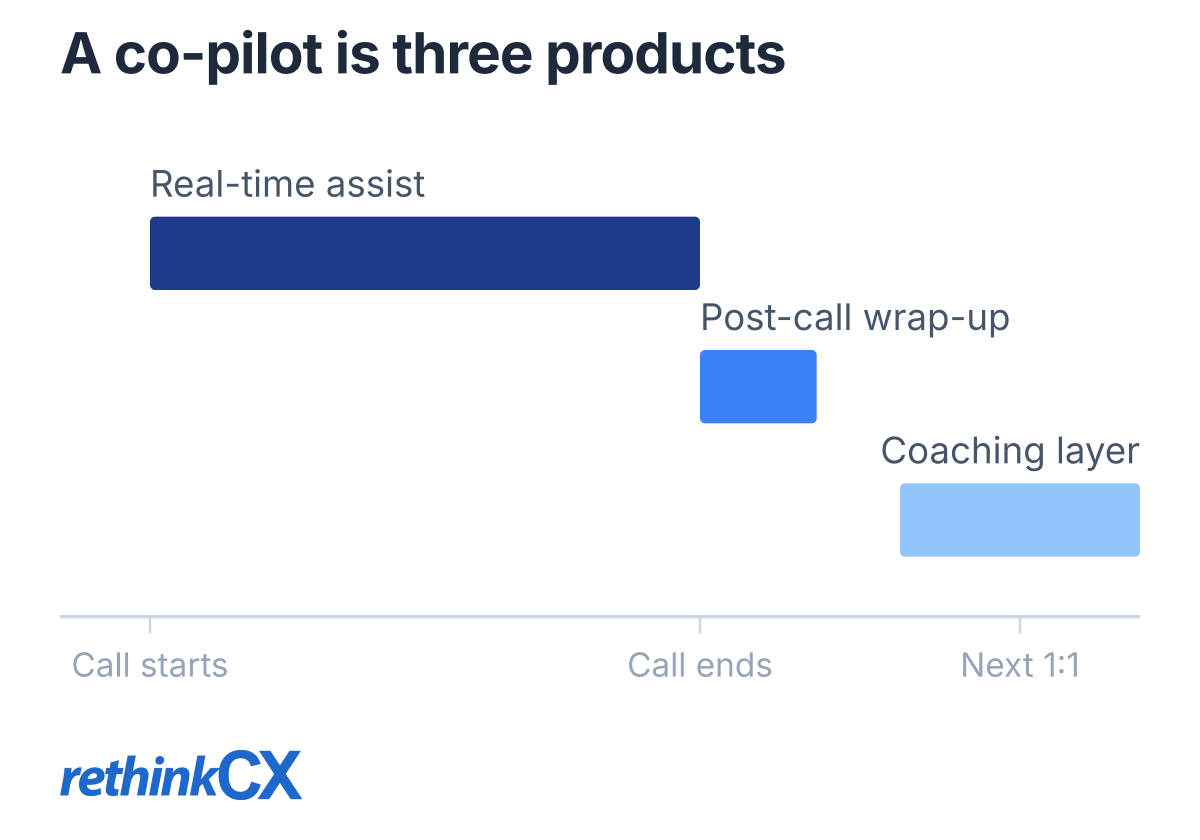
The vendor decks blur three different products into one term. Worth being precise:
Real-time agent assist: surfaces knowledge base articles and suggested responses during the live conversation. This is the core co-pilot.
Post-call automation: writes the call summary, populates CRM fields, fires the wrap-up workflow. Same category but different timing.
Coaching layer: reviews completed interactions, identifies coaching moments, sometimes prompts the supervisor with what to discuss in the next 1:1. Adjacent product, often bundled, but a different deployment workstream.
A "co-pilot" purchase typically gets you all three. They unlock different value at different times in the rollout — and they break in different ways. If you bought "agent assist" and the vendor only showed you the real-time piece, ask about the wrap-up automation explicitly. The post-call piece is often where the AHT savings actually compound, because every call ends with 90 seconds of the agent typing notes that the AI can do in 5 seconds.
Agent assist vs. co-pilot: same category, different buyer language
If you ran an RFP at a contact center any time in the last decade, you wrote "agent assist" in the requirements doc. If you watched a vendor pitch any time in the last 18 months, they sold you a "co-pilot." Same category, different label, and the labels carry different baggage worth being explicit about.
Agent assist is the older, operations-side term. It came out of contact centers in the 2010s, where it referred to anything that surfaced information to an agent during a live interaction — knowledge base lookups, scripted prompts, decision trees, sentiment flags, next-best-action prompts. It's still what your CCaaS platform's RFP template calls the category. The framing is operational: a tool that helps the human do their job better. NICE, Genesys, and Five9 all sell agent-assist products under that exact label and have for years.
Co-pilot is the AI-era rebrand. Same product category, but the term shifted after GitHub Copilot's success in software engineering, and CX vendors imported the language because it sells better. The framing is partnership: an AI working alongside the agent rather than just feeding them static information. Both keep a human in control, which is what separates them from an AI customer service agent that resolves tickets end to end on its own, a different tier with a very different risk profile.
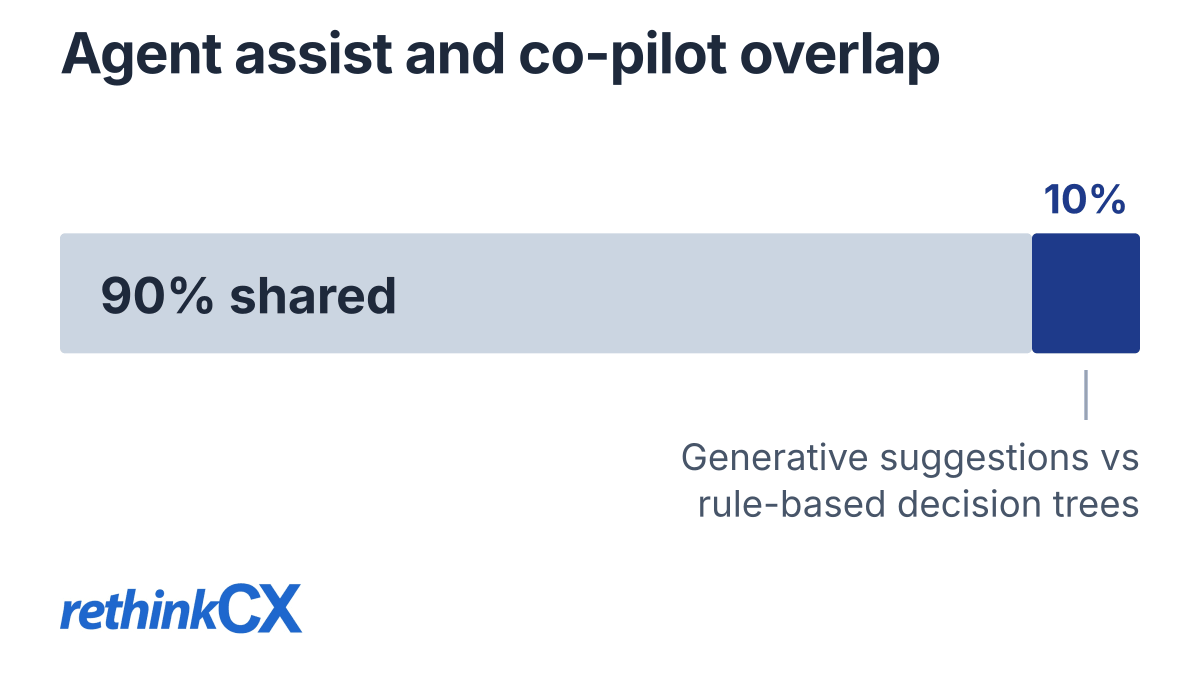
The functional overlap is roughly 90%. Both surface information in real time. Both pull from CRM and knowledge base. Both write call summaries. The 10% difference is that newer co-pilot deployments lean harder into generative AI for response suggestions and free-form summarization, while older agent-assist deployments leaned harder into rule-based decision trees and deterministic knowledge surfacing. That distinction is shrinking fast — the rule-based platforms have added LLM layers, and the LLM-first platforms have layered in deterministic guardrails because pure-generative agent assist hallucinated procedures in production at every operation I watched it ship.
What I tell buying teams: when comparing vendors, ignore the term and read the feature list. If the platform does real-time knowledge surfacing, suggested responses, sentiment cues, and post-call automation, it's agent assist or it's a co-pilot — same thing. The vendor that calls itself a co-pilot is not better at this work than the vendor that calls itself agent assist; they're describing the same workstream with different marketing.
The one place the language matters operationally: internal communication. If your floor managers and supervisors think of the category as "agent assist," shipping a "co-pilot" deployment can feel like a different project to them, which slows adoption. Match the rollout language to the team's existing vocabulary. The two operations I've watched roll out fastest both introduced the new tool as "the next-generation agent assist platform" to the floor, even though the vendor contract called it a co-pilot. Save the co-pilot framing for the executive presentation and the agent-assist framing for the supervisor huddle.
The case for co-pilots
Here's the contrarian take, and I'll defend it: AI co-pilots are the only AI deployment in customer service that has worked for me at every operation I've run. Full chatbot automation broke at edge cases. Predictive routing was right 80% of the time and wrong loudly the other 20%. Sentiment scoring needed a human review layer to filter false positives, which negated the speed-up it was supposed to deliver. Co-pilots respect the human in the loop. They move handle time without moving CSAT in the wrong direction.
The reason co-pilots survive contact with reality where other AI categories don't: the agent is the safety net. When the AI suggests something stupid, the agent ignores it. The customer never sees the bad suggestion. Compare that to a chatbot that confidently mishandles a refund — the customer sees that, complains about it, and your CSAT drops. The architectural difference matters more than vendor benchmarks suggest.
Where co-pilots actually move the numbers
Specific ranges I've seen, plus what each requires to land:
Average handle time (AHT)
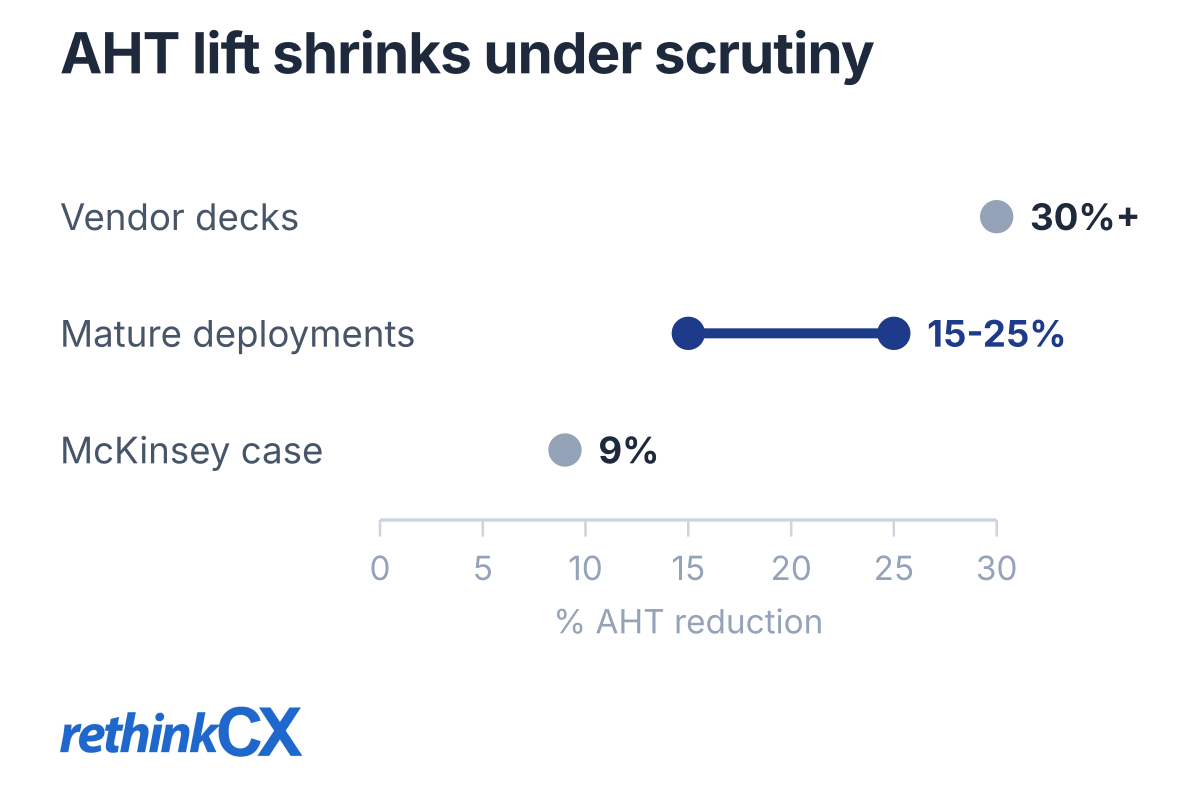
Realistic 15-25% reduction in mature deployments — meaning the deployment has been live 6+ months, the knowledge base is clean, and agents have been coached on when to trust vs. override the AI. The 30%+ figures vendors quote are real but were earned in operations that had already done their KB hygiene before the AI shipped. McKinsey's reported case study of a 5,000-agent operation found a 9% AHT reduction and a 14% issue-resolution lift per hour. That's a defensible benchmark; anything bigger than ~25% should make you ask what they fixed in parallel.
New agent ramp / time-to-productivity
This is where co-pilots compound the fastest, in my experience. A new agent on a clean co-pilot reaches baseline KPIs in roughly 60% of the time it would have taken without one. The mechanism: instead of memorizing a knowledge base before going live, they look things up in real time and the AI surfaces the right answer. The trade-off is that pure recall scores stay lower; agents lean on the tool. That's fine — the tool is faster than human memory anyway.
First-call resolution (FCR)
Smaller lift than AHT — maybe 5-12 percentage points in the first year, more if your FCR was bad to start with. The AI doesn't make the agent smarter; it makes the right answer easier to find. If your FCR problem is product complexity or undertrained agents, the AI helps. If your FCR problem is broken back-office workflows that the agent can't fix on the phone, the AI doesn't help. The biggest FCR lift consistently shows up on technical support workflows, where agents juggle troubleshooting trees and product knowledge simultaneously and "right answer easier to find" compounds across every interaction.
Where it doesn't move (and the vendor won't tell you)
CSAT is the trickiest metric to claim. In my experience, CSAT moves up modestly (2-5 points on a 100-point scale) in deployments where the AI was paired with a knowledge base refresh. In deployments where the KB was stale and the AI shipped anyway, CSAT was flat or down — because the AI confidently surfaced outdated procedures, the agent followed them, and the customer got a wrong answer faster than they would have before. Any vendor telling you "CSAT lifts 15%" out of the box is selling you the deployment they wish you'd buy, not the one you'd actually run. (If you're new to how CSAT, NPS, and CES actually measure what they measure, read those before negotiating any metric-lift commitment with a co-pilot vendor. The lift claims fall apart under even basic statistical scrutiny.)
What to look for in a co-pilot
Here's the practitioner's checklist. The order matters; don't reverse it.
Knowledge base readiness
Before evaluating any AI vendor, audit your KB. Pick 20 of the most-frequent customer issues and check whether the answer your KB returns is (a) accurate, (b) current, and (c) findable in under 30 seconds. If fewer than 80% pass all three tests, fix the KB before bringing in vendors. Otherwise the AI will surface the broken answers faster — which makes things worse, not better. Our QA complete guide has a section on KB audit methodology that lays out the workstream.
Sentiment scoring honesty
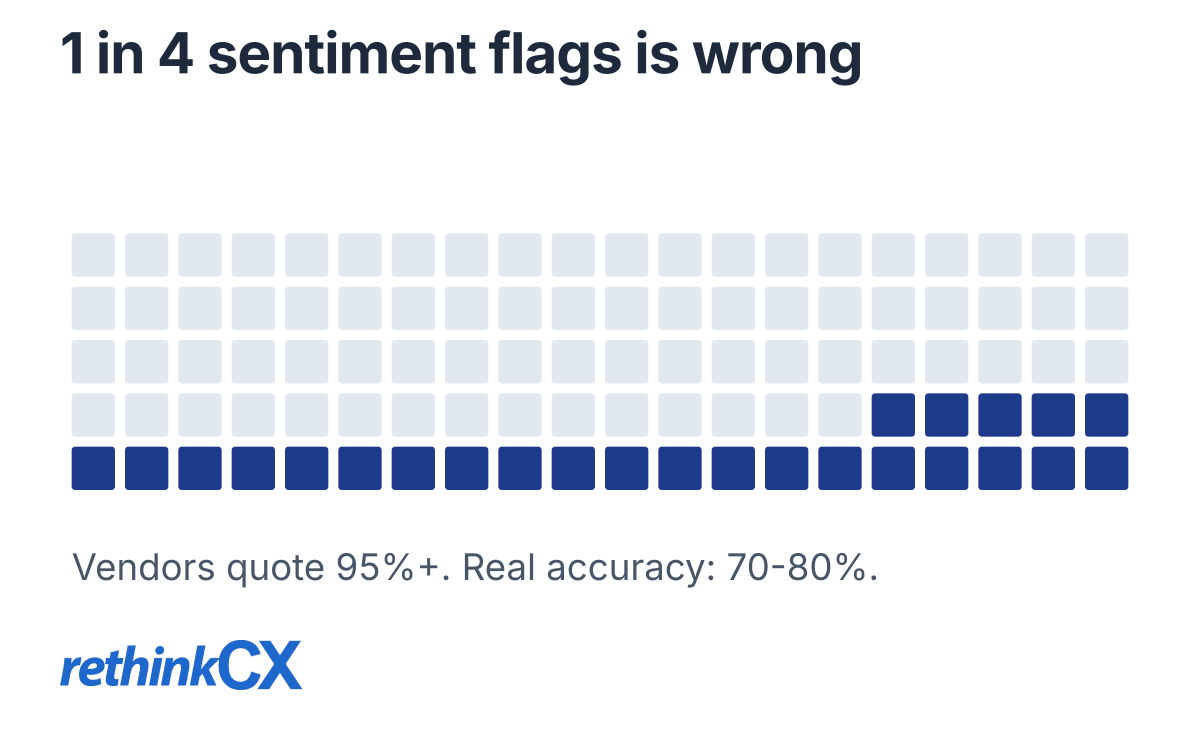
Every vendor claims sentiment analysis. Most score around 70-80% accuracy on the binary positive/negative dimension. The 20-30% miss rate matters because it gets surfaced to supervisors as "calls flagged for review." Ask the vendor (a) what their precision/recall is on your industry's typical call mix, (b) whether you can tune the threshold, (c) what happens when the AI thinks the customer is angry but the agent thinks they're fine. The honest vendors will say "70-80% and we let you tune the threshold." The dishonest ones will quote 95%+ accuracy from a benchmark dataset that doesn't look like your traffic.
Coaching layer depth
Some co-pilots ship a strong post-call coaching workflow; others bolt on a thin one. The coaching layer is where the supervisor's time gets multiplied. Look at the actual flow: does it surface specific moments in specific calls with timestamps and recommended discussion topics, or does it spit out scorecards that the supervisor then has to dig through? The first is real coaching multiplication; the second is a dashboard.
Integration depth with your existing stack
This is where the vendor pitch and the operational reality diverge most. Native integrations with your CCaaS (Talkdesk, Five9, NICE CXone, Genesys) and help-desk (Zendesk, Salesforce, Intercom) are not optional — they're the difference between a 6-week deployment and a 6-month one. If the AI vendor offers "API integration" but no native connector, the integration build will cost you more than the AI license.
A point on rotation in your stack: as agents close cases mid-call and hand off escalations to second-tier or back-office teams, you want a case object that follows the customer through escalation handoff and post-call wrap — not a fresh ticket created at every step. Co-pilots that respect the case lineage compound their value over time; ones that create orphan tickets at handoff lose half their post-call automation lift.
Five risks no one talks about
-
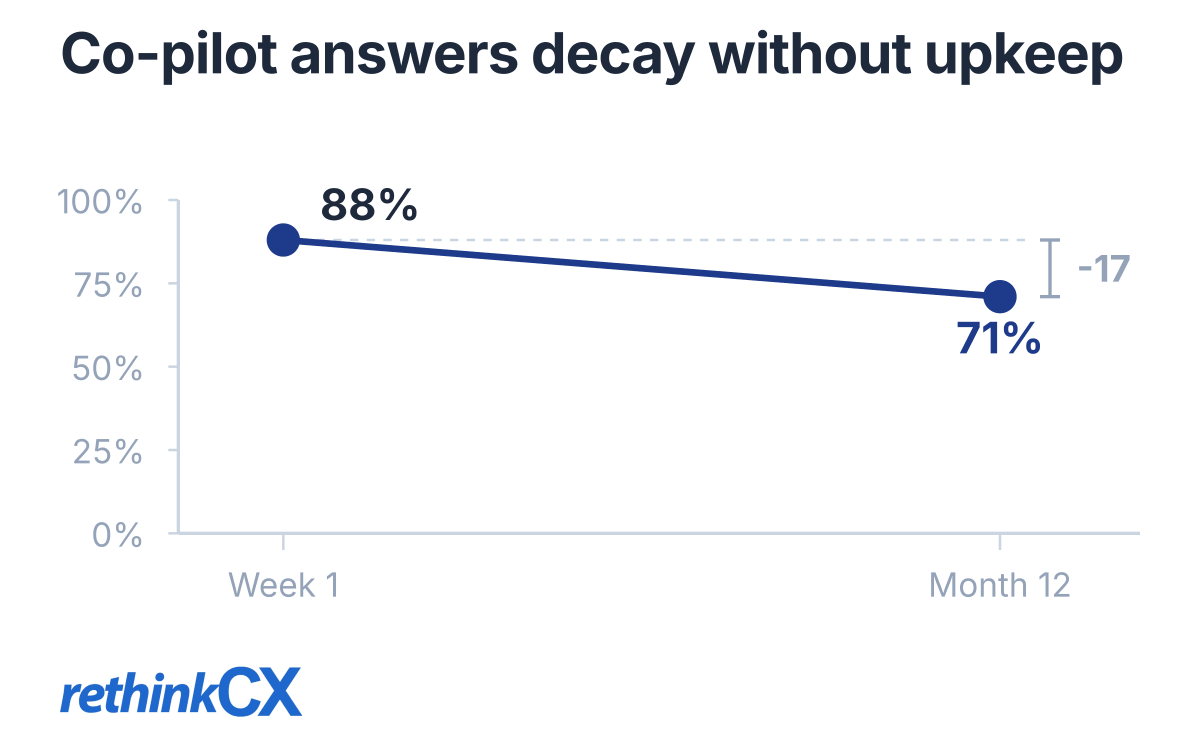
Knowledge base entropy. The AI's accuracy degrades as your KB drifts. Without a quarterly KB hygiene workstream, the deployment that scored 88% accuracy in week 1 is at 71% by month 12. Budget the maintenance the same way you budgeted the launch.
-
Agent over-reliance. Agents who never had to know the procedure in the first place are worse fallback when the AI is down. Make periodic "AI off" drills part of the operation. Yes, it slows you down for an hour. It's the only way to keep the agent skill from atrophying.
-
Supervisor erosion. AI-suggested coaching topics often get blindly forwarded to agents instead of digested by the supervisor. If your supervisors stop adding their own judgment to the coaching flow, you've automated a worse version of coaching, not a better one. Audit a sample of weekly 1:1s to confirm the supervisor is still doing the work.
-
The black-box problem. When the AI suggests something the agent doesn't understand and the customer pushes back, the agent has to defend a recommendation they didn't generate. This breeds quiet agent resistance, which never shows up in the vendor's success metrics. Build an "explain the recommendation" workflow into the rollout.
-
Vendor lock-in via training data. The longer the AI has been running, the more your operation-specific tuning lives inside the vendor's system. Switching providers later means rebuilding that tuning from scratch. Negotiate the off-ramp clause when you negotiate the contract — most teams forget.
How to deploy (the order I'd run it)
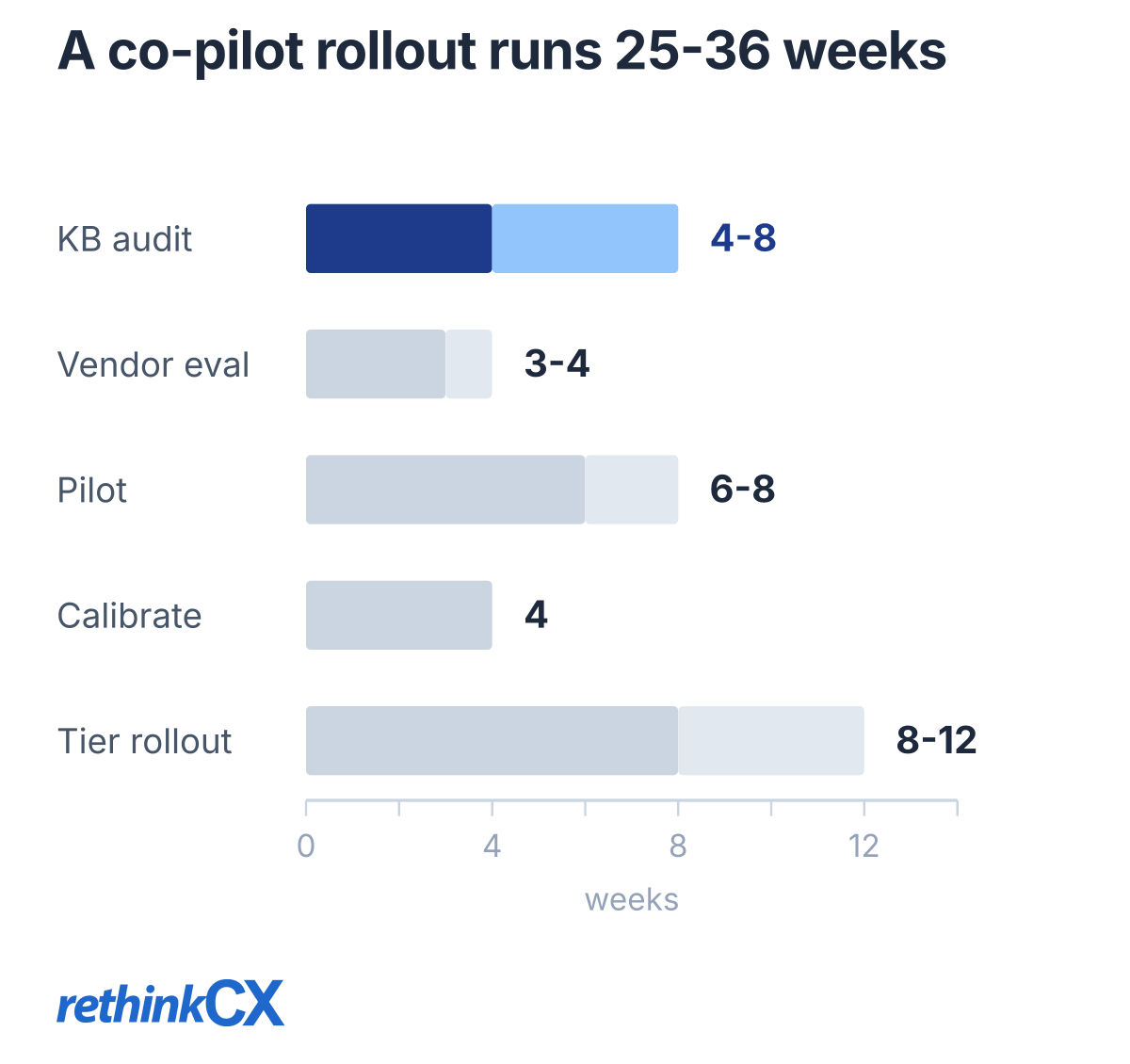
- KB audit and refresh (4-8 weeks before AI selection). 20-issue accuracy test, fix the gaps, document the maintenance cadence.
- Vendor evaluation against your specific stack (3-4 weeks). Demo with your real call types, not their pre-canned scenarios.
- Pilot with a 10-agent cohort (6-8 weeks). Track AHT, FCR, CSAT, and agent confidence (survey the cohort weekly).
- Calibrate the AI (4 weeks). Tune sentiment thresholds, add missing KB content the AI surfaced as gaps, retire suggestions that the cohort consistently overrode.
- Tier rollout (8-12 weeks). Roll to next 30 agents, then next 50, then full deployment. Don't big-bang — the calibration is operation-specific and you want the next cohort to inherit a refined system.
- Establish ongoing KB governance (permanent). Quarterly KB review, monthly AI-output audit, annual vendor calibration check.
If your operation is under 30 agents, stop after step 1 and reconsider. The AI economics get hard at small scale; spending the same effort on a clean knowledge base and direct agent training often delivers more for less.
What I'd do differently
If I were starting an AI co-pilot deployment fresh tomorrow, I would do three things differently from the typical project shape I've watched.
First, I'd treat the KB workstream as a first-class project with its own budget and timeline, not a prerequisite folded into the AI deployment. The KB work is harder, less glamorous, and gets cut when the AI vendor's go-live date pressures the schedule. Pulling it forward as an independent workstream protects it.
Second, I'd insist on a 90-day "AI off" exit window in the contract — meaning if month 90 we want to switch vendors, we can take our tuning data with us and migrate. Vendors push back on this. The pushback tells you everything about the lock-in.
Third, I'd budget more for change management than for the technology. The agents who succeed with co-pilots are the ones who've been coached on when to trust the AI and when to override it. That's a training program, not a tooltip. Most projects underspend on this and wonder why agent satisfaction stayed flat. The change-management discipline that gets this layer right (coaching cadence, performance scorecards, governance review) is what our call center management advisory is built around. It's the layer where co-pilot deployments quietly win or lose.
How co-pilots fit the bigger AI-in-CX picture
Co-pilots are one of about five AI categories worth deploying in 2026 — alongside machine-learning-driven customer insight programs, AI-powered routing, knowledge base search, post-interaction QA scoring, and intelligent self-service for routine intent. All five ladder up into the same broader CX strategy framework. The AI work is the execution layer; the strategy choices about which signal trips which action sit one level above. Per Gartner's contact center forecast, conversational AI is projected to reduce contact center agent labor costs by $80 billion by 2026 — but most of that lift comes from automating routine interactions, not from co-piloting complex ones. The co-pilot category is the smaller, more reliable lift; the chatbot/automation category is the bigger but riskier one.
The sequencing question (which AI category to deploy first, and what to measure once it's live) sits one layer above co-pilot deployment specifically. The 22 KPIs worth tracking against any AI-in-CX rollout are where the lift either shows up in the dashboard or doesn't, and response-time architecture is the operational lever co-pilots compound with the most when both are tackled in the same quarter rather than sequentially.
Where this fits commercially
If you're evaluating whether co-pilot tooling is the right next CX investment, the CX maturity assessment tells you whether your operation has the foundation (KB readiness, integration depth, change-management capacity) to make the deployment land. Skipping that diagnostic is the most common reason AI projects ship and then quietly underperform. The full vendor-and-stack selection work, where co-pilot deployments get sequenced against the other AI categories worth running, is what our CX technology advisory covers at the consulting level.
The point
AI co-pilots work. They're the AI category in customer service that has consistently delivered for me — at Mejuri during hypergrowth, at Canada Goose through scale, and across the operations I've advised since. They work because they keep the human in the loop, which is exactly the architectural choice that other AI categories in CX get wrong.
But they only work when the foundation is right. Clean knowledge base, deep integrations, honest sentiment thresholds, change-managed agents, and a governance cadence that survives the launch. Skip any of those and you'll get the deployment that ships, scores well in the launch dashboard, and quietly degrades into a coaching liability six months later.
The 2026 version of this work looks different from the 2023 version mostly because the vendor stack has matured. The deployment discipline hasn't. Get the discipline right and the AI delivers what it promises. Get it wrong and the AI becomes the next thing on the list of CX tech investments that didn't pay back.