

The short answer
AI in customer experience is the use of machine learning, natural language processing, and automation to improve how brands understand and serve customers. The 2026 strategic question isn't whether to deploy AI but where it adds value versus where human judgment matters more. The implementations that work treat AI as augmentation: agent-assist that drafts replies and surfaces context, intent classification that routes contacts on the first try, personalization that uses data the team actually has. The implementations that fail use AI as a wall customers must defeat to reach a human, and quietly lose the customers who give up.
This guide is the practitioner version of "AI in CX." I run a CX consultancy and I've helped brands across stages (Series A SaaS to mid-market DTC) figure out where AI investments pay off and where they generate impressive demos but fail to move retention. The pattern is consistent enough that this guide can be opinionated about what works.
Why this changed in 2024-2026
Three shifts made the AI-in-CX conversation different now than it was three years ago:
Quality crossed a threshold. GPT-4 in 2023 and the subsequent generation made conversational AI good enough that customers couldn't always tell they were talking to a bot. That made deflection viable for tier-1 contacts in a way that the rule-based chatbots of 2018-2022 weren't.
Agent-assist matured. Tools like Cresta, Forethought, Sierra, and the agent-assist features inside the major customer service software platforms (Zendesk, Intercom, Salesforce) went from experimental to deployable. The agent-side use case (drafting replies, surfacing context) turned out to be more reliably valuable than the customer-facing chatbot use case. Zendesk's 2025 CX Trends Report found that 90% of high-performing CX organizations report positive ROI on agent-side AI tools, which matches what we see in advisory work: the operationally-grounded, agent-facing plays pay back faster and more reliably than the customer-facing ones.
Agentic AI emerged as a category. Systems that can plan and execute multi-step workflows autonomously became a real product category in 2025, with vendors promising autonomous customer service agents that can resolve complex issues end-to-end. Real production adoption is narrower than the pitch decks suggest, but the trajectory is clear.
If your AI strategy was set in 2022-2023, it's probably underweighting agent-assist and overweighting customer-facing chatbots. The economics flipped.
The framework: where AI adds value vs where it doesn't
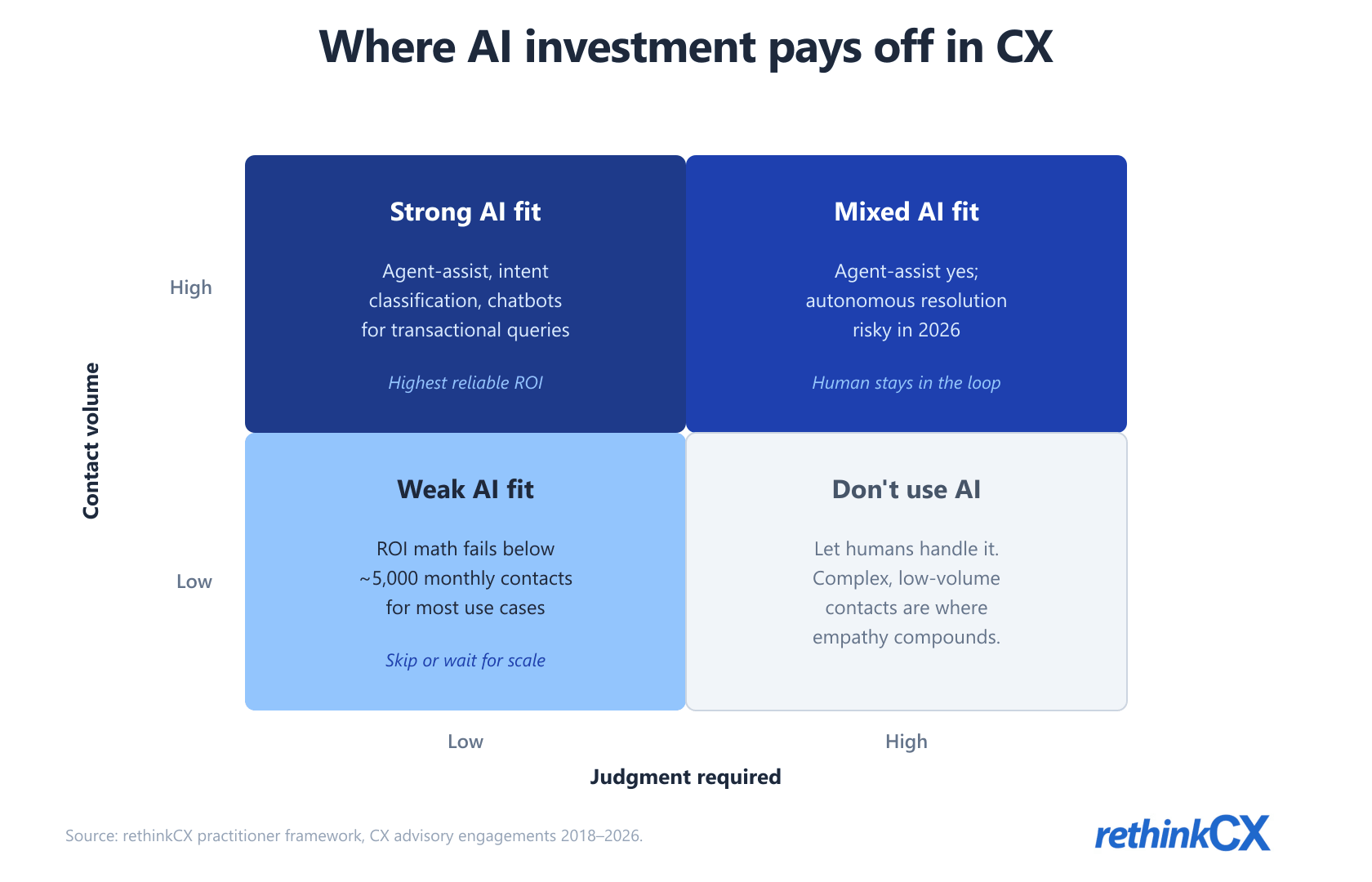
A useful way to think about CX AI investments is on two axes:
| Low judgment required | High judgment required | |
|---|---|---|
| High volume | Strong AI fit (deflection, agent-assist, intent classification) | Mixed AI fit (agent-assist yes, autonomous resolution risky) |
| Low volume | Weak AI fit (not worth the implementation cost) | Don't use AI (let humans handle it) |
The high-volume, low-judgment quadrant is where AI investment pays off most reliably. Order status questions, password resets, return label generation, FAQ-style queries, basic account changes. These are the contacts where customers don't want a human if they can get a fast accurate answer.
The high-volume, high-judgment quadrant is where AI assists humans rather than replacing them. Complex troubleshooting, dispute resolution, churn-risk conversations, anything requiring nuanced empathy. AI helps the agent (drafts a reply, surfaces context), but the human stays in the loop.
The low-volume quadrants are usually wrong places to invest. The ROI math doesn't work below a certain volume threshold (typically ~5,000+ monthly contacts for the use case).
The five highest-ROI AI use cases in 2026
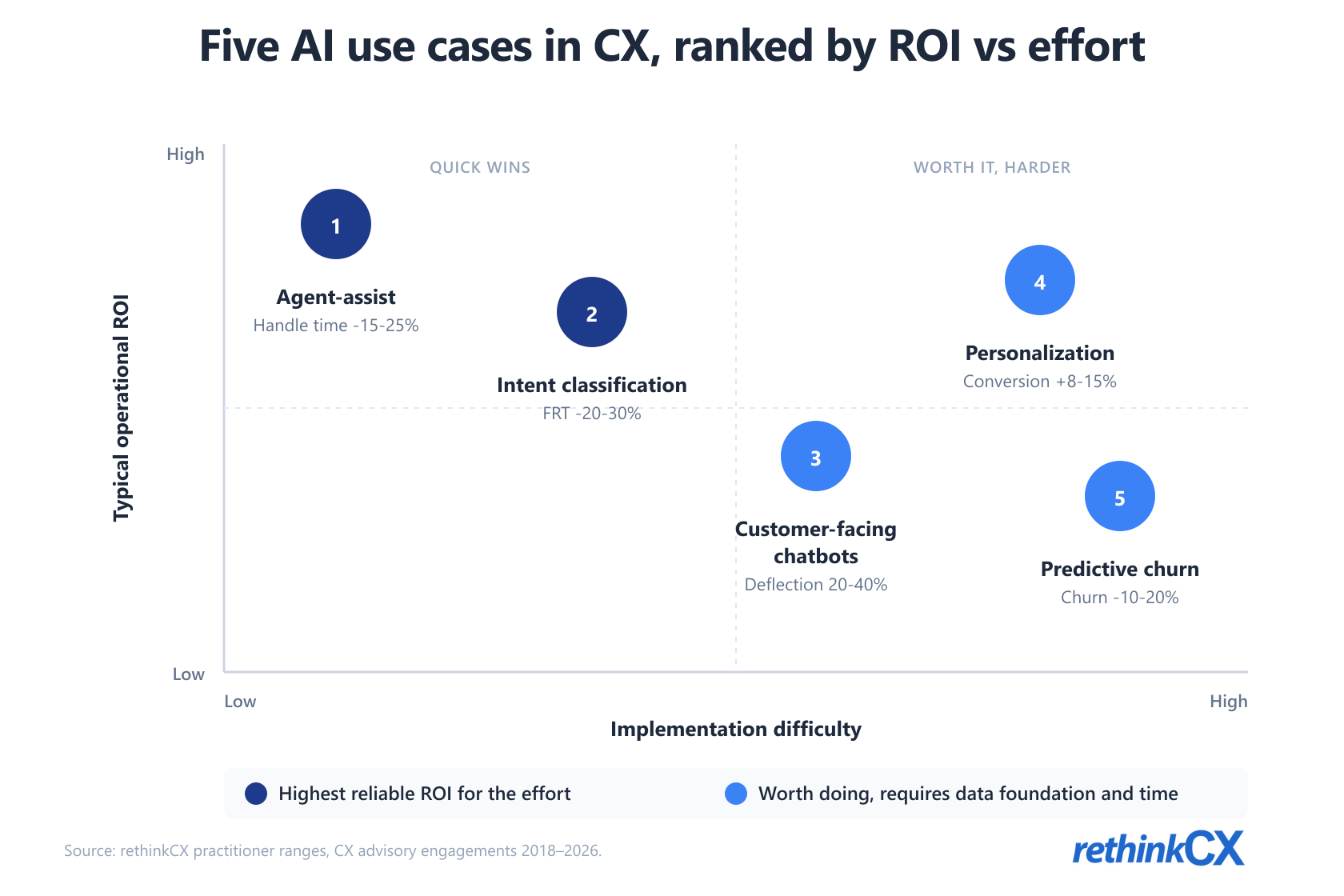
Five plays are doing the heavy lifting in 2026. Plotted against implementation difficulty, two cluster as quick wins (agent-assist, intent classification) and three deliver real ROI but cost more to stand up (chatbots, personalization, predictive churn). The order below is rough priority — go top to bottom unless your contact mix forces a different sequence.
1. Agent-assist (the most underrated)
Agent-assist tools sit alongside human agents during customer interactions and provide:
- Real-time draft replies the agent can edit and send
- Context surfacing (past interactions, customer profile, related cases)
- Suggested actions and next-best-step prompts
- Automated post-call summarization
- Compliance prompts in regulated industries
Real ROI in the deployments we've worked on: handle-time reduction in the 15-25% range, CSAT lift of 4-8 points, agent-satisfaction improvement (work feels less repetitive), faster ramp time for new agents. The variance inside those ranges is driven by ticket-mix complexity and how well the knowledge base is structured, not by which vendor you pick.
Why it's the most underrated: it doesn't have a flashy customer-facing demo. The customer doesn't see the agent-assist tool. So vendors marketed it less aggressively than chatbots. But the operational impact is consistently better than chatbot deflection for most mid-market brands.
For the support operations side of where this fits see how to reduce customer service response time and our AI co-pilot for call centers guide.
2. Intent classification and routing
Most help desks we audit misroute 15-30% of contacts before routing AI is in place. Misrouted contacts wait the full queue time, get reassigned, then wait the full queue time again. Compounding delay.
AI intent classification reads the inbound contact (text, voice transcript, form input) and routes to the correct queue or agent on the first try. This is mature, proven technology in 2026.
Real ROI we typically see: median first-response time reduction of 20-30%, escalation rate down, agent-satisfaction lift (less work on misrouted tickets they can't solve).
3. Customer-facing AI chatbots (with constraints)
Chatbots work when:
- The contact mix is heavily transactional (order status, FAQ, basic account)
- The bot is genuinely good (modern LLM-based, not rule-based)
- The handoff to humans is smooth (one click, full context preserved)
- The customer can always escape to a human without fighting the bot
Chatbots fail when:
- Used as a wall to prevent customers from reaching humans
- Built on legacy rule-based platforms that frustrate complex queries
- Deployed without measuring whether deflected contacts were actually resolved
- Optimized for "tickets deflected" without measuring downstream callbacks
Real ROI when done well, from the engagements we've run: 20-40% deflection of routine queries, faster answers for customers who want self-service, cost reduction on tier-1 volume. Zendesk's 2026 AI customer service statistics roundup found that 51% of consumers prefer interacting with bots over humans when they want immediate service, which is consistent with what we observe: customers don't dislike bots, they dislike bots used as a barrier.
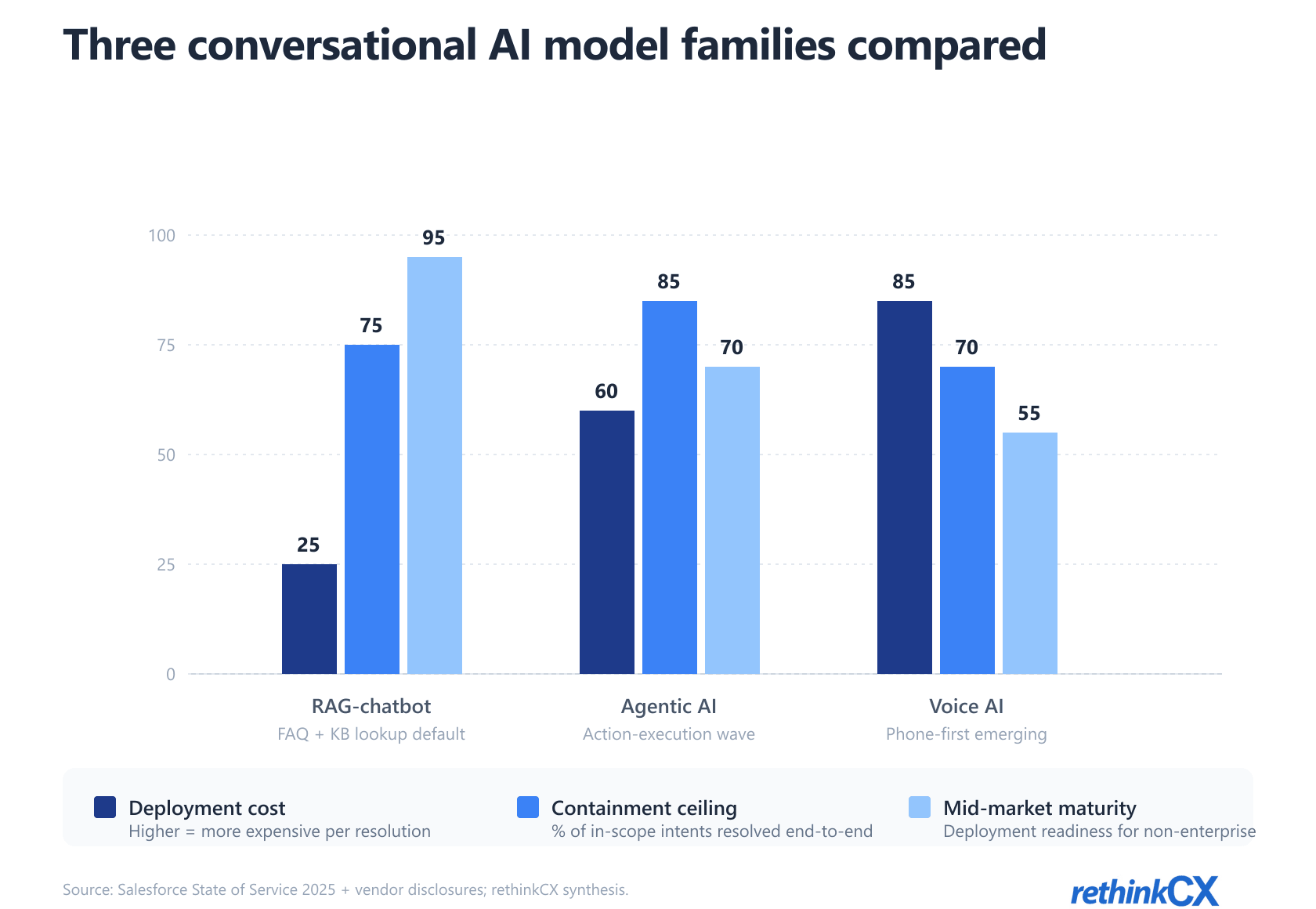
The deeper question is which model family to deploy in the first place. RAG-chatbots, agentic AI, and voice AI behave differently on cost, escalation, and failure modes; the implementation playbook for customer-facing conversational AI walks through the three families and the eight-step deployment sequence.
4. Personalization engines
AI personalization analyzes customer behavior, profile, and context to deliver tailored experiences: product recommendations, content variations, journey orchestration, message timing.
For most mid-market brands the highest-ROI flavor is hyper-segmentation (50-200 dynamic micro-segments) with dynamic content variation across email and on-site experiences, rather than full ML recommendation engines. The data infrastructure underneath matters more than the model selection.
Real ROI we see when the data foundation is solid: conversion lift of 8-15% on personalized journeys, email open-to-click lift of 25-40% with modular dynamic content, retention lift in the segments where personalization most affects experience. The failure point on most personalization programs is the data integration upstream of the model, not the model selection itself.
For the operational deep-dive see our AI personalization at scale pillar and AI personalization for customer interactions.
5. Predictive analytics for churn and intent
Machine learning models that flag at-risk customers (predicted to churn) or high-intent prospects (predicted to convert) in time for the team to intervene.
Real ROI when done well, in the engagements we've run: 10-20% churn reduction in the segments where intervention is feasible, lift in conversion on identified high-intent prospects.
The execution requirement is what kills most predictive analytics programs: the prediction is useful only if there's a defined operational response. Flagging an at-risk customer with no playbook for what to do about it produces dashboards, not retention.
For the modeling side specifically, our customer churn prediction guide walks through the four model families and where the action-layer gap most often hides. For the broader machine-learning context see our machine learning for customer insights guide.
The agentic AI question
Agentic AI is the 2026 hype cycle. The pitch: AI systems that can reason, plan, and execute complex multi-step workflows autonomously, resolving customer issues without human intervention end-to-end. How those systems actually work, what they cost, and where they break is its own subject; AI customer service agents deploy on a specific sequence, and the teams skipping it are most of the disappointed ones.
The reality:
Where it works in production today:
- Narrow vertical workflows with tight constraints (booking management, returns processing within defined parameters, simple account changes)
- Internal back-office automation (data entry, document classification, contract review)
- High-volume, low-stakes interactions where errors are recoverable
Where it doesn't work yet:
- Open-ended customer service across heterogeneous contact types
- Anything requiring deep contextual judgment
- High-stakes interactions where errors damage relationships
- Domains where regulatory compliance requires human accountability
My current take: Pilot agentic AI in narrow scopes. Measure honestly against actual customer outcomes, not vendor-defined success metrics. Scale only what proves out. The vendors are aggressive in promises; the production reality is narrower. Don't bet the CX strategy on broad agentic deployment yet.
The five real risks
1. Data privacy and compliance
AI systems consume customer data at volume. Compliance requirements (GDPR in EU, CCPA in California, HIPAA in healthcare, PCI-DSS in financial services) constrain what data can be used, how, and where it's stored. Vendor selection has to weight compliance posture explicitly. That weight lands hardest in regulated verticals; the healthcare-specific view walks through what HIPAA and live patient data actually demand of a deployment.
Mitigation: data classification before any AI deployment, contractual data handling provisions with vendors, regular audits, customer-facing transparency about AI use.
2. Algorithmic bias
ML models trained on biased data produce biased outcomes. The classic example: a financial services AI that systematically denied loans to certain demographics because the training data encoded historical bias.
Mitigation: diverse training data, regular fairness audits, monitoring for differential outcomes across customer segments, human-in-the-loop on consequential decisions.
3. Over-deflection
The chatbot that successfully prevents customers from reaching humans isn't winning, it's failing. Customers who give up trying to get help leave silently. Deflection metrics look good while retention metrics quietly degrade.
Mitigation: measure customer outcomes (was the issue actually resolved) rather than only deflection (was the contact prevented from reaching a human). Always-available escape hatch to a human. Monitor downstream callbacks and escalations.
4. Hallucination
Generative AI can confidently produce wrong information. In CX context this manifests as bots giving customers incorrect answers about policies, prices, account status: answers that sound authoritative but aren't true.
Mitigation: retrieval-augmented generation (RAG) that grounds AI in your actual knowledge base, not the model's training data. Fact-checking layers. Defined escape protocols when the AI isn't confident. Human review on high-stakes interactions.
5. Loss of customer feedback signal
If AI handles all tier-1 contacts, humans never see the patterns in customer issues. Product feedback, edge cases, emerging problems get filtered out by the deflection layer. The company loses one of its most important customer research feedback loops.
Mitigation: explicit reporting from the AI layer to humans (what topics are increasing, what are customers asking about that the AI couldn't handle). Periodic human review of AI conversations. Don't sever the feedback loop.
How to actually implement AI in CX
The order matters. Most failed AI programs got the order wrong.
Phase 1: Data foundation (Months 1-3)
Before any AI deployment, get the data infrastructure into shape:
- Identity resolution (unified customer profile across systems)
- Behavioral events flowing in near-real-time (not batch nightly)
- Knowledge base accessible via API
- Compliance and data classification done
Without this, AI is making decisions on incomplete or stale data. Garbage in, expensive AI garbage out.
Phase 2: Agent-assist on the highest-volume contact type (Months 3-6)
Start with the lowest-risk, highest-ROI play. Agent-assist on your top-volume support category. Measure handle time, CSAT, agent satisfaction. Iterate.
Phase 3: Intent classification for routing (Months 6-9)
Add AI routing to reduce misroutes. This compounds with the agent-assist gains.
Phase 4: Personalization (Months 9-15)
Once data foundation and core operational AI are stable, layer in personalization. Hyper-segmentation + dynamic content first; full ML recommendation engines later if the simpler plays plateau.
Phase 5: Customer-facing chatbots (selectively, Months 12-18)
Only after agent-assist is mature and the contact mix is genuinely well-suited. Don't lead with this; too many programs invert the order and fail.
Phase 6: Agentic AI pilots (Year 2+)
Narrow vertical scopes, defined success metrics, honest measurement. Scale only what proves out.
What AI in CX actually costs in 2026
Vendors prefer not to itemize these costs and consultancies prefer not to commit to them. From the advisory work we've done with mid-market brands in 2025-2026, here are the ranges that match production reality, not pitch-deck pricing.
Agent-assist platforms. Typically priced per agent seat per month, in the $40-150 range depending on vendor and feature depth. A 50-agent support team running a mid-tier agent-assist platform comes in at roughly $30,000-90,000 per year on platform fees alone. Add implementation services (knowledge-base structuring, integration with the help desk, training) which usually run another $40,000-120,000 one-time for a mid-market deployment. ROI typically lands inside 12 months when contact volume justifies it.
Customer-facing chatbot platforms. Enterprise platforms (Ada, Forethought, Sierra, Intercom Fin, Zendesk AI agents) price on a mix of seats, conversations, and AI-resolved tickets. A reasonable budgeting heuristic is $50,000-200,000 per year all-in for a mid-market deployment, with the higher end driven by conversation volume and the cost per AI-resolved ticket (often $0.50-$2.00 per resolution). Cost grows with success — a chatbot that resolves more tickets costs more, which is the right incentive structure but surprises teams that budgeted flat.
Personalization stack. This is where costs get genuinely variable. A hyper-segmentation play built on existing CDP and email infrastructure can be $50,000-150,000 per year incremental. A full ML recommendation engine with custom modeling can be $300,000+ per year between platform, data infrastructure, and the data-science headcount to operate it. Most mid-market brands should not be running the second of those in 2026.
Agentic AI pilots. Honest 2026 pricing is unstable because the category is new. Expect $75,000-250,000 for a narrow vertical pilot (one workflow, one contact type, 6-month measurement window). Don't commit to multi-year enterprise pricing yet — the platforms are moving too fast.
Internal headcount. The unsexy line item that determines whether any of the above pays back. Plan for at least one dedicated CX-engineering or CX-ops role to own the AI stack day-to-day. The programs that fail almost always treat AI as a vendor decision rather than an operating-model decision, and skip this hire.
The numbers above are ranges, not quotes. The point is to give you the order-of-magnitude shape so a vendor pitch deck doesn't anchor your budgeting. If a vendor's pitched ROI requires you to spend $400,000 on platform and $0 on internal capability, the math is dressed up.
What I'd do differently if I were starting today
Patterns from helping brands stand up AI-in-CX programs:
Invest in the data foundation harder than feels comfortable. It's the unglamorous part and it's where most programs eventually realize they should have invested earlier. Spend the first 90 days on identity resolution and event infrastructure.
Pick the unsexy use case first. Agent-assist on tier-1 support is boring compared to "autonomous AI customer service agent." It also delivers ROI 4-6x faster. Boring wins.
Measure customer outcomes, not vendor metrics. AI vendors love metrics like "deflection rate" and "automation percentage." Track customer outcomes instead: resolution rate, repeat-contact rate, downstream CSAT, retention. The vendor metrics can look great while customer metrics degrade.
Keep tier 3 in human hands. Complaints, escalations, churn-risk conversations (the contacts that teach you about the business) should not be fronted by AI. Hand them to humans first; let AI assist the human.
Pilot agentic AI in narrow scopes only. The vendors will pitch broad autonomous deployment. The production reality is narrower. Pilot honestly, scale what works, don't take the marketing pitch as a strategy.
How AI in CX connects to broader strategy
AI in CX is a capability, not a strategy. It plugs into the broader CX strategy framework (see our CX strategy pillar) at the delivery layer. It's how you execute parts of the experience faster, more consistently, and at higher scale.
The strategic decisions around AI in CX should flow from the broader CX strategy, not the other way around. "We need AI" without a clear understanding of which CX problems it solves usually produces expensive AI projects that don't move retention.
Two adjacent pieces worth reading next: customer self-service for the deflection layer this guide assumes is already working, and what AI does well in journey mapping and what to skip.
The point
AI in CX in 2026 is about execution discipline, not technology novelty. The companies that get the most value invest in the data foundation first, deploy the unsexy agent-assist use cases before the flashy customer-facing chatbots, measure actual customer outcomes rather than vendor-defined metrics, and pilot agentic AI in narrow scopes rather than betting the strategy on broad autonomous deployment.
The risks are real but manageable: data privacy, algorithmic bias, over-deflection, hallucination, loss of feedback signal. Each requires explicit guardrails, none is a reason not to deploy AI.
The 2026 differentiator isn't whether you use AI. It's how cleanly you've integrated it into the broader CX strategy: augmenting humans where humans add value, automating routine work where automation makes sense, and keeping the customer in mind rather than the efficiency dashboard.
On the operational side: omnichannel customer service, 22 customer service KPIs, and the customer churn pillar for the outcome these plays are ultimately judged on. For the consulting side of selecting and integrating CX tooling end-to-end, see our CX technologies service. And our CX maturity assessment gives you a fast diagnostic on whether your data foundation is actually ready for the AI plays in this guide.