

I run a CX consultancy and most of the calls I take from startup founders go the same way. They've grown faster than they expected, founders are personally answering tickets at 11pm, and they want to know: should we outsource?
The honest answer is usually "yes, but not the way you're thinking about it." This guide is the version of that conversation I wish I could send people before the call. It covers when outsourcing is the right move, what to delegate first, what to keep in-house, what to pay, and the diligence that separates the partnerships that work from the ones that quietly cost you customers for two quarters before you notice.
When outsourcing is the right call (and when it isn't)
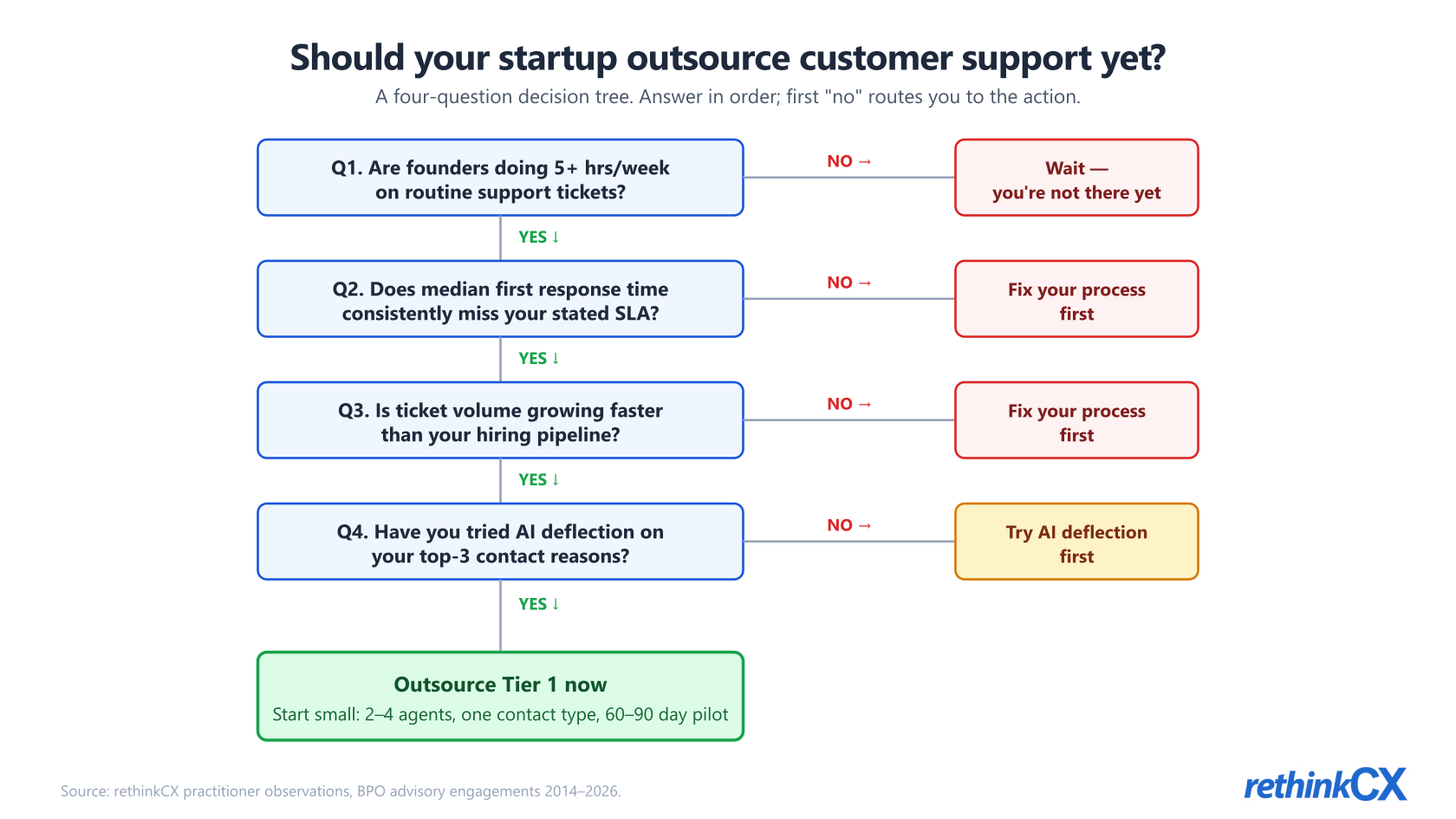
Most startups should consider outsourcing customer support when three signals converge: founders are spending 5+ hours per week on routine tickets, median first response time consistently misses the stated SLA, and ticket volume is growing faster than the hiring pipeline. Outsourcing earlier than that usually exports an unfinished process. Outsourcing later than that quietly costs revenue through churned customers and burned-out founders.
There are three signals I look for when a founder asks whether they should outsource:
- Founder hours on routine support exceed 5/week. Founder time is the most expensive support time on your P&L. If you're spending a half-day a week on tickets that don't need your judgment, you're paying yourself $200/hour to do work that costs $5/hour to do well elsewhere.
- Median first response time consistently misses your stated SLA. Not the occasional spike. The median. If your stated SLA is 4 hours and your median is 9, you have a sustained capacity gap. HubSpot's 2024 State of Service report found that 82% of service pros say customers now expect resolution immediately, with a desired window under three hours. The bar is moving against you whether you outsource or not.
- Ticket volume is growing faster than your ability to hire. This is the classic seasonal-or-launch surge problem. If volume doubles in 60 days and your hiring pipeline takes 90, outsourcing fills the gap.
If none of those are true, the answer is usually no. You probably have a process problem (bad triage, missing autoresponder, unclear SOPs) and outsourcing would just spread that problem across more people. See how to reduce customer service response time for the structural fixes that solve most early FRT issues without any new headcount. The companion read here is 7 signs you should outsource your call center, which goes deeper on the operational symptoms that point at outsourcing vs. the ones that point at process work.
The other thing I'd add: don't outsource because you read a stat about how many small businesses do it. Outsource because you have a specific operational pain that a vendor can solve better than you can solve internally right now.
When should a SaaS startup outsource customer support?
A SaaS startup should outsource customer support when the three signals above converge: founders spending more than 5 hours a week on routine tickets, median first response time consistently missing the stated SLA, and ticket volume growing faster than the hiring pipeline. Company size is the wrong trigger. The real prerequisite is a documented, stable tier-1 process you can hand to someone else, which is why some startups clear the bar at Series A and others not until Series B. The section on when to start the conversation below has the longer version of that argument.
What to outsource first (and what to never outsource)
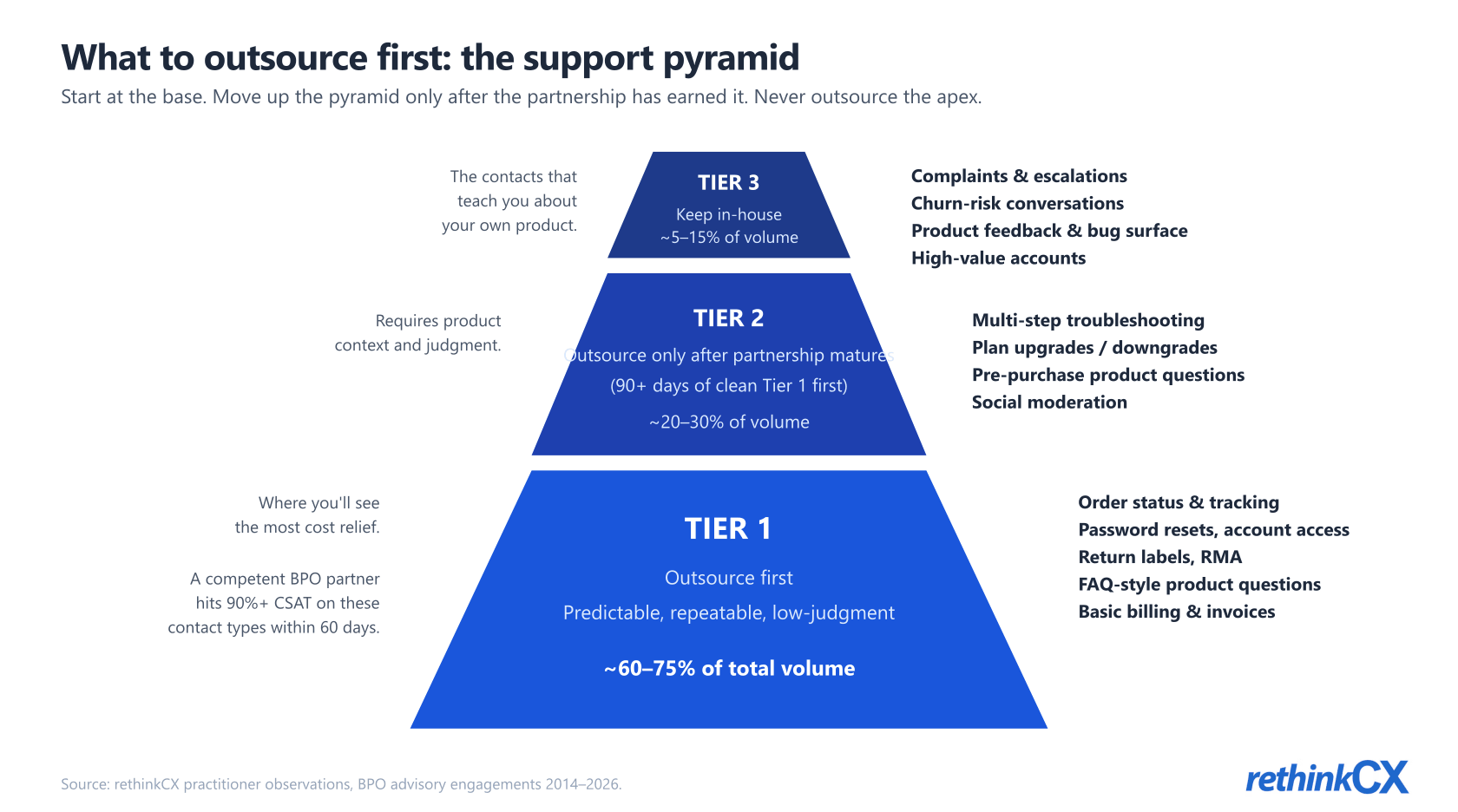
The mistake I see most often is founders trying to outsource the entire inbound queue on day one. That doesn't work. The vendor inherits a mess, makes calls without context, and you spend the next quarter cleaning up complaints from customers who got a brand-mismatched reply about a refund policy that changed last month.
Outsource in tiers, in this order:
Tier 1 — outsource first
These are predictable, repeatable, low-judgment contacts. You can write a clear SOP for each, and the right answer is the same regardless of who the customer is.
- Order status, shipping, tracking
- Password resets, account access
- Return labels, RMA processing
- FAQ-style product questions
- Basic billing and invoice requests
A competent BPO partner will hit 90%+ CSAT on these contact types within 60 days of onboarding. Tier 1 is also where you'll see the most cost relief, because in our experience it's usually the majority of total volume for early-stage B2C and consumer SaaS startups.
Tier 2 — outsource only after the partnership matures
These contacts require some product context and some judgment, but they're still systematizable. Move them to the vendor only after you've seen 90+ days of clean tier-1 performance.
- Multi-step technical troubleshooting
- Subscription changes, plan upgrades/downgrades
- Pre-purchase product questions where bad answers don't directly damage the relationship
- Social media moderation (with clear escalation rules)
Tier 3 — keep in-house, probably forever
These are the contacts where the right answer depends on context only your team has, where the wrong answer creates churn, or where the conversation is itself a customer research signal.
- Complaints and escalations
- Cancellation and churn-risk conversations
- Product feedback and feature requests
- High-value account interactions
- Any contact that surfaces a bug, edge case, or systemic issue
The reason to keep tier 3 in-house isn't sentimentality — it's that these conversations are where you learn what's actually broken about your product or your CX. Hand them to a vendor and you sever the most important feedback loop in the company.
Where AI deflection fits before you outsource humans
The 2026 founder decision isn't outsource-or-don't anymore. It's deflect-then-outsource-the-residual.
A modern conversational AI agent, connected to your order system, helpdesk, and a decent knowledge base, will resolve 30-50% of tier-1 contacts before a human ever sees them. Zendesk's 2025 CX Trends Report found that 75% of CX leaders now expect 80% of customer interactions to be resolved without human intervention within the next few years, and case studies from operators like Vagaro report 44% of incoming requests already being resolved by AI today. Order status, password resets, shipping ETAs, refund policy questions, store hours, basic account changes — these are the contact types where an AI answer is genuinely just as good as a human answer, available 24/7, and lands in seconds instead of hours. Loaded cost per resolved AI contact in 2026 sits in the $0.03-0.10 range for most off-the-shelf platforms. The math is hard to argue with on volume.
The practical sequence I'd recommend: pull your top 10 tier-1 contact reasons from the last 90 days, identify the ones where the right answer is the same regardless of customer context, and pilot an AI agent on those first. If your top three contact reasons account for 60% of tier-1 volume (typical for B2C), and AI deflects 60% of those, you've taken 36% of total tier-1 volume off the human queue before signing a BPO contract. The remaining 64% is what you outsource to humans, and the per-ticket economics on that contract are meaningfully better than they would have been on the full volume.
A few rules of thumb from this work:
- Don't deflect complaints. Route them to a human within the first turn, every time. AI mishandling of an upset customer is the single fastest brand-damage path in modern CX.
- Don't deflect anything churn-adjacent. Cancellation flows, downgrade requests, contract questions — these are tier-3 forever, and the AI shouldn't even be in the loop.
- Pair the AI with a strong self-service layer. A good knowledge base and IVR setup deflects another 10-20% on top of the AI agent, often at near-zero marginal cost.
- Measure deflection by resolved contact, not by handled contact. If the AI handles 1,000 tickets and 400 escalate to humans, your true deflection rate is 60%, not 100%. The vendor math depends on this number.
The structural insight for founders is that AI and BPO are complements, not substitutes. AI handles the volume; humans handle the judgment. For a longer treatment of where the two combine, see how AI is reshaping the BPO model.
When to start the outsourcing conversation
The framing question I'd use is not "are we big enough to outsource yet?" It's "do I have a documented, stable Tier 1 process that I can hand to someone else?" If yes, you can outsource almost regardless of company size. If no, building that process is the prerequisite, not the company-size milestone.
Some startups outsource as early as Series A (30-50 employees) when they hit a B2C launch surge. Others wait until Series B (100+ employees) because their support is genuinely complex and the SOPs take longer to mature. Both can be right. The wrong move is outsourcing because the team is tired and you haven't done the SOP work first.
A useful sanity check: can you write a one-page document that explains how to handle the top 10 most common ticket types, including exact response templates, escalation triggers, and what success looks like? If you can, you're ready to outsource that work. If you can't, your in-house team is also winging it, and outsourcing won't fix that.
What it actually costs
Loaded per-agent monthly costs by region, current as of mid-2026:
| Region | Loaded cost / agent / month | Best for |
|---|---|---|
| Philippines | $400-700 | Tier 1 voice + chat, 24/7 coverage, English fluency |
| India | $350-650 | Tier 1 + tier 2 technical, English fluency, mature BPO ecosystem |
| Latin America (Colombia, Mexico) | $700-1,200 | US-timezone overlap, Spanish bilingual, brand-fit for US consumer |
| Eastern Europe (Poland, Romania, Ukraine) | $1,000-1,800 | EU-timezone, multilingual, technical SaaS |
| South Africa | $800-1,400 | UK-timezone overlap, neutral accent, EU/UK consumer brands |
| US / Canada (domestic remote BPO) | $2,500-4,500 | Premium brand voice, regulated industries, complex products |
Per-ticket pricing is more variable but roughly $1.50-4 for tier-1 contacts in Philippines/India, $4-10 in LatAm, $8-15 in Eastern Europe, $15-30 in US/Canada. Per-ticket usually makes sense when your volume is highly variable; per-agent makes sense when your volume is predictable. Most startups end up on a hybrid: a base block of agent hours plus a per-ticket overflow rate. See our full BPO pricing models guide for the detail on each model.
The cost trap I see most often: founders pick the cheapest per-agent rate, then the vendor only assigns 30-40 tickets/agent/day because their internal QA process is weak. The "$400/mo agent" turns into a $13/ticket cost that's worse than a $1,200/mo agent doing 90 tickets/day at $14/ticket. Compare loaded cost per ticket, not loaded cost per agent. Deloitte's 2024 Global Outsourcing Survey flags this directly: cost is no longer the sole outsourcing driver enterprise buyers cite. Skilled talent and agility have moved up the priority list, and startups that pick on rate alone tend to lose on the dimensions buyers further up the maturity curve are already optimizing for.
How to actually pick a partner
Here's the diligence I run when I'm evaluating BPO partners for clients. It's not exhaustive, but it catches 80% of the failure modes I've seen.
What to ask in the first call
- "Walk me through your QA process. How many tickets per agent per week get reviewed and by whom?"
- Good answer: a specific number (usually 4-10% sample), a defined rubric, weekly calibration.
- Bad answer: vague "we have a QA team" without specifics.
- "What's your average tenure for tier-1 agents? What's your monthly attrition?"
- Good answer: 12+ months tenure, sub-10% monthly attrition.
- Bad answer: avoidance, or numbers worse than 8 months / 15%+.
- Context for the number: ICMI's analysis of the contact center attrition crisis, citing ContactBabel's 2024 industry data, found 54% of contact centers run annual attrition between 21% and 50%+. A vendor quoting sub-10% monthly is meaningfully better than the industry baseline; one dodging the question is almost certainly worse.
- "How do you handle ticket volume that exceeds the contracted block?"
- Good answer: clear overflow pricing, named escalation contact, defined response time.
- Bad answer: "we'll figure it out" or vague reassurance.
- "Show me a sample weekly report from a similar-sized client (with their info redacted)."
- Good answer: clean reporting on volume, FRT, CSAT, escalation rate, top contact reasons.
- Bad answer: "we'll build something for you" — they don't have a standard, which means they don't have a process.
What to ask in the reference call
When the vendor gives you references (always ask for 3, take whichever 2 they provide first):
- "What surprised you about working with them in the first 90 days?"
- "What did the vendor get wrong, and how did they handle being told?"
- "If you were starting over, what would you negotiate differently in the contract?"
The references the vendor sends are obviously their best customers. The valuable signal is in the texture of the answers, not whether the customer is happy in aggregate.
Red flags
- No defined onboarding process beyond "send us your SOPs."
- Pricing structure that disincentivizes them from caring about CSAT (pure per-ticket without quality gates).
- Refusal to start with a small pilot (most good vendors will pilot with 2-4 agents for 60-90 days), or refusal to run that pilot month-to-month with no long-term contract behind it.
- No transition or offboarding clause in the MSA.
- Sales team that promises 99% CSAT and 30-second FRT without seeing your tickets first.
For deeper evaluation criteria see our full BPO vendor selection guide.
What the first 90 days should look like
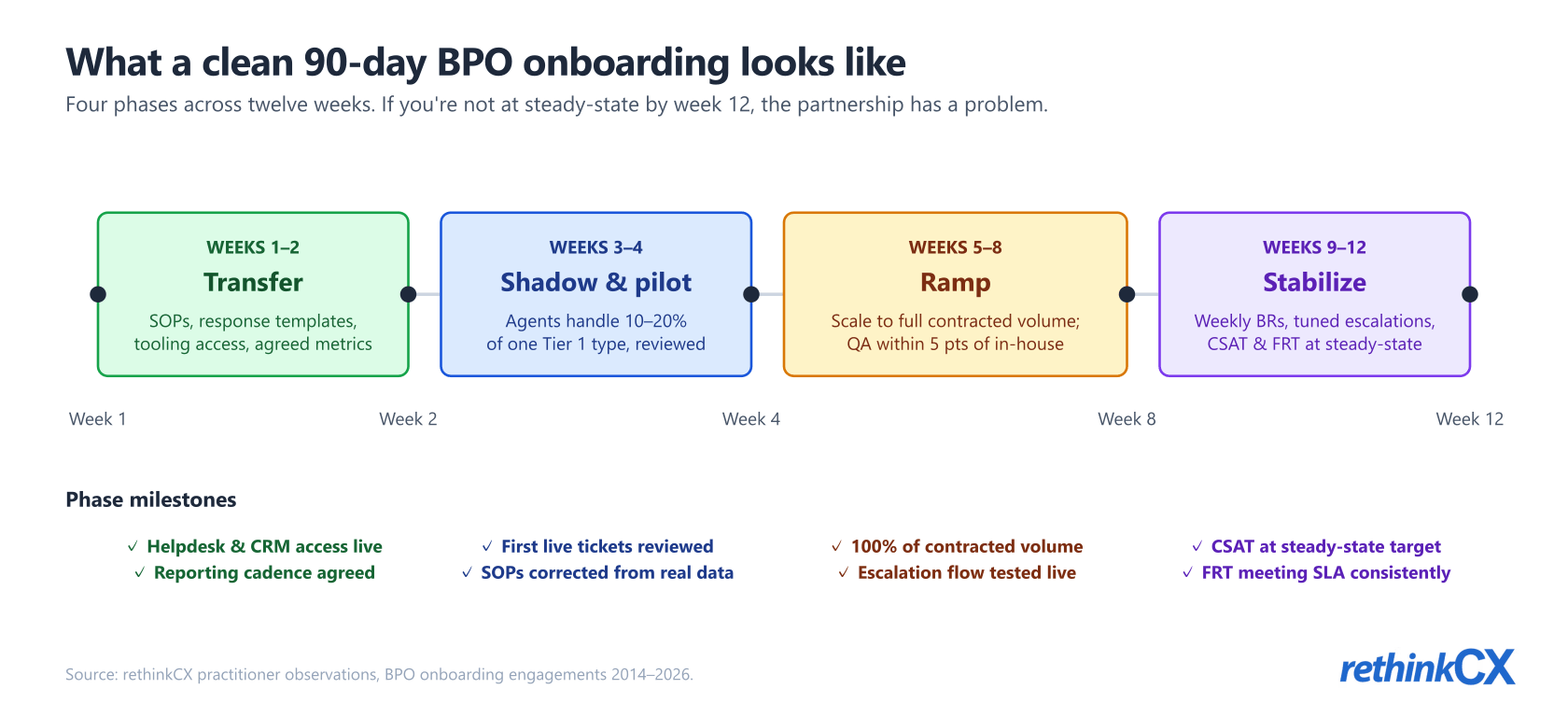
A clean BPO onboarding follows roughly this shape:
Transfer SOPs and tooling (weeks 1-2). You provide the response templates, escalation rules, knowledge base access. The vendor sets up their access to your help desk, CRM, and any tooling. Both sides agree on the metrics and reporting cadence.
Shadow and pilot a contact slice (weeks 3-4). Vendor agents shadow your in-house team or watch recorded ticket resolutions. They handle a small slice of contacts (usually 10-20% of one tier-1 contact type) under direct review.
Ramp to full contracted volume (weeks 5-8). Volume scales as quality holds. By the end of week 8 you should be at full contracted volume with QA scores within 5 points of in-house benchmarks.
Stabilize and tune (weeks 9-12). Weekly business reviews, refined SOPs, escalation rules tuned. CSAT and FRT should be at or near steady-state.
If you're not there by week 12, the partnership has a problem. Either the SOPs were undercooked, the agents weren't a fit, or the tooling integration is broken. Address it directly. Don't let "we just need a bit more time" stretch into quarter two.
What I'd do differently if I were starting today
I've watched a lot of startup outsourcing arrangements, including ones I helped set up. The ones that worked did what the sections above describe: small pilot, documented SOPs handed over on day one, tier 3 kept in-house. What separated the failures was narrower than that, and neither half of it shows up in a vendor scorecard.
The ones that failed picked for cost. Every single one. The cheapest vendor became the most expensive vendor when measured 12 months out, including the cost of customers churned and reputation repaired.
The ones that failed treated the vendor as a vendor, not a team. The vendor relationships that work look like internal team relationships: weekly syncs, real feedback, joint problem-solving. The ones that fail look like a quarterly invoice review.
The point
Startup support outsourcing is a tool, not a strategy. The teams that get it right know exactly what problem they're solving with it (capacity, coverage, cost, or all three), document the work first, pilot before scaling, and keep the contacts that teach them about their product in-house. The teams that get it wrong outsource because they're tired, pick the cheapest option, and discover six months later that nobody owns the customer relationship anymore.
For the operational side of building the SOPs you'll hand over, 22 customer service KPIs to track is the place to start. When you're ready to evaluate vendors directly, our BPO matching service handles partner selection for startups specifically, and the BPO cost calculator gives you a clean baseline before any vendor conversation.