

BPO pricing runs $8 to $15 per agent hour offshore, $14 to $22 nearshore, and $30 to $45 onshore. On a per-FTE basis that is $1,200 to $2,500 per agent per month offshore, $3,500 to $6,500 nearshore, and $5,000 to $9,000 onshore. Per-ticket work bills at $1 to $5 per resolved ticket.
Those rates sit inside six outsourcing pricing models: hourly, per-FTE, per-transaction, fixed-fee, performance-based, and hybrid. Each bills the work differently — by agent time, by dedicated headcount, by resolved unit, by scoped flat rate, by outcome, or by some combination. Call center and helpdesk RFPs often label the same six as billing models. Most mid-market business process outsourcing (BPO) relationships end up on hybrid once real volume patterns hit the contract. The cost lever, though, isn't the model — it's the unit you compare quotes on.
Most pricing guides tell the reader to weigh hourly against per-FTE against per-transaction. Almost none teach them how to compare a $4,500-per-month FTE quote against a $3.50-per-ticket quote against a $4-per-resolution quote when those are the three sitting on the desk. That comparison is the work, and it's what this guide spends its weight on — alongside the per-vertical rate card, the anatomy of a real hybrid contract, and the buyer-side management overhead nobody quotes you upfront. For the longer arc of how BPO pricing evolved from per-hour cost arbitrage to today's outcome-linked contracts, see the evolution of BPO; for the startup-specific framing, the cluster sibling covers when not to outsource at all.
| Model | Billing basis | Typical 2026 rate | Best for | Primary risk |
|---|---|---|---|---|
| Hourly | Per agent hour | $8-15 offshore / $14-22 nearshore / $30-45 onshore | Short-term, variable workloads | Cost drift when AHT slips |
| Per-FTE | Per dedicated agent / month | $1,200-$2,500 offshore / $3,500-$6,500 nearshore / $5,000-$9,000 onshore | Sustained, judgment-heavy work | Idle-time waste in volume troughs |
| Per-transaction | Per resolved unit | $1-$5 per ticket / $0.50-$1.50 per call | High-volume, standardized work | Quality erosion under speed incentive |
| Fixed-fee | Monthly flat rate | Scope-dependent | Predictable, well-defined scope | Renegotiation when scope drifts |
| Performance-based | Per outcome | $1-$7 per resolution, avg ~$4 (Crescendo 2026) | Measurable, attributable outcomes | Disputed measurement |
| Hybrid | FTE block + overflow | Composite of above | Volatile or mixed contact streams | Reconciliation complexity |
Which BPO pricing model should you choose?
Pricing model is the single contract decision that determines whether outsourcing actually pays back. Pick the wrong one and the vendor's incentives diverge from yours from month one. In our advisory work with growth-stage brands we routinely see contract drift of 15-30% on poorly-structured BPO scope, the kind of drift that turns a +30% NPV business case on the headline rate into a year-2 budget review.
The model also determines who eats which risk. Hourly and FTE shift volume risk to the buyer; per-transaction and performance flip volume risk to the vendor in exchange for buyer-side quality oversight (the mechanics live in the risk-allocation section below). Either way, the flip only works in the buyer's favor when KPIs are defined so vendors prioritize them rather than gamed for speed.
The headline rate is no longer the only driver buyers price against. Per Deloitte's 2024 Global Outsourcing Survey, skilled talent and agility have joined cost reduction as primary motivations, and 83% of buyers now use AI as part of their outsourced services. The unit a buyer compares quotes on is no longer "dollars per hour of human labor"; it's dollars per resolved outcome, with AI deflection, agent skill, and quality oversight all priced into the same number. The ROI math only works if the unit is right.
What are the six BPO pricing models?
The six outsourcing pricing models that show up across BPO contracts are hourly, per-FTE, per-transaction, fixed-fee, performance-based, and hybrid. Each H3 below carries the 2026 rate anchor, the work it fits, and the failure mode buyers underestimate.
Hourly
The hourly model charges per agent hour: the cleanest structure for short-term or variable-volume work where commitment is the enemy. The 2026 baseline we anchor against: $8-15/hr offshore, $14-22/hr nearshore, $30-45/hr onshore, corroborated by text.com's 2026 BPO pricing breakdown. That offshore floor is where the Philippines sits, broken down in our PH outsourcing guide. The risk is cost drift: when AHT slips from a forecast 6 minutes to a real 8, the rate doesn't change but the bill does. A 24/7 helpdesk on hourly pricing gets the drift exposure without the flexibility benefit.
Per-FTE pricing in BPO
FTE pricing commits the vendor to a fixed number of full-time equivalents at a fixed monthly rate per agent. Typical 2026 ranges: $1,200-$2,500 offshore, $3,500-$6,500 nearshore, $5,000-$9,000 onshore. The range is wider than hourly because FTE wraps training, benefits, and bench overhead into one number. The hidden risk is attrition. Per Insignia Resource's 2026 turnover benchmarks, outsourced call center attrition runs 49-53% annually versus 33-39% in-house, with full replacement cost between $22,500 and $46,000 per agent. FTE works best when the work is judgment-heavy enough that agent tenure compounds.
Per-transaction pricing
Per-transaction pricing charges by resolved unit: typically $1-$5 per ticket, $0.50-$1.50 per call, $0.40-$1 per chat in 2026. It aligns the vendor's bill with output, which fits high-volume, well-scripted work like order processing, refund handling, or tier-1 inquiries. The mechanic buyers underestimate is who carries QA. Per-transaction shifts calibration, escalation routing, and outcome review onto the buyer's side of the table, which is why pure per-transaction tends to need more internal management than pure FTE (covered in the hidden-cost section below).
Fixed-fee pricing
Fixed-fee locks a flat monthly rate to a defined scope: $3K-$12K/month for sub-10-seat scoped work, $15K-$50K for mid-market engagements with clear deliverables. The appeal is budget certainty — procurement can put a single line on the spreadsheet. The failure mode is scope drift. Fixed contracts hold together when the work is stable and erode the moment a buyer asks for a new channel, a new language, or a new escalation path. In our advisory work the renegotiation cycle on a fixed contract in a fast-changing operation runs 4-6 months, which is roughly the cadence at which scope inevitably shifts.
Performance-based pricing in BPO
Performance-based pricing in BPO, also called outcome-based pricing, ties payment to outcomes (resolved tickets, retained accounts, qualified leads, CSAT thresholds) rather than time on task. Per Crescendo's 2026 outsourced call center pricing guide, per-resolution rates run $1-$7 with an industry average around $4; AI-augmented resolutions price as low as $1.25-$2.25. The model only works when outcomes are unambiguously measurable and attributable. Per Zendesk's 2025 CX Trends report, 75% of CX leaders expect 80% of interactions to be resolved without human intervention within a few years; when the vendor is paid per resolution, AI deflection becomes their economics, not yours.
Hybrid pricing
Hybrid pairs a base FTE block with per-transaction or performance overflow: an FTE block sized to forecast steady-state volume plus a per-ticket rate for anything above the block's threshold. Per Everest Group's analysis of outcome-based metrics in BPO, most BPO deals today remain hybrids combining a base fee with outcome-linked components. The mechanics that decide whether a hybrid actually works (block size, overflow trigger, overflow premium, reconciliation cadence) get their own section below.
In our advisory engagements the practical landing pattern is consistent: pure single-model contracts hold up under the steady-state assumptions they were sold against, then break the first quarter volume mixes shift, seasonality bites, or a channel migration shows up unforecast. That's where hybrid earns its complexity.
Comparing models on a single axis: cost per output
The hardest thing in a BPO RFP isn't picking a model. It's comparing three vendor quotes denominated in three different units. Vendor A quotes $4,500 per FTE per month. Vendor B quotes $3.50 per resolved ticket. Vendor C quotes $4 per resolved outcome with a 15% performance kicker. None is directly comparable, and most pricing guides stop at the model definitions without giving the reader the math to decide between three live offers.
Cost per output is the normalization. Pick one unit that matches the work (resolved tickets for support, closed sales for outbound, qualified leads for telesales) and reduce every vendor quote to that unit before comparing.
The four-step method:
- Pick the output unit. The unit should be what your business actually consumes, not what the vendor offers to bill in.
- Derive each vendor's cost in that unit. For Vendor A's $4,500-per-month FTE quote, assume 800 resolved tickets per agent per month (a defensible mid-market load factor): that's $5.63 per resolved ticket. Vendor B at $3.50 per ticket already has the unit. Vendor C at $4 per outcome plus a 15% performance kicker lands at $4.60 fully-loaded.
- Load the hidden costs. Add transition fees amortized over contract life, technology integration, QA tooling, and (critically) the buyer-side management overhead covered below. For most mid-market engagements this loading adds 10-25% on top of the headline unit cost. Vendor B's $3.50 might be $4.20 fully-loaded; Vendor A's $5.63 might be $6.40.
- Re-rank. The vendor with the lowest fully-loaded cost per output wins, not the vendor with the lowest headline rate. In the worked example, Vendor B looked 38% cheaper than A on the headline; fully loaded, B is still cheaper, but the gap narrows to 34% — and Vendor C, which looked priciest on the per-resolution kicker, lands $0.20 inside B once integration premiums get loaded against custom middleware. Two of the three rankings change. You can't know until you do the math.
How to compare pricing between BPO vendors
To compare pricing between BPO vendors, convert every quote to the same output unit before you rank them, then load the hidden costs on top: transition fees, technology integration, QA tooling and buyer-side management overhead add 10-25% to the headline unit cost in most mid-market engagements, and they add a different amount to each vendor. That loading is what re-ranks two of the three quotes in the worked example above. A vendor that will not quote fully-loaded cost per resolved ticket is telling you something about how the relationship will run.
To pressure-test a quote against fully-loaded baselines by country, our call center outsourcing cost calculator runs the same math across 18 regions.
What "hybrid" actually looks like in a real contract
"Most engagements end up hybrid" is the line every pricing guide closes its hybrid section with. True, and useless. It tells the buyer the destination without showing what's in the contract. I've watched this play out across hypergrowth DTC operations and multi-region retail and financial-services teams, and the mechanics are consistent enough to template. A hybrid contract is five decisions, not a vibe.
1. The FTE base block. Sized to the steady-state forecast at a defensible load factor. The math: forecast contacts × AHT ÷ (productive hours × occupancy target) = seats. We anchor against 80% occupancy, 30% shrinkage, and the vertical's standard AHT (4-7 minutes retail, 8-12 healthcare, 10-15 SaaS tier-2). Round up. An undersized block triggers overflow constantly and burns the premium rate; an oversized block burns FTE waste in troughs.
2. The overflow trigger. A threshold above which contacts spill onto overflow pricing. Typical formulation: 110-120% of contracted block volume on a 7-day rolling average. Daily triggers fire too often on natural variance; monthly triggers fire too late to matter.
3. The overflow rate. Per-ticket or per-minute, priced at a 15-25% premium above the implied FTE-block rate. A 15% premium signals a vendor with deep bench; 25% signals tighter capacity. Below 15% is suspicious; usually it means the vendor is willing to absorb overflow cost on the bet that you'll renegotiate the block size upward at the next true-up.
4. The reconciliation cadence. Monthly true-up fits hypergrowth and volatile DTC where the volume shape changes faster than a quarter. Quarterly true-up fits steady multi-region operations where smoothing reduces administrative load. Rolling true-up is operationally messy; we advise against it.
5. The renegotiation clause. A clean clause: three consecutive months above 120% of block triggers a mandatory block resize at the original FTE rate, not at overflow. Without it, vendors have an incentive to let overflow accumulate (it's their premium rate) rather than right-size the block.
Risk allocation by pricing model
Each model parks the risk somewhere different. Hourly and FTE push volume risk to the buyer but keep quality risk on the vendor's side. Per-transaction and performance flip that: vendor eats volume risk, buyer inherits quality oversight because a vendor paid per resolved ticket has every incentive to resolve quickly and few to resolve well. Hybrid splits both. The model that fits is the one whose risk allocation matches what your team can actually manage on its side of the table.
Vendor tech stack alignment shifts the rate inside whichever model you pick. We see vendors discount 5-15% when integration is trivial (standard Zendesk, Salesforce Service Cloud) and load 10-20% premiums when integration requires custom middleware or compliance-sensitive data flows — the same FTE engagement quoted by the same vendor can shift 25 points on integration depth alone.
Per-vertical BPO pricing breakdown: typical ranges by industry
Pricing model is one variable; the other is what the vertical does to the rate card. The cost of customer service outsourcing moves on both: the same FTE engagement produces different per-hour numbers depending on compliance burden, agent skill, and how scripted the work is. When a vendor quotes "$X/hour" without naming the vertical, the quote is incomplete.
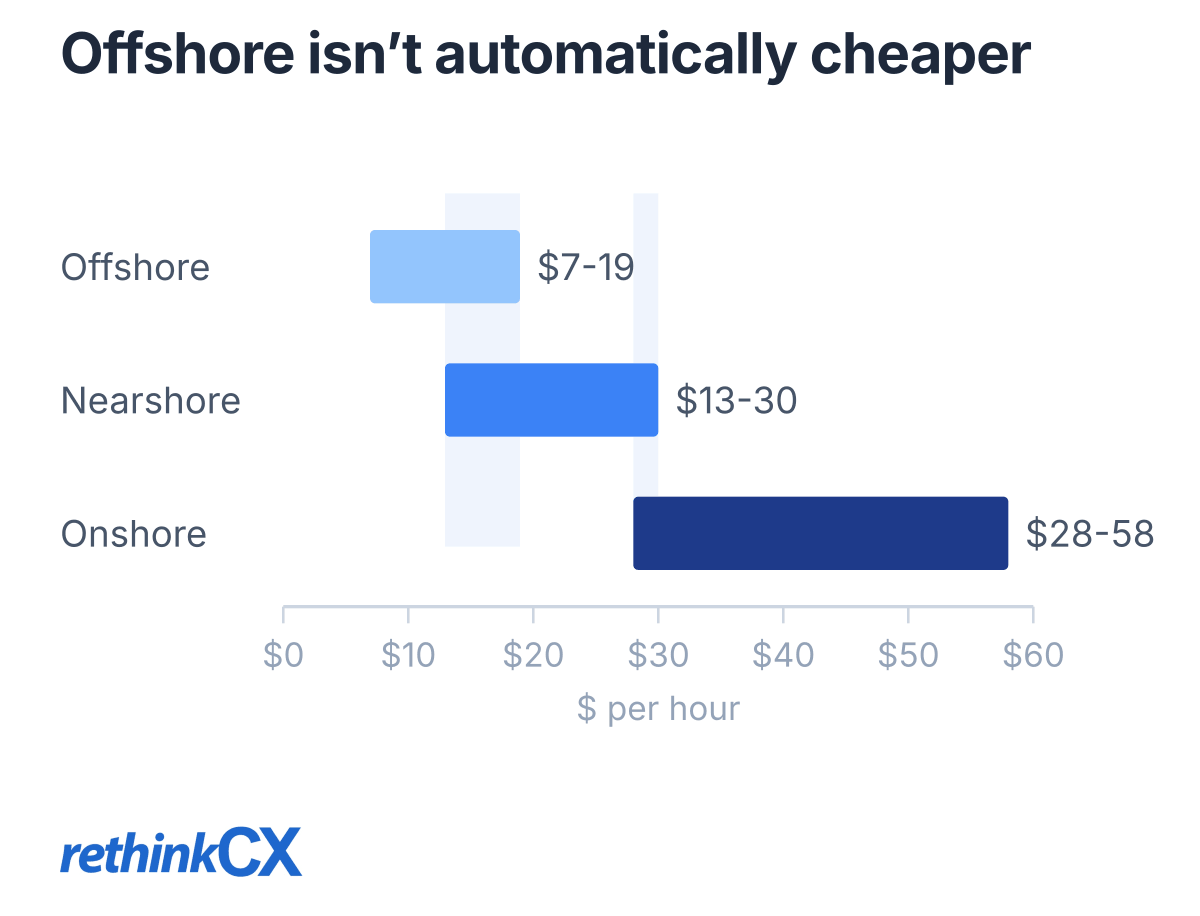
The baseline rate card I see in 2026, before vertical adjustments:
- Onshore (US, UK, Australia, Canada): $30-45/hr fully-loaded, $45-65/hr for licensed or certified roles.
- Nearshore (Mexico, Latin America, Eastern Europe, Portugal): $14-22/hr fully-loaded, $20-30/hr for bilingual or technical roles.
- Offshore (Philippines, India, South Africa, Egypt): $8-15/hr fully-loaded, $12-20/hr for technical or escalation tiers.
Vertical adjustments on top of those baselines:
Healthcare: +20-40% above the vertical baseline. The premium reflects HIPAA compliance, BAA paperwork, dedicated PHI-handling training, and the smaller pool of certified healthcare vendors. Onshore healthcare BPO commonly lands $40-60/hr; offshore HIPAA-compliant work $14-22/hr; narrower gap than most verticals because the certification cost is largely fixed. For the operational mechanics behind running compliant healthcare CX outsourcing, see the HIPAA-compliant healthcare BPO playbook.
Financial services / fintech / insurance: +15-30% above baseline. SOC 2, PCI DSS, and (for some workflows) FINRA-aware vendor selection compress supply. Onshore lands $38-55/hr; nearshore $18-28/hr; offshore for non-regulated tier-1 work $12-18/hr, but anything touching regulated workflows comes back closer to nearshore numbers regardless of geography.
SaaS / B2B tech support: +10-25% above baseline. The premium is knowledge-depth, not compliance; tier-2 SaaS support requires agents who can read API responses and reproduce bugs, a smaller hiring pool than tier-1 retail. Onshore $35-50/hr, nearshore $18-26/hr, offshore $11-17/hr for tier-1, $14-22/hr for tier-2.
eCommerce / retail / DTC: baseline to -10%. Highest-volume vertical with the most-scripted workflows; competitive vendor supply and abundant seasonal flex capacity. Onshore $28-38/hr, nearshore $13-19/hr, offshore $7-13/hr. Most of the $7-9/hr quotes you see in the market are eCommerce seasonal-surge roles. For a breakdown of what ecommerce brands actually outsource, the cluster sibling covers the scope split.
Hospitality / travel: baseline with a multilingual premium of +10-15% baked in. Vendors with 6+ languages on the floor charge a premium worth paying when your booking traffic spans regions.
Telecom / utilities: -5% to -15% below baseline. Highest scripted-workflow share and lowest skill-floor requirement of any major vertical. The trade-off is QA overhead; telecom BPO engagements typically need stronger calibration and escalation paths because issue volume is high and the brand-distance feels acute when an agent gets it wrong.
The ±30% variance across verticals is large enough that the same vendor will quote a 2× spread between an eCommerce surge engagement and a healthcare HIPAA-compliant engagement using the same FTE model. Vertical, geography, and pricing model all sit upstream of any meaningful cost comparison — pinning all three before talking to vendors is what stops the conversation from drifting into apples-vs-oranges quote rounds.
The hidden cost no one quotes you: managing the BPO relationship
"Hidden costs" sections in BPO pricing guides almost always cover the same vendor-side line items: setup fees, transition costs, after-hours premiums, technology integration. The cost they leave out is the buyer's own. In advisory engagements with growth-stage CX teams the ratio we land on is one internal vendor manager per 30-50 outsourced FTEs, loaded at $100K-$150K in North America. For a 100-seat outsourced operation, that's two to three internal heads costing $200K-$450K a year that the vendor's quote does not contain.
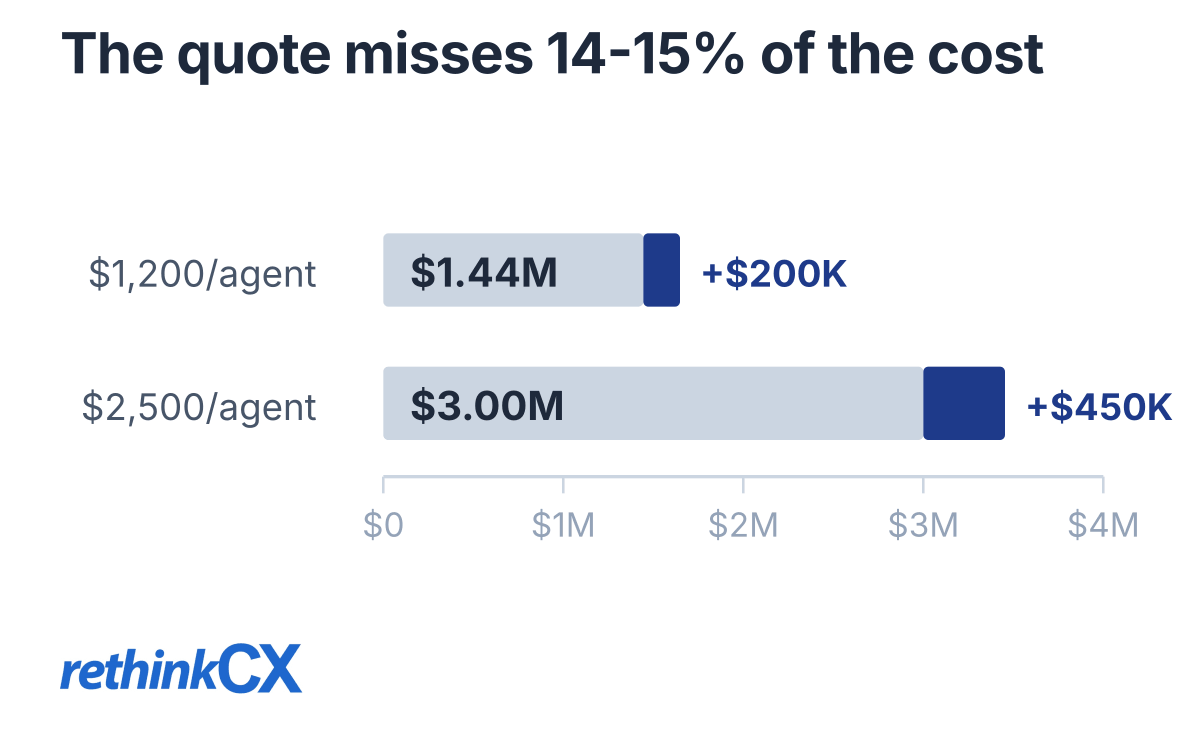
What does the internal role actually do? Five things: weekly calibration with the vendor on edge-case handling, escalation routing for tickets that can't sit on the BPO side, QA review of vendor-side sample audits, vendor-performance reporting to internal leadership, and change-request handling when scope drifts. None of those are optional.
The counterintuitive part: pure per-transaction and performance-based contracts need more internal management than pure-FTE, not less. The headline rate is lower because the vendor's accountability is narrower; they own the resolution but not the quality narrative, so QA, calibration, and escalation oversight stay on your side. The in-house vs outsourced math only nets out once this line item is on the spreadsheet, and most build-vs-buy analyses we review have it missing. Transition fees sit on top of the management overhead, not in place of it.
Add this number to the cost-per-output formula above. A 100-FTE engagement at $4,500/agent/month is $5.4M annual vendor spend; the internal management overhead at 2.5 internal heads × $125K loaded adds $312K, a 5.8% effective load on the headline rate. That's the number procurement should see before signing.
Six vendor-side clauses to lock down before signing
Beyond the buyer-side management overhead above, six vendor-side line items routinely show up in year-2 budgets that weren't in the year-1 RFP.
Transition and onboarding fees. Vendors charge $500-$2,500 per agent for ramp and knowledge transfer. Negotiate amortization across the contract term and tie a portion to retention milestones so the vendor wears the cost of early attrition.
Technology and integration costs. CRM connectors, telephony provisioning, QA platform licensing, middleware. Ask for itemized pricing on every system touchpoint before signing.
Overflow and after-hours premiums. After-hours and weekend coverage prices at 15-30% above base. Specify the premium window explicitly so it can't expand by interpretation.
SLA breach credits. Credits are usually capped at 5-10% of monthly fee, well below the cost of a real miss. Negotiate a higher cap or a hard termination right after three consecutive misses.
Termination and renewal terms. Push for 30-60 day notice (not 90) and a defined exit-assistance commitment covering data export, knowledge handoff, and agent transition cooperation.
Scope-creep mechanics. Lock the unit definition tight in the SOW. A "resolved ticket" should have an unambiguous definition; otherwise reconciliation becomes an argument about what counts as resolved.
The negotiation closer: ask the vendor for fully-loaded cost per resolved ticket including transition amortization, technology pass-through, overflow assumptions, and QA tooling. A vendor that resists the question is signalling something about how the relationship will run. For the QA process behind quality, the cluster sibling covers how to instrument the metrics behind SLA credits and performance kickers.
How to choose the right BPO pricing model
Choosing a BPO pricing strategy is a sequence, not a vibe. Six steps, in order, each producing an input to the next.
1. Forecast volume and predictability. Pull 12-24 months of contact volume and chart weekly variance. Stable volume with under 15% week-over-week swing favors FTE or fixed-fee. Volatility above 25% pushes toward hourly or hybrid with overflow. Price against the forecast accuracy you can defend in a board meeting, not the optimistic version.
2. Map task complexity and judgment depth. Rate each contact type on a complexity axis from scripted FAQ to multi-system troubleshooting requiring product context. High-judgment work needs FTE or hybrid because per-transaction pricing erodes quality when agents are paid for speed. Scripted tier-1 is fine on per-transaction. Mixed contact streams almost always end up hybrid.
3. Assess quality measurability. Performance-based pricing only works when outcomes are unambiguous. If FCR can be measured cleanly and attributed to the vendor's action, per-resolution pricing aligns incentives. If success requires multi-touch judgment hard to attribute, fall back to FTE with QA-tied bonuses. Contracts where the metric is contested every month are worse than flat-rate.
4. Vet vendor diligence and integration depth. Run a vendor diligence framework on the shortlist. Ask how each vendor prices overflow, what the QA cadence looks like, what transition contains. Some vendors quote attractive per-transaction rates but lack the QA infrastructure to defend the work, which means the buyer absorbs quality risk that should have been priced in.
5. Pilot on a defined scope. Sign a 60-90 day pilot before locking the full pricing model. Pilots reveal cost drift the RFP never surfaces: actual AHT, real shrinkage, escalation rate, what the vendor's QA cadence looks like under load. Treat the pilot as a research tool aimed at the metrics where your forecast is weakest, not a vendor showcase.
6. Negotiate the unit, not the rate. Negotiate per resolved ticket (or per closed case, per qualified lead) rather than per hour or per FTE, for the reason the opening section gives: output is the only unit that captures talent, agility and cost at once. Pin the unit, ask for transparent overflow pricing, and tie 10-20% of fees to QA thresholds.
Cost-per-output is the comparison the procurement meeting needs to land on. Bring it to the table with the unit defined, the management overhead loaded, and the overflow assumptions explicit — the vendor conversation gets twice as productive and a third as long.
Three things I'd do differently if I were running an RFP today
The six models exist for a reason, but the one that actually fits is whichever one survives translation onto a single comparable axis with the hidden costs loaded in. Doing that translation across a live bake-off is most of what our outsourcing advisory work consists of, because vendors rarely quote in the same units twice. Three things I've changed my mind on after watching enough of these contracts unfold.
I used to fight hardest on the headline rate. I'd skip that fight now. The 5-15% you can claw off the per-hour or per-FTE number gets erased by overflow premium math or by buyer-side management overhead nobody priced in. I'd put the same negotiation energy into pinning the unit definition (what counts as a resolved ticket?) and the overflow trigger formula. Both carry more dollar weight over a 24-month contract than the headline rate ever will.
I used to size FTE blocks against the optimistic forecast. That looked defensible in the original business case and stranded us in overflow premiums every other month when actual volume came in 15% under. I'd now size against the forecast accuracy I could defend in a board meeting — the realistic number, not the pitched one — and treat upward block resizing as a planned quarterly discipline, not a contract event triggered in panic.
I used to treat the pilot as the vendor's audition. The pilot's real job is finding out which AHT, shrinkage, and escalation-rate assumptions in the RFP are wrong. I'd now scope the pilot specifically around the metrics where I have least confidence in the RFP numbers, not around whichever work the vendor is most eager to demo. A pilot that surfaces operational drift early is worth more than the cheapest sticker price over a contract life.
Plug your numbers into the BPO cost & savings calculator first. If the cost-per-output view is still ambiguous after that, book a free consultation and we'll work through the model selection with you.