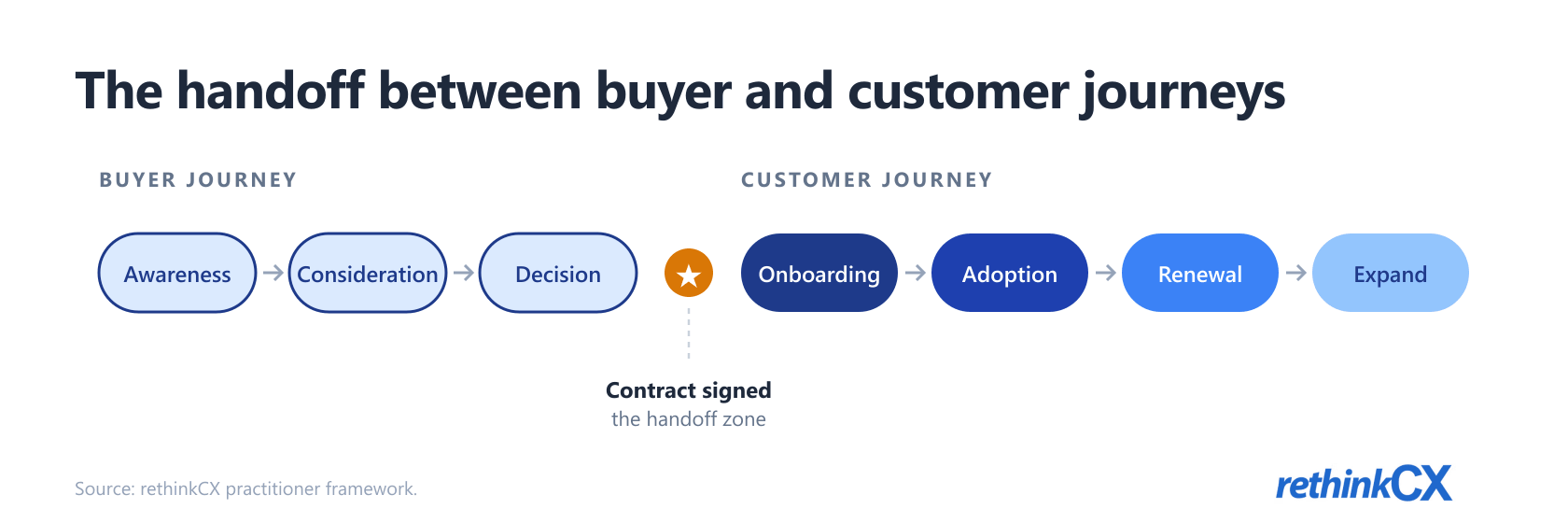
Here's the difference in one sentence: the buyer journey ends when the contract is signed, and the customer journey is everything that happens next.
Almost every other framing of "buyer journey vs customer journey" turns the question into a definitional swamp. It isn't. The two journeys share a single moment in time (the purchase) and diverge sharply on every operational dimension that matters: who's involved, who owns it, how it's measured, what good looks like. Treating them as one journey is the most common operating-model mistake I see in mid-market B2B, and it concentrates risk in the precise transition point where most revenue quietly leaks.
This post is the short version. If you want the fuller treatment of mapping either journey end-to-end, our step-by-step customer journey mapping guide is the pillar — this post is its sub-pillar on a single, common confusion.
The two journeys, side by side
| Dimension | Buyer journey | Customer journey |
|---|---|---|
| Time horizon | First problem awareness → contract signed | Contract signed → renewal, expansion, advocacy (or churn) |
| Audience | Prospects, evaluation committees, economic buyers | Onboarding teams, daily users, executive sponsors, support requesters |
| Stages | Awareness → consideration → decision | Onboarding → adoption → value realization → renewal → expansion |
| Internal owner | Marketing (top of funnel) → Sales (MQL onward) | CX / Customer Success → Support |
| Primary KPIs | Conversion rate, win rate, sales cycle length, CAC | Time-to-value, NPS, gross retention, net revenue retention, expansion ARR |
| Tooling | CRM, marketing automation, attribution platform | Product analytics, CS platform, ticketing, NPS / CSAT |
| What "good" looks like | A signed contract at predicted ACV | A renewed contract at expanded ACV, with referenceable advocacy |
| Failure mode | Pipeline gap, low close rate, long cycles | Activation failure, silent disengagement, surprise churn |
The dimensions don't overlap. The owners don't overlap. The systems don't overlap. The only shared element is the customer record — and even that is often two records (a Lead in CRM, an Account in CS tooling) that have to be deliberately stitched.
The handoff cliff: where revenue actually leaks
The most expensive 30 days in any B2B subscription business are the 30 days immediately after closed-won. This is the handoff zone, where the buyer journey ends and the customer journey is supposed to begin. In failed deployments, no one explicitly owns it. Sales believes the deal is done; CS hasn't met the customer yet; the customer is sitting on a contract they signed and a product they haven't logged into.
The pattern across every B2B subscription business I've watched is the same. A deal closes Friday. The AE celebrates. The CSM gets a Slack notification Monday. Onboarding starts Wednesday — 12 days after the contract was signed. By then the executive sponsor who championed the purchase has moved on to the next priority and the implementation team that was supposed to drive adoption is wondering why nobody's reached out yet. The relationship is already cooling and CS hasn't taken its first action.
This is the operational gap a merged journey map hides. When the buyer journey and the customer journey are treated as one continuous flow, "post-purchase onboarding" looks like the next bullet in a slide deck. When they're treated as two journeys with a designed handoff, the transition becomes a workstream of its own, with named owners, an SLA, and a measurable health check.
The strategic stakes are real. Gartner's research on B2B buying complexity has consistently found that purchase decisions involve large groups of stakeholders with overlapping interests, and that the post-purchase phase determines whether that group becomes references or regrets. Gartner's published B2B buying analysis frames the modern B2B buying journey as non-linear and increasingly digital, which makes the handoff into the customer journey even more consequential, because the buyer's mental model of the product was formed mostly without a salesperson present. Forrester's 2025 Global CX Index reinforces the same lesson from the customer-journey side: brands whose CX scores declined year over year did so largely because post-purchase experience deteriorated, not because acquisition got worse.
The B2B truth nobody puts on the slide: the buyer is not the user
In B2B SaaS, the person who signs the contract is rarely the person who logs in every day. The economic buyer (a VP, a director, sometimes the CFO) is solving a budget problem. The daily user (an analyst, a manager, an individual contributor) is solving a workflow problem. They have different personas, different success criteria, and different definitions of "this product is working."
A merged buyer-and-customer journey map flattens this distinction. It treats "the customer" as a single persona moving through a single funnel, when in operational reality there are at least two and often three or four people on the customer side, each in a different stage of their own relationship with the product. The buyer is at the "did I make the right call?" stage. The user is at the "am I going to figure out how to use this thing?" stage. The executive sponsor is at the "am I going to defend this when it's time to renew?" stage. Designing onboarding for one of them and ignoring the others is how you end up with a customer who looks engaged on the QBR slide and quietly disengages in the product.
McKinsey's research on B2B buying behavior underscores the same point on the buying side: successful B2B sellers engage multiple decision-makers in parallel rather than treating the deal as a linear path through one champion. The same multi-persona discipline has to extend into the customer journey post-purchase, or the activation work falls into the gap between buyer and user. Some of the operational mechanics of doing that well are covered in our piece on personalization at scale across customer journeys, where the persona-routing question shows up in concrete tooling form.
Different KPIs, different owners
The buyer journey and the customer journey are measured against different metric families that should not be averaged together.
Buyer journey metrics are velocity metrics. They measure how fast a prospect moves through the funnel and what fraction make it to the next stage. They report up to a CRO or VP of Sales. They reward speed and conversion. The team that owns them is structurally optimized to close deals and move on.
Customer journey metrics are durability metrics. They measure how long the customer stays, how much they expand, and how loyal they become. They report up to a Chief Customer Officer, VP of CX, or VP of Customer Success. They reward depth and retention. The team that owns them is structurally optimized to nurture relationships over years. The economic case for funding this side of the house is well-established: Bain & Company's foundational analysis on retention economics found that a 5% lift in retention can drive 25% to 95% increase in profit depending on the business model — a multiple no buyer-journey investment can match at the same scale.
When organizations merge the two functions or roll the metrics into a single dashboard, two things break. The velocity metrics dominate executive attention because they're more legible and move faster, so the customer journey work gets quietly underfunded. And the customer journey owners start optimizing for short-cycle metrics they can influence in a quarter (NPS, ticket SLA) rather than long-cycle metrics that determine the actual economic outcome (net revenue retention, expansion ARR). Both functions get worse. The fix isn't reorganization. The fix is keeping the metric families separate and only merging at the executive scorecard layer where total customer LTV-to-CAC ratio matters. Anything more granular than that should live in two views with two owners.
The same principle of measurement separation shows up in adjacent CX work. Our 22 customer service KPIs guide breaks down the metrics that belong specifically to the post-purchase stages, none of which are useful in evaluating the buyer journey. Conflating them is how dashboards become noise.
How to wire the two journeys together without flattening them
The framing in this post is "two journeys, not one." But the two journeys obviously have to connect. The question is how to design the linkage without losing the distinction. Three things matter.
A shared persona system. The buyer persona and the user persona should both live in the same persona library, with explicit notes on how they map to each other within a target account. If your buyer persona is "VP of Operations" and your user persona is "Operations Analyst," the persona library should name both and describe the relationship. Most companies have one persona document (the marketing one), and CS quietly invents its own informal personas in onboarding playbooks. That's how the two journeys drift apart.
A named handoff event. Pick the moment that defines the boundary, name it, and instrument it. For enterprise B2B, the handoff event is usually contract execution. For self-serve SaaS, it's first product activation. For PLG with a sales-assist motion, it can be either. Whatever it is, every system on both sides of the boundary (CRM, CS platform, product analytics, support tool) should fire on the same event and use it as a synchronization point. Without a named event, "handoff" is a meeting on a calendar that gets rescheduled. With one, it's a workflow.
Overlapping ownership for 30 to 90 days post-handoff. The cleanest handoff is not a clean handoff. The AE who closed the deal should remain on the account for the first 30 to 60 days alongside the CSM who's taking over. The customer experiences a continuous relationship instead of being passed across an organizational seam. The internal cost is one extra meeting per account; the avoided cost is the silent disengagement that the cliff produces. For the broader operating-model implications of doing this well, our digital customer journey optimization piece covers the toolset side of the same question.
A small operational detail worth naming: the handoff is also the moment churn risk modeling becomes possible. The accounts that disengage in the first 90 days are the ones that show up in the predictive customer churn prediction pipeline a year later. Catching them early starts at the handoff, not at the renewal warning.
What a designed handoff actually looks like
The shorthand version of a working handoff: an internal kickoff meeting between AE and CSM during the contract negotiation phase (not after closed-won), a customer-facing kickoff within 5 business days of contract signing, a 30-60-90 day onboarding plan agreed with the customer in writing, an explicit time-to-value target, and a check-in cadence shared by both sides until the AE drops off at day 60.
That's it. None of this is novel. What's notable is how rare it is in practice. Most mid-market subscription teams have some version of this on paper and almost none of them execute it consistently. The reason is structural: the buyer journey owners (sales) are compensated to move on, and the customer journey owners (CS) are compensated to keep accounts they may not have fully met yet. The overlap costs both teams something in the short run. Without an explicit operating-model decision to fund the overlap, it doesn't happen.
The teams that do it well treat the handoff as the most important workstream in the post-sale window: more important than QBR design, more important than feature adoption tracking, more important than expansion playbooks. Because all of those depend on the handoff working. If the customer doesn't activate cleanly in the first 90 days, no QBR rhythm is going to recover them. The teams that benchmark this part of their operating model usually do it through the CX Maturity Assessment, which surfaces the handoff seam as a specific dimension rather than burying it inside generic "onboarding" scoring.
For the upstream retention thesis these mechanics plug into, our customer loyalty playbook covers the strategic frame, and the omnichannel customer service guide maps the support-channel layer that the customer journey runs through after handoff.
The single line to take away
The buyer journey is about turning a prospect into a customer. The customer journey is about turning a customer into a renewal, an expansion, and eventually an advocate. Conflating them is how mid-market B2B teams end up over-investing in pipeline and under-investing in the moment that determines whether the pipeline was worth building.
If you want help designing the handoff and the customer journey behind it, that's the work covered in our customer journey mapping advisory. The buyer journey side is owned upstream by marketing and sales — the customer journey side is where most of the recoverable revenue actually lives, and it's the half most B2B operating models systematically underfund.