
An AI customer service agent is software that resolves a customer's request end to end. It reads the message, decides what to do, takes the action in your systems, a refund, an address change, an account reset, and closes the ticket without a human. That is the distinction that matters: a chatbot answers, a copilot assists a person, an autonomous agent owns the resolution.
The technology is no longer the hard part. The hard part is whether your data and systems can feed and act on a request, and most still can't. An agent that can't see your order system can't tell a customer where their package is, and one that can't write to it can't cancel anything. Buy the model before you fix that, and all you've built is a more expensive wall between customers and the help they came for.
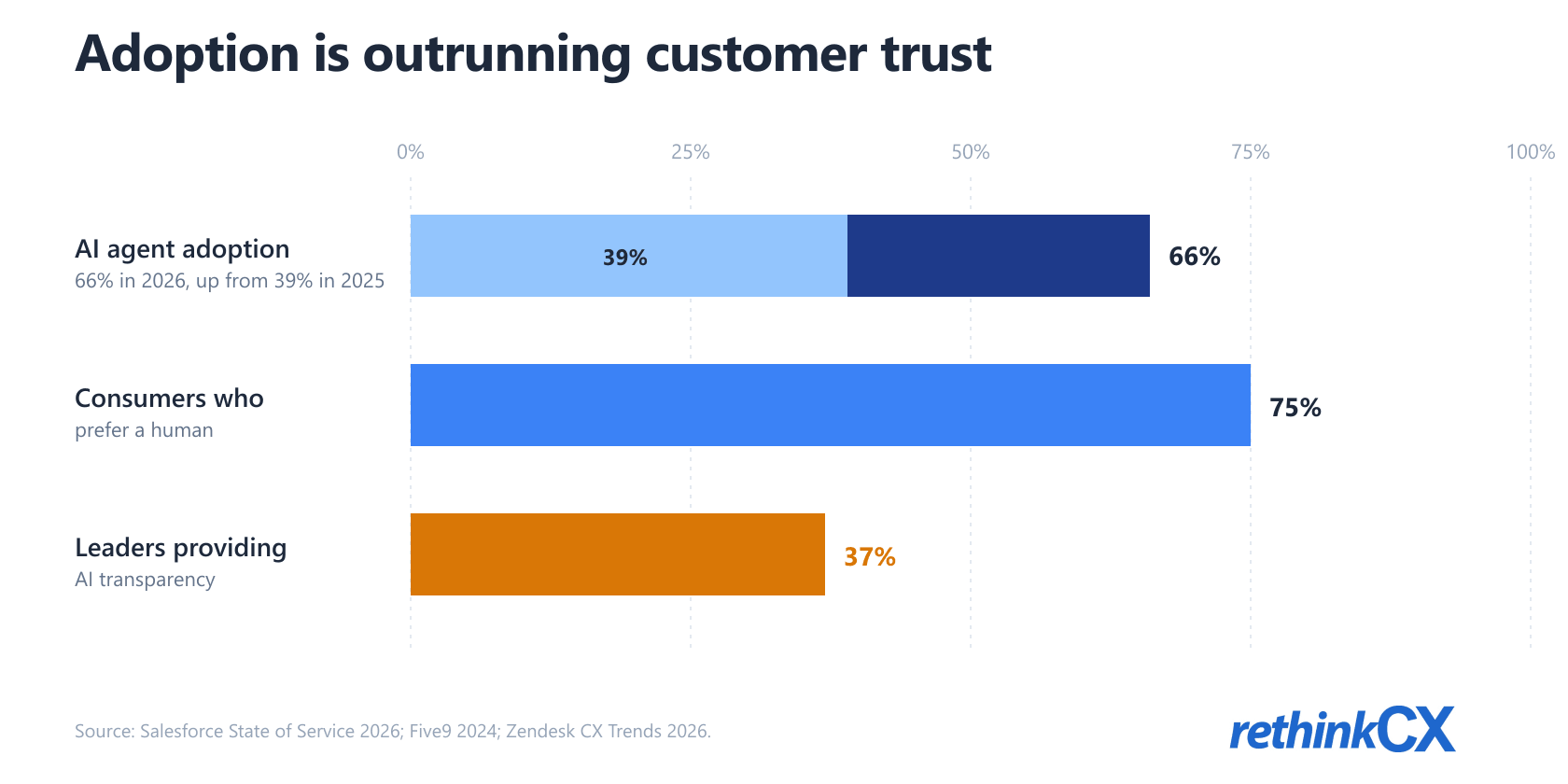
This guide draws the three tiers cleanly, gives the cost math the product pages leave out, and maps the vendors actually building these systems, from well-funded standalones to the platform incumbents buying their way in. Adoption is moving fast. Salesforce's 2026 State of Service report found AI-agent use in service jumped from 39 to 66 percent in a single year. Whether a deployment works or quietly fails comes down to the same thing, and it isn't the vendor.
What an AI customer service agent actually is
Strip away the marketing and an autonomous agent does three things a chatbot never could: it reasons over an open-ended request, it acts on that request across your systems, and it owns the outcome. Ask a chatbot to change a delivery address and it hands you a help article. Ask an agent and it verifies the order, checks whether it has shipped, updates the address if it can, and tells you plainly when it can't. The verb is the giveaway. Chatbots answer; agents do.
It sits at the far end of the broader conversational AI category, past the scripted bots most customers remember from 2020. What makes the 2026 version different is the combination of a large language model for understanding, retrieval for grounding answers in your actual policies, and a set of tools, the API calls and system permissions, that let it act rather than just talk. Remove the tools and you're back to a chatbot with better grammar. The reasoning is impressive, but it's the connection to your systems that turns reasoning into resolution, which is exactly where most of the difficulty, and most of the failed projects, actually live.
Chatbot, copilot, or autonomous agent: the three tiers
The single most expensive confusion in this market is treating "AI in support" as one thing. There are three tiers, and the difference between them is who is in control of the resolution.
| Tier | What it does | Who resolves |
|---|---|---|
| Chatbot | Answers from a script or knowledge base | Nobody acts; it deflects or routes |
| Copilot | Drafts replies and surfaces context | A human, faster |
| Autonomous agent | Reasons, acts, and closes the ticket | The AI, end to end |
A scripted chatbot follows a decision tree and stops at the edge of its script. An agent-assist copilot sits behind a human agent, drafting responses and surfacing the right knowledge while the person stays in control, and it's the one form of AI in service that reliably moves handle time without denting satisfaction, typically a 15 to 25 percent reduction. An autonomous AI customer service agent is the only tier that resolves on its own.
These are not stages every team should march through, they're different tools for different risk profiles. The copilot is the low-risk play: it can't issue a wrong refund because a human approves every action. The autonomous agent carries more upside and more risk, because it acts. The reason the "ai customer service agent vs chatbot" question gets asked so often is that vendors blur the line, selling a chatbot's capabilities under an agent's name. The clarifying question for any demo is simple: show me the agent take an action in a real system, not answer a question. If it can only answer, you're looking at tier one with better marketing.
How an autonomous agent actually works
Under the hood, an autonomous agent runs a loop that's easy to name and hard to operate well: perceive, reason, act. It perceives the request and the context it can pull from your systems, reasons about the steps to resolve it, takes an action, then observes the result and decides whether it's done or needs another step. A refund request becomes: read the order, confirm eligibility against policy, issue the refund through the billing system, confirm to the customer.
Four components make that loop possible, and a weakness in any one breaks it. The language model handles understanding and planning. A retrieval layer grounds the agent in your real policies and product data so it isn't inventing answers. A set of tools and permissions lets it call your systems and write changes. And an orchestration layer manages multi-step flows and decides when to escalate. The model gets the attention, but in practice the retrieval and the tools are what separate an agent that resolves from one that confidently hallucinates a policy that doesn't exist. That failure mode is why grounding and tightly scoped permissions matter more than raw model horsepower, and why the best deployments spend most of their effort there rather than on prompt cleverness.
What they actually deliver: the resolution-rate reality
Here's the honest version of the performance story, because the headline number and the shipping number are not the same. Gartner forecasts that by 2029, agentic AI will autonomously resolve 80 percent of common customer service issues and cut operational costs 30 percent. That's the ceiling, and it's three years out. The floor today is roughly half that. Intercom's published Fin data puts out-of-the-box resolution near 51 percent, climbing to 65 percent and higher only after real customization on a specific company's data.
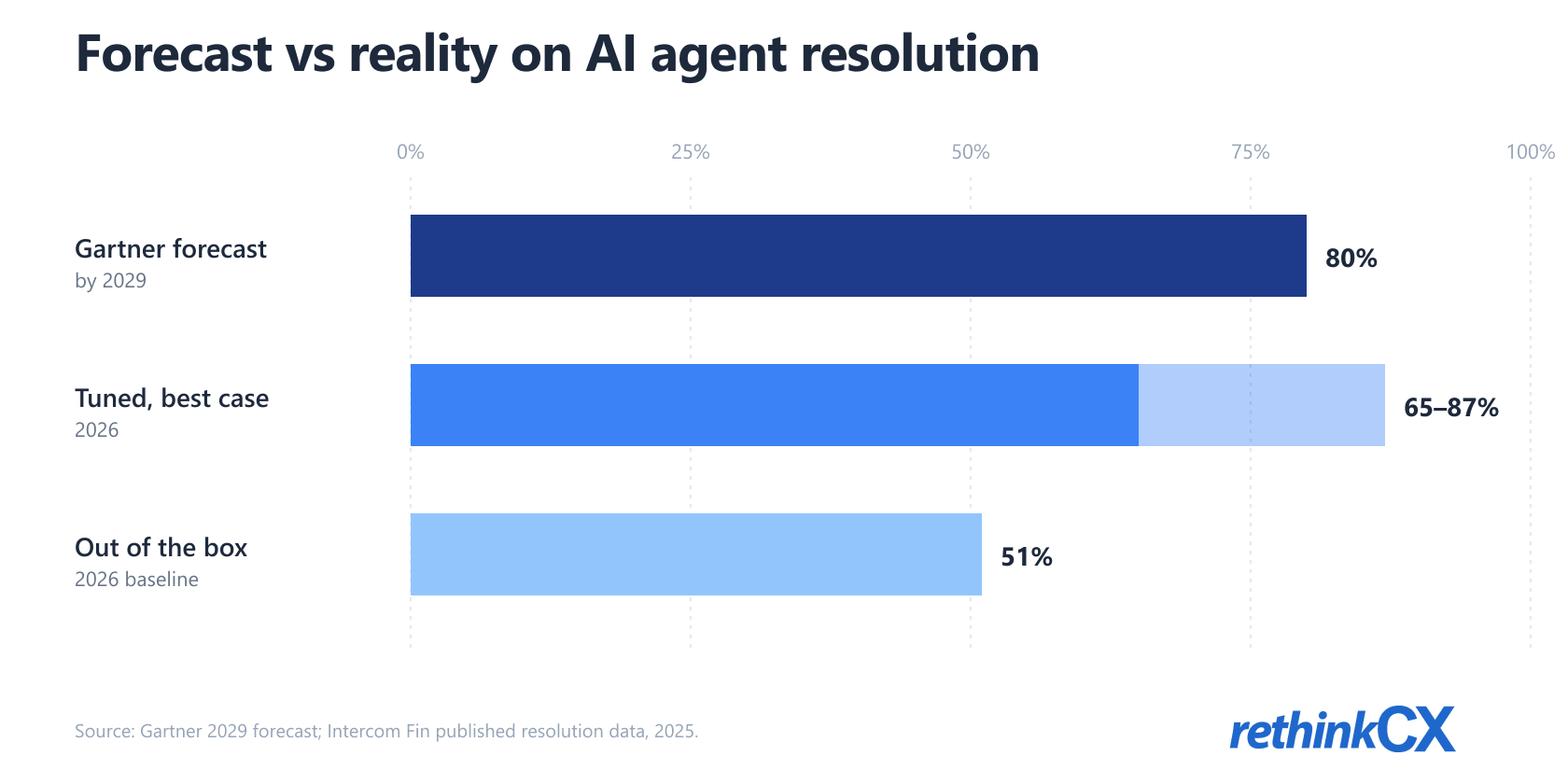
The gap between 51 and 80 isn't a vendor problem, it's a readiness problem. The agents that hit the high end of the range are deployed on clean data, narrow intents, and well-defined actions. The ones stuck at the low end were pointed at the whole messy queue and asked to figure it out. So the realistic 2026 benefit isn't 80 percent of everything. It's end-to-end resolution on the routine, structured slice of your volume, 24-hour coverage without staffing a night shift, and consistent policy enforcement, with a human team that shrinks rather than disappears. Plan the business case around the floor you can verify in a pilot, not the forecast on the vendor's slide.
The honest cost math
The claim that AI agents are simply cheaper than humans is true right up until it isn't. Pricing has moved to outcomes, so you mostly pay per resolved ticket, roughly $0.50 to $2.00 depending on the vendor and the ticket, with platform fees on top. On high-volume, simple intents, that math crushes a human agent's fully loaded cost, and the first-response and resolution-time gains are real on top of the savings.
Then complexity enters and the curve bends. A hard ticket might take the agent several reasoning steps, multiple model calls, and a few tool actions, and each of those costs money. Gartner projects that GenAI cost per resolution will exceed $3 by 2030, higher than many offshore human agents. That doesn't make agents a bad deal. It means the savings concentrate on the routine band and can invert on the long tail, which is the opposite of the "deploy it everywhere to cut costs" pitch. The teams that win on cost automate the simple, repetitive volume aggressively and deliberately keep humans on the complex tail, where a person is both cheaper and better. A custom build starts around $15,000, mid-market tools run $500 to $2,000 a month, and none of those numbers mean anything until you know which slice of your tickets the agent can actually close.
The real reason agents fail: your data, not the model
Most AI agent projects don't fail on the model. They fail because the organization treated its data as a second-class problem, and the agent inherited the mess. An agent is only as capable as the context it can reach and the actions its systems permit, and in most companies both are weaker than anyone wants to admit.
I watched a version of this years ago, well before the current generation of models. We tried to let a self-service bot answer order-status questions in live chat. It couldn't, because the order-management systems didn't talk to each other and the platform the bot lived on wasn't connected to any of them. The bot had nothing to read, so it deflected customers in circles. Push the idea one step further, to canceling an order or changing it, and the problem gets worse: the underlying systems often don't permit the action at all. That isn't a technology problem, it's an organizational one. Data gets treated as something to clean up eventually, and "eventually" turns into a runaway train, because the more data accumulates across disconnected systems, the harder it is to ever get under control.
This is the part the product pages skip, and it's the whole game. A human agent papers over bad systems with judgment, thinking their way around a process that doesn't quite work. An AI agent can't improvise around a permission it doesn't have or data it can't see. So when the systems can't supply context, the agent becomes a barrier, a gate the customer has to defeat to reach a person who can actually help, which is exactly why so much "self-service" makes people furious. Five9's 2024 consumer study found 75 percent of consumers still prefer a real human for support, and bad self-service is a large part of why. The trust gap shows up in the operators too: Zendesk's 2026 CX Trends report found 80 percent of CX leaders say transparency about AI is essential, while only 37 percent actually provide the reasoning behind it.
The principle I'd anchor every decision to is this: be where the customer wants you to be, and don't add AI for its own sake. Nobody spends their money intending to contact support. Something already went wrong in the journey to trigger the conversation, so treating that moment as a gate to be defended is exactly backwards. Look at Uber, which refunds an order the instant a customer says it didn't arrive. It isn't an AI showcase, but it's the right instinct: you made a mistake, you fix it, fast, without friction. That's the bar autonomous agents should clear, and the ticket classes where they can't, regulated workflows, fraud and account recovery, high-emotion service recovery, and anything novel, are the ones to keep with humans on purpose. Knowing where AI actually adds value across CX is mostly knowing where it doesn't.
How to deploy one without building a barrier
A deployment that respects all of the above is unglamorous and sequenced. The order matters more than the vendor.
-
Audit your data and systems first. Map what the agent would need to see and do, and check whether your systems can actually supply it. If the order system isn't connected or won't permit a cancellation, fix that before you shop for a model. Running a CX maturity assessment here is cheaper than discovering the gap in production.
-
Start in shadow mode. Let the agent draft resolutions it isn't allowed to send, and compare them against what your human team actually did. This gives you a real accuracy baseline on your own tickets, not the vendor's benchmark, before a customer sees anything.
-
Automate low-complexity, high-volume intents first. Pick two or three repetitive, structured, low-risk intents like order status or password resets. Prove the agent there, where a wrong answer is cheap, and expand only once it holds.
-
Expand action scope deliberately. Move from reading to writing one permission at a time. Issuing a refund carries real consequences, so add each action with guardrails, limits, and an audit trail, and confirm the system supports it cleanly first.
-
Design the escalation and handoff. Decide when the agent steps back and make sure it passes the full transcript and context to a human. A handoff that forces the customer to start over is worse than no agent.
-
Measure resolution quality, not deflection volume. Deflection counts a customer who gave up as a win. Track genuine resolution, repeat-contact rate, and CSAT on agent-handled tickets, using the support metrics worth tracking rather than a vanity deflection number.
The vendor landscape: who's actually building these
The market splits into three honest buckets, plus a hybrid worth knowing about. No single-vendor "best" list survives contact with your specific stack, so match the bucket to your buyer type and integration depth.
Standalone best-of-breed agents are helpdesk-agnostic pure-plays. Sierra, co-founded by former Salesforce co-CEO Bret Taylor, is the best-funded of all, valued near $15.8 billion in 2026, with horizontal enterprise agents that take independent actions. Decagon, valued at $4.5 billion, runs multi-channel concierge agents and points to Chime cutting support cost more than 60 percent and Duolingo deflecting over 80 percent. Ada is the established incumbent, repositioned from chatbot to reasoning engine. Maven AGI, Lorikeet, and Gradient Labs round out the group, with Lorikeet and Gradient deliberately targeting complex and regulated work where the action permissions are hardest.
Voice-first contact-center platforms lead with the phone. Parloa, valued at $3 billion, is the best-funded here, agentic across voice and chat for enterprises like Decathlon. Cognigy, now part of NiCE after a roughly $955 million acquisition, brings the deepest enterprise voice and omnichannel story, with customers like Lufthansa and DHL.
Platform-native agents live inside a suite you may already run. Salesforce Agentforce is the scale leader, reaching $1.2 billion in ARR and grounding resolution in CRM data. Intercom Fin resolves end to end at outcome-based pricing and deploys both native and standalone, and Salesforce is acquiring it for $3.6 billion. Zendesk built its agents largely through acquisition, absorbing Ultimate and then Forethought in 2026. Gladly Sidekick targets retail and DTC brands on a people-centered platform.
The outlier is Crescendo, a hybrid that pairs autonomous AI with an embedded human workforce and runs the whole contact center, pricing on outcomes rather than headcount. The throughline across all of it is consolidation. Cognigy went to NiCE, Forethought to Zendesk, Fin to Salesforce, and the standalone field is narrowing fast as incumbents buy the capability rather than build it. For a buyer, that means betting on a small standalone now carries acquisition risk, while a platform-native agent carries lock-in risk. Neither is wrong, but the tradeoff should be a conscious one.
What I'd do differently
If I were standing up an AI customer service agent today, I'd spend the first month on data and systems, not vendors. The model you choose is nearly interchangeable next to whether your agent can see an order and act on it. That's where the resolution rate is won or lost, and it's the work everyone wants to skip.
I'd deploy for consistency and coverage on the right intents, not for blanket cost savings, because the savings story falls apart on complex tickets and the CSAT risk is real when an agent becomes a wall. I'd start narrow, run shadow mode honestly, and measure resolved customers rather than deflected ones. And I'd keep humans firmly on the cases where judgment beats automation, treating that not as a failure of the AI but as the design.
The companies getting this right aren't the ones talking the most about AI. They're the ones who did the unglamorous work of connecting their systems first, so the agent has something real to reason over. If you're weighing where to invest before you automate, that diagnosis is the heart of CX technology advisory, and it's a far better use of the first quarter than a vendor bake-off. Be where the customer wants you to be, fix what went wrong without friction, and let the AI handle the volume it can genuinely own. That's the version of this that customers actually thank you for.