
Conversational AI in healthcare is software that uses natural-language processing to handle patient and clinical conversations: booking appointments, answering insurance questions, triaging symptoms, and drafting clinical notes. It ranges from simple chatbots to voice agents to ambient scribes. It works well for high-volume administrative work. Where it fails is predictable, and it fails hardest exactly where healthcare is most sensitive.
Here is the part the vendor demos skip. The model is almost never the hard part. Whether one of these systems helps a patient or just frustrates them is decided long before you pick a vendor, by two things: whether your data can actually support the conversation, and whether you have guardrails for the moments the model gets it wrong. Buy the smartest model in the category, feed it nothing but the FAQ already sitting on your website, and you have built an automated FAQ. Nobody wanted the FAQ. If self-service FAQs worked, we would all have been self-serviced years ago.
The category is growing fast. Grand View Research puts it on a compound annual growth rate near 25% through 2030, though the dollar estimates swing wildly depending on where you draw the category line. Growth isn't the interesting question. What matters is what these systems actually do, how far they can safely go, what "HIPAA-compliant" really requires, where they break, which vendors do which job, and the payoff that has nothing to do with cutting support costs.
What conversational AI in healthcare actually is (and isn't)
Strip away the acronyms and there are three things people mean when they say conversational AI, sitting on a spectrum of how much the system decides on its own.
A chatbot follows scripts, matching your question to a predefined answer. It's useful but limited, honestly closer to a search box than to intelligence. Conversational AI proper understands natural language, holds a flexible exchange, and increasingly runs on a large language model that can handle phrasing it has never seen. This is the same core technology behind conversational AI for customer service in any industry; healthcare is the vertical that raises the stakes on getting it right. Agentic AI goes one step further and completes multi-step tasks without being walked through each one, like taking a patient-access request and working it across scheduling, eligibility, and records on its own.
The distinction matters because the risk scales with the autonomy. A scripted FAQ bot that gives a wrong answer is annoying; an agentic system that takes a wrong action on a patient's record is a different category of problem entirely. More autonomy isn't automatically better. It earns its place only when the data and the oversight underneath it can carry the weight.
What it can do, by data and risk
The most useful way to think about conversational AI in healthcare is not a list of features. It is a ladder, where each rung asks more of your data and carries more risk if it fails.
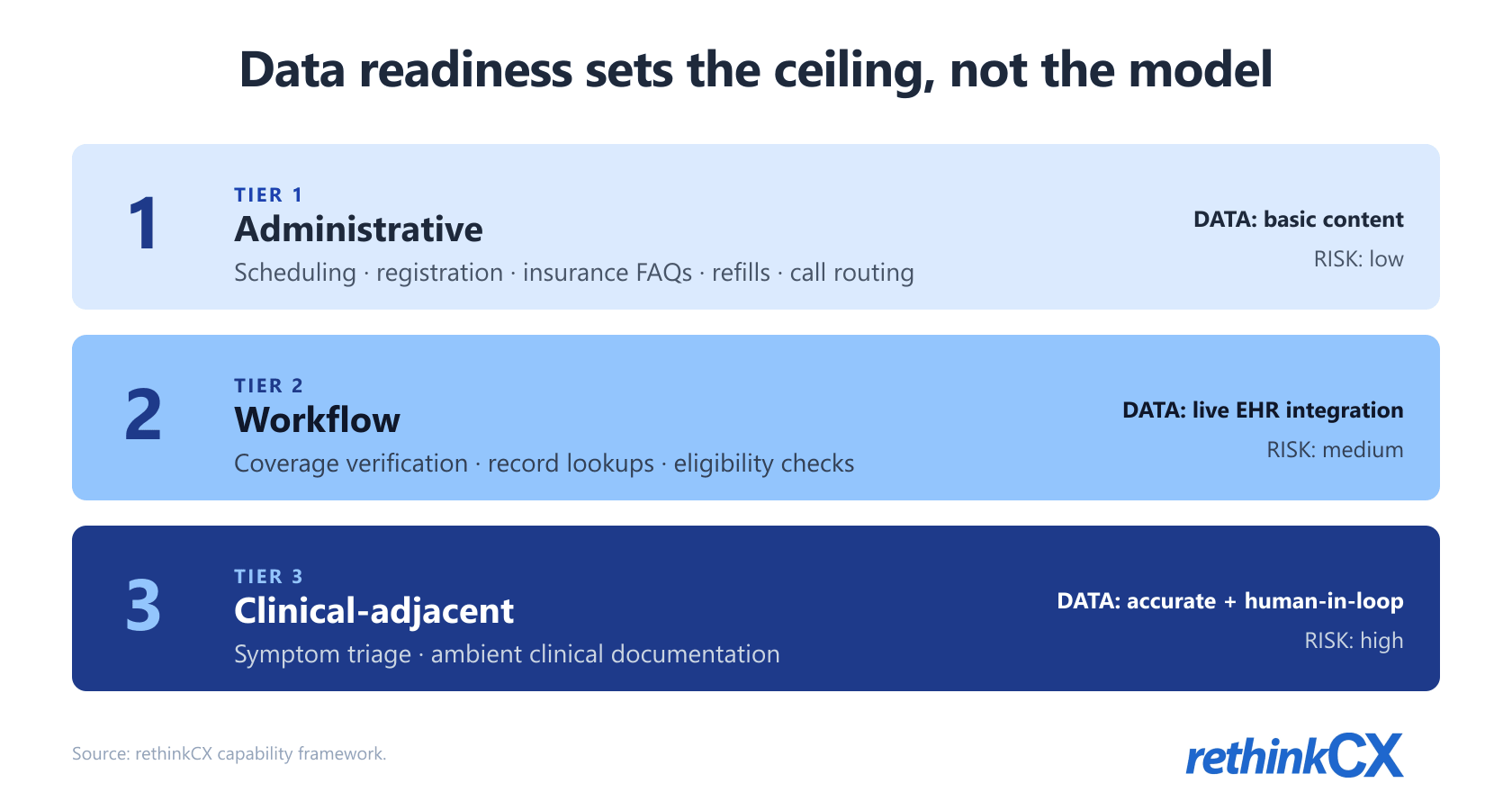
Tier one is administrative. Appointment scheduling, patient registration, insurance and billing questions, prescription refill requests, physician lookup, after-hours routing. This is where conversational AI earns its keep with the least risk. The questions are high-volume and mostly deterministic, the data needed is limited, and a wrong answer is recoverable. If you deploy nothing else, deploy here. Most of the value in the category lives on this rung.
Tier two automates workflows that need live data. Verifying a patient's specific coverage, checking whether a referral is on file, confirming a particular appointment. This is where deployments start to separate. The system now has to reach into your real systems and act on what it finds, which means it needs genuine integration, not a knowledge base of generic answers. When teams tell me their bot "doesn't really do anything useful," this is almost always the rung they stalled on.
Tier three is clinical-adjacent. Symptom triage, and the fast-growing use case of ambient documentation, where a system listens to a visit and drafts the clinical note for the physician to review and finalize. The upside is real. Clinicians spend a large share of their day on documentation, and taking that load off is worth a lot. But this rung demands accurate data and a human in the loop by design, because the cost of a confident error is a clinical one.
How far up this ladder a deployment can climb is set by your data and your guardrails, not by the model. Give a brilliant model nothing but tier-one data and all you get is a very smart FAQ.
The real gate is your data, not the model
If there is one thing I could carve into every healthcare AI project before it starts, it is this: it is always the data, never the model. In the deployments I have watched underdeliver, the failure almost never traced back to the model being too weak. It traced back to the model having nothing real to work with.
A conversational system with no access to your data cannot genuinely help anyone. It cannot personalize, it cannot check a fact specific to the person in front of it, and it cannot do anything a static webpage couldn't already do. The classic bad implementation is a health system that feeds the AI the FAQ content already on its website and calls it a deployment. What they have built is an automated FAQ with a chat interface. Patients don't care about FAQs, which is exactly why they were calling instead of reading the website in the first place.
The good version requires connecting the system to where your patient data actually lives, through the AI agents that resolve tickets end to end approach: real integration with the electronic health record, scheduling, and eligibility systems, using healthcare data standards like FHIR and HL7. That integration is the expensive, unglamorous, decisive part. It is also why two health systems can buy the identical platform and get wildly different results. One connected it to live data. The other pointed it at a content library.
It's the same lesson that shows up wherever AI co-pilots for agents get deployed in a contact center. The model is a commodity; what separates a system that helps from one that doesn't is the data plumbing beneath it and the investment a company is willing to put in.
HIPAA, past the hand-wave
Most writing on this topic says "choose a HIPAA-compliant platform" and moves on. That sentence is close to meaningless, so here is what it actually involves.
HIPAA compliance is not a property the software has. It is a property of how you deploy it. Three things carry most of the weight. First, a Business Associate Agreement (BAA): a contract, described in the HHS guidance on business associate agreements, that a vendor must sign before it is allowed to touch protected health information, limiting how it may use that data and requiring it to safeguard it. No BAA, no PHI. That single rule disqualifies most consumer chatbots out of the box.
Second, and this is the line vendors are least clear about: your patient data must not be used to train the underlying model. Feeding PHI into a general model that learns from it is, in most configurations, outside what a BAA permits without explicit authorization. If a vendor cannot tell you plainly that your data stays out of their training pipeline, that is your answer.
Third is the ordinary but non-negotiable work of encryption, access controls, and knowing which subprocessors sit behind the vendor and touch the data. None of this is exotic. It is just the part that "choose a compliant platform" quietly skips, and it is the part that determines whether your deployment is actually safe or just labeled that way.
Where it fails, and what 2026 taught us
The honest risk conversation is not "accuracy could be better." It is that fluent, confident wrongness is the default failure mode of these systems, and healthcare is the worst place for it.
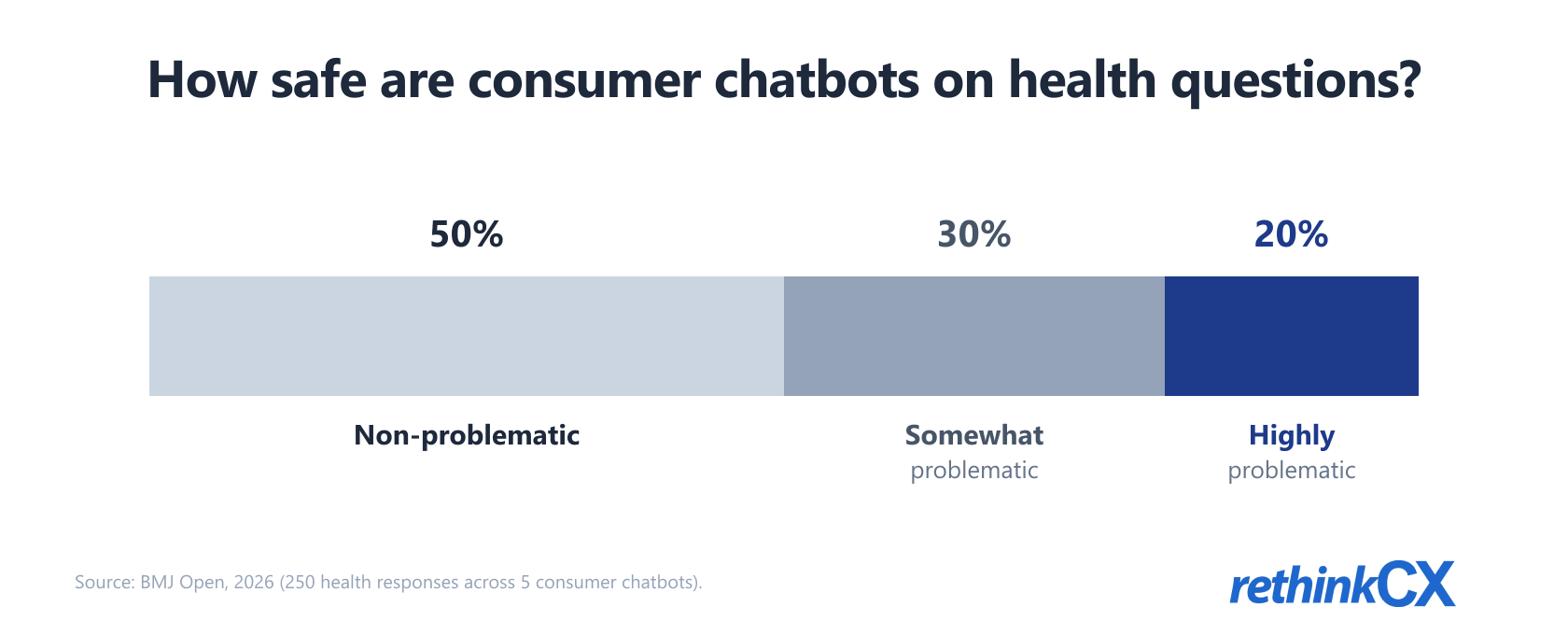
The clearest recent evidence is blunt. A 2026 audit published in BMJ Open tested popular consumer chatbots on health questions and found half of the responses were problematic: 30% somewhat, 20% highly. The reference quality averaged 40%. Read that correctly, though. It tested general-purpose consumer assistants, not purpose-built clinical systems. The takeaway is not "AI can't do healthcare." It is that the raw model, on its own, is not clinical-grade, which is the entire argument for grounding it in verified data and putting a human on the high-stakes output.
That last point is where the regulators have landed too. In its January 2026 revision to clinical decision support guidance, the FDA actually eased oversight on lower-risk tools, while keeping the important line intact: software that presents information for a clinician to review and finalize sits in a different category than software that makes the call itself. The human-review-and-finalization step is what keeps a tool on the safe side of that line.
None of this means the technology is untrustworthy. It means the trust has to be engineered rather than assumed. The conventional wisdom frames the exposure as accuracy, but the real exposure is accountability: when the system is fluent and wrong, who owns the answer? Build the deployment so that on anything clinical, the answer is always that a qualified person did.
The vendor landscape, by job to be done
The single most useful thing I can tell a buyer is that the vendors building conversational AI for healthcare are not one market. They do different jobs, and comparing them on one axis is how procurement decisions go wrong. Group them by the job first.
Patient access and contact center. These systems handle the front door: scheduling, FAQs, physician lookup, refills, call routing across voice and chat. Vendors here include Hyro, whose pitch is an adaptive system that pulls answers from your existing content without manual intent training; Talkdesk, with a healthcare-specific contact center product line; and enterprise conversational platforms like Cognigy and Kore.ai that run patient operations across many channels. If your problem is call volume and access, this is your aisle.
Clinical documentation. A completely different job. Ambient scribes like Suki, Heidi, and Nuance DAX listen to the clinical encounter and draft the note, integrating with the EHR so the physician edits rather than types. The buyer here is usually a clinical leader worried about physician burnout, not a contact center manager worried about hold times.
A patient-access agent and an ambient clinical scribe are not competitors. They solve unrelated problems for different buyers. Put them in the same RFP scored on the same criteria and you will pick badly. For organizations weighing this against simply adding trained human capacity, the tradeoffs of healthcare customer service outsourcing belong in the same decision, because sometimes the right answer is people, not software.
The real ROI isn't cutting support costs
Here is the reframe that almost nobody in this category is willing to make, because it doesn't sell a per-seat license. The real return on conversational AI in healthcare is usually not the support savings. It is the outcome.
Start with cost, because it sets up the point. What a deployment costs depends almost entirely on your data. An organization built with clean, connected data from the start can stand up something genuinely useful quickly and cheaply. An organization with fragmented data, which is most of them, faces something bigger than a software purchase. It becomes a cultural shift, where you have to sort out your data before you can seriously talk about AI automation at all. The license is cheap; the data work is the real project.
But once the data is there, the payoff stops being about deflecting tickets. It becomes about what you can now see and act on. If your data can tell you a high-risk patient hasn't been in for a while, an AI system can reach out and get them booked. It can auto-invite the specific patients whose conditions make a given seminar relevant. In a payer or insurance context, that is preventative care, and preventative care doesn't save money by cutting a CX headcount. It saves money by keeping people healthier, which in healthcare means it can genuinely save lives. That is a different order of return than "we reduced call volume 20%," and it only exists if you did the data work first. Whether your data and operating model can carry that kind of move is answerable before you commission anything, and the CX maturity assessment scores the data-and-action side of it.
When not to deploy it
The metric that gets conversational AI approved is almost always the wrong one to judge it by. It is volume reduction, or average handle time, or some other efficiency number. And here is the uncomfortable truth: you can hit every one of those targets while making the patient experience worse.
I have watched this pattern play out the same way across organizations. Self-service gets deployed as a wall rather than a door. Leadership sees deflection climb and handle time drop and calls it a win. Meanwhile the patient is stuck in a loop, trying to get to a person, because their question was never the FAQ-shaped question the bot was built for. In healthcare this is more acute than anywhere else, because the questions carry more weight. "Where is my order" and "how do I return this" tolerate a bot. "Is this symptom serious" and "why was my claim denied" do not tolerate a wall.
So the rule is simple. If the deployment's real goal is to stop people from reaching you, don't. The outcome of a patient reaching an agent is the same whether or not you put a barrier in front of it, except now they are also frustrated. This is the difference between deflection and genuine assistance, and it is the same line we drew for where it fails in customer experience generally. Deploy conversational AI where it makes the outcome faster or better. Never deploy it purely to make yourself harder to reach.
Three things I'd do differently
If I were advising a health system standing up conversational AI today, three things would come before any vendor conversation.
Start with data, even if it feels too late. The data foundation only gets harder to fix as time goes on and more systems pile up. Every month you wait talking about AI before fixing data is a month the problem compounds. Fix the plumbing first, and the AI decision gets easy. Skip it, and no model saves you.
Think outcomes, not "digital." Patients want a seamless experience, not a technology. If your average patient is 70 years old, they do not care that your system is AI-integrated. What they care about is being taken care of. Lead with the outcome you want for the patient and let that decide whether digital is even the right tool, rather than starting from "we need an AI strategy."
Make the AI invisible. The best conversational AI in healthcare is the kind the patient never notices. If it is seamless enough that a person cannot tell whether a doctor, an agent, or an AI arranged their care, it works for every age and demographic at once. A patient will never care who took care of them, only that they were taken care of. Build for that, and the technology stops being the point, which is exactly where it should be.
If you are working through where conversational AI fits your operating model, our CX technology advisory and healthcare CX advisory start from your data and your patients, not from a platform.