

Healthcare customer service outsourcing is the practice of contracting a specialized vendor to handle patient or member interactions, such as scheduling, billing questions, benefits and eligibility, and telehealth support, under HIPAA-compliant controls. Done well, it adds round-the-clock multilingual capacity a single provider can't staff alone. Done on price, it hands protected health information to a vendor that treats it like any other ticket.
That second outcome is the avoidable one. It's tempting to treat healthcare customer experience outsourcing as a single decision with an obvious answer. It isn't one decision. It's two, and the thing that decides whether either one works is the criterion that's easiest to underplay: whether the vendor has actually run healthcare support before, with real protected health information, under real audit pressure. In a regulated vertical, that experience is the gate. Everything else is detail.
Member services or patient support: decide which one you're outsourcing
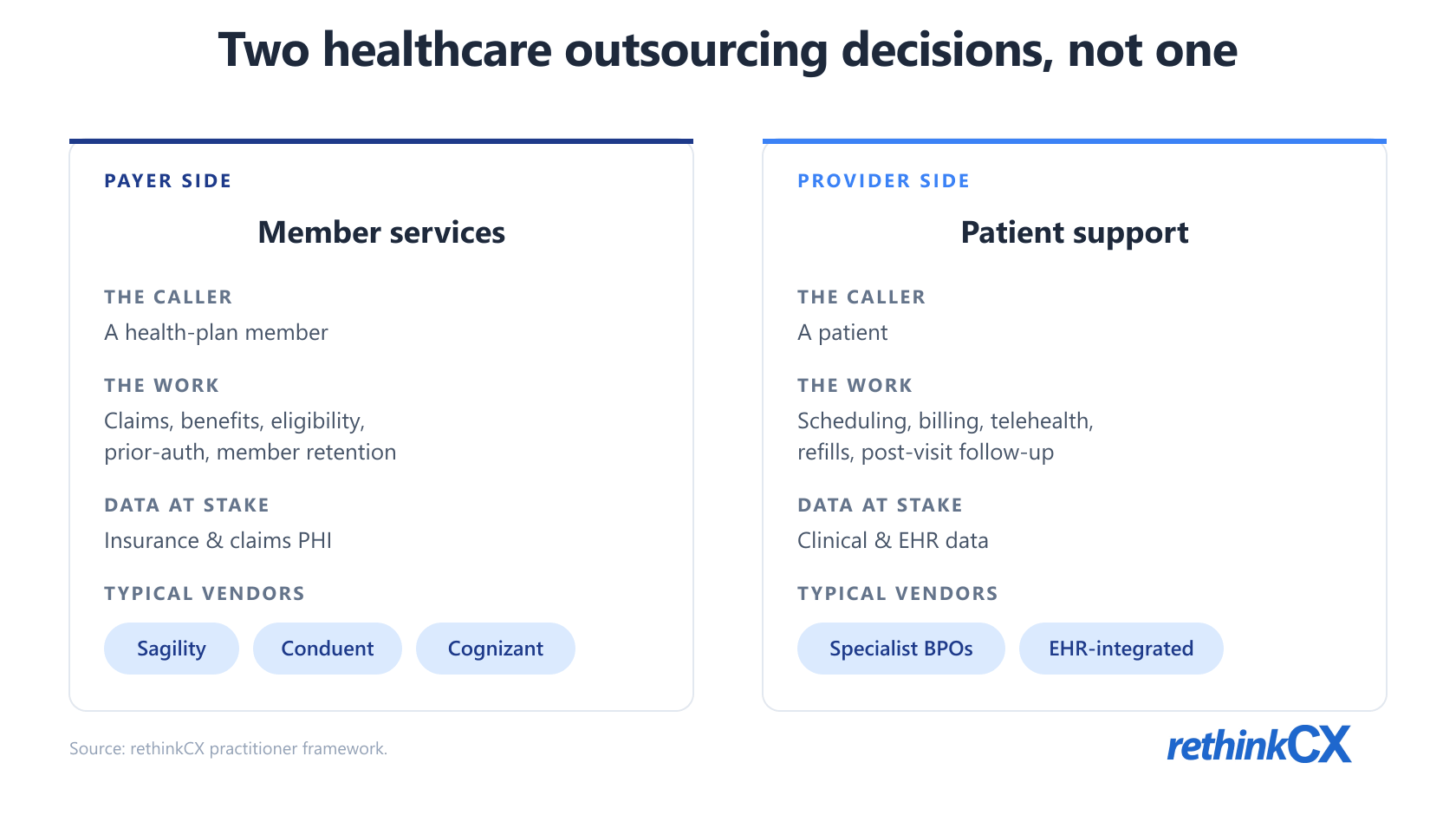
The phrase "healthcare customer service outsourcing" hides two different operations that happen to share a word.
What is healthcare member support outsourcing?
Healthcare member support outsourcing is payer-side work contracted to a specialist vendor: claims status, benefits and eligibility, prior-authorization questions, plan changes, and member retention. The caller is a member, the data is insurance and claims data, and the vendor pool skews toward large healthcare-BPO specialists like Sagility and Conduent that have built their benches around payer rhythms and AHIP-world compliance.
What is patient support outsourcing?
Patient support outsourcing is provider-side work contracted to a specialist vendor: appointment scheduling, billing inquiries, portal and telehealth tech support, prescription and refill questions, and post-visit follow-up. The caller is a patient, the data is clinical and scheduling data tied to an EHR, and the right vendor is often a mid-market specialist with a healthcare bench rather than a giant payer-services machine. Because agents usually work inside Epic or Cerner, EHR integration is the item to confirm before you sign rather than after.
These look adjacent and behave differently. The BAA scope differs because the PHI differs. The integration surface differs, because provider work usually means living inside Epic or Cerner and payer work usually means claims systems. The economics differ, because the contact mix and the seasonal swings differ. I've watched buyers shortlist vendors before deciding which of these two they were actually buying, and the result is a procurement process comparing payer specialists against provider specialists on a spreadsheet that flattens the one distinction that matters.
Decide the motion first. Then build the shortlist for that motion. A vendor that's excellent at member services for a health plan can be a poor fit for patient scheduling at a hospital network, and the reverse is just as true.
What outsourcing actually gets you (and what it doesn't)
Healthcare customer experience outsourcing gets pitched on five benefits: cost savings, scalability, multilingual coverage, 24/7 availability, and focus on core care. All five are real. They are not equally valuable, and ranking them honestly changes how you scope the contract.
The clearest wins are capacity and coverage. A rural hospital or a growing telehealth provider often can't justify staffing overnight, weekend, and surge coverage in-house, because most of those seats sit idle most of the time. A vendor flexes that capacity up and down on weeks of notice instead of months of hiring. During a flu-season surge or an open-enrollment spike, that elasticity is the difference between answered and abandoned, and it's the benefit that holds up under scrutiny.
Multilingual access is the second real win, and it's underrated. Serving a patient population that speaks eight languages is a hiring problem in most home markets and a floor-staffing reality at a mature healthcare BPO. For providers under federal language-access obligations, that capability also lowers a compliance risk, not just a service one.
Cost savings are real but smaller than the pitch. The sales math implies 50 to 60 percent. After you load in vendor management, QA, compliance overhead, the ramp period, and the premium for healthcare-trained agents, the realized number is more often 30 to 40 percent. Healthcare seats carry a premium over generic BPO for a reason: you're paying for agents who can handle PHI without improvising. Fully loaded, nearshore healthcare seats tend to run around $25-40K per year and offshore around $15-25K. Treat those as starting ranges to model against, not promises. For the cost mechanics across shores, the nearshore-versus-offshore math and the call center outsourcing cost calculator will get you to a defensible baseline faster than any vendor quote.
What outsourcing does not get you is a way to skip the operational work. The provider that hands a vendor an undocumented process gets an undocumented process run badly at a distance. The benefits above are available only to buyers who keep ownership of their own SOPs, their quality bar, and the clinically-sensitive contacts that should never leave the building. This sits inside the broader business process outsourcing model, where the same rule holds: outsourcing accelerates whatever process you give it, in either direction.
How to vet a healthcare BPO vendor
This is the part that's easy to skip, because the honest version of vendor diligence is uncomfortable for the vendor on the other side of the table. Here's the diligence I'd run, in order, before any protected health information moves. It is the sequence behind the vendor diligence we run on a client's side of the table, tightened at every step where PHI changes hands.
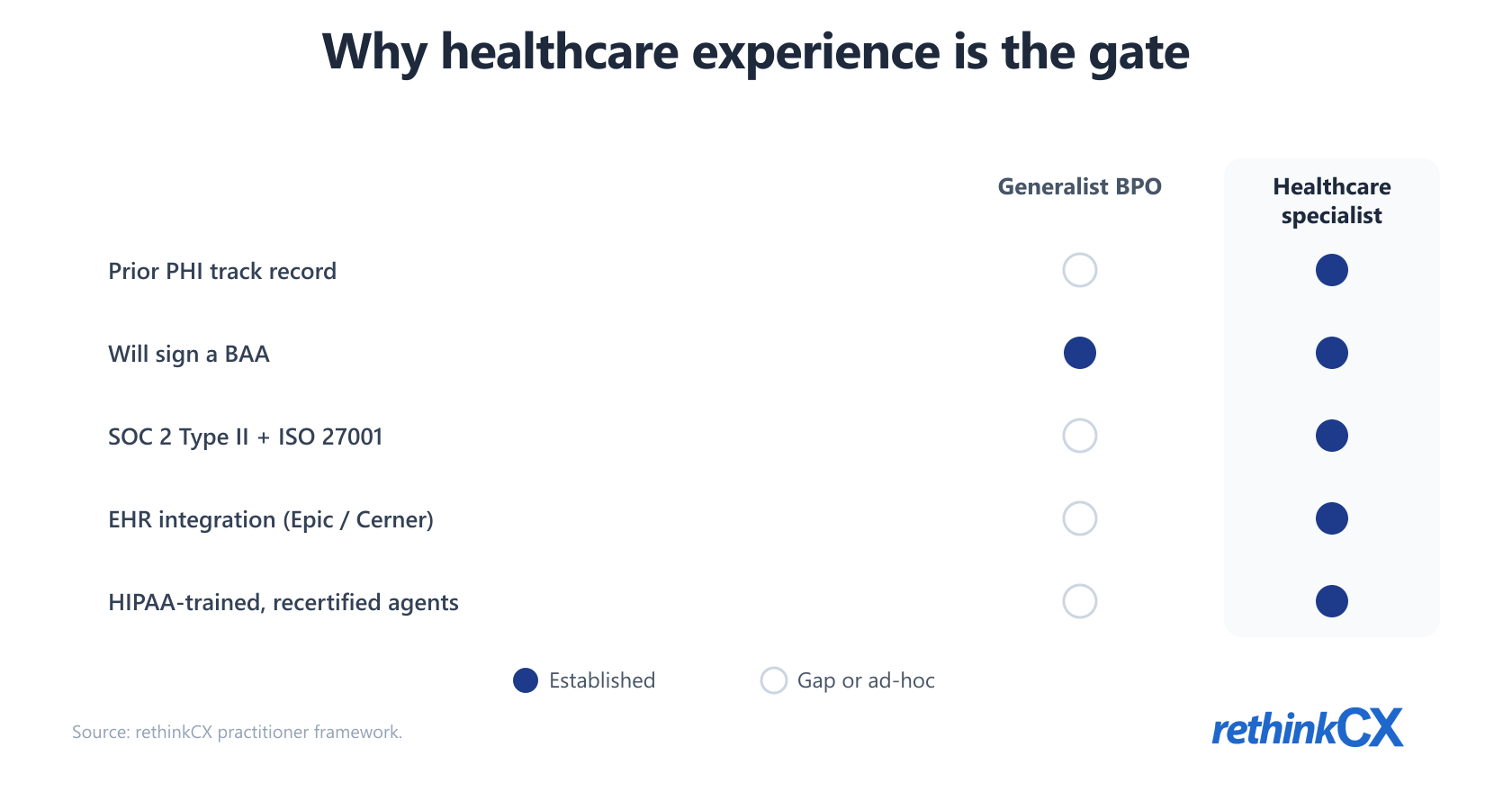
1. Demand proven healthcare experience first. Confirm the vendor has run healthcare engagements with PHI, not just generic support that happened to include a hospital logo. A generalist BPO that has never handled protected health information will learn HIPAA, PHI handling, and patient sensitivity on your data, and that is the single most expensive way for a vendor to learn it. Ask how many healthcare clients they run, payer or provider, and for how long. Thin answers end the conversation.
2. Get a signed BAA and read what's in it. HIPAA requires a signed Business Associate Agreement before a vendor handles PHI on your behalf. The signature is the floor; the contents are the substance. The document should define permitted uses of PHI, security obligations, how subcontractors are handled, breach-notification timelines, and what happens to your data when the relationship ends. A vendor that stalls on signing, or can't walk you through the clauses, is answering the question for you.
3. Verify SOC 2 Type II and ISO 27001, not "HIPAA compliant" claims. "HIPAA compliant" is a phrase with no certifying body behind it. Ask for a current SOC 2 Type II report, which tests controls over a window of time rather than a single day, and for ISO 27001 alignment. Request the real reports under NDA, not a badge on a slide. Certifications confirm the controls live in daily operations instead of in the sales deck.
4. Check PHI access controls and audit logging. Confirm who can see patient data and whether every access is recorded. You want role-based access, encryption in transit and at rest, multi-factor authentication, and an audit trail you can actually review. Ask how the vendor would reconstruct who touched a given record after an incident. If they can't answer that, the logging isn't real, whatever the policy document says.
5. Set the breach-notification SLA in the contract. Decide the window in which the vendor must tell you about a suspected or confirmed breach, and write it in with consequences attached. As the covered entity, you inherit downstream notification obligations, so a soft "we'll let you know" clause leaves you holding the regulatory risk. Name the hours, name who gets called, and require a documented incident-response runbook.
6. Confirm EMR/EHR integration before you sign. If agents need to read or write to Epic, Cerner, or your other systems, integration is the line between real-time accuracy and a second data silo. Confirm the vendor has integrated with your specific platform, get the interface details, and pilot the integration before full rollout. Broken EHR access produces scheduling errors and stale records, which corrode exactly the trust you outsourced to protect.
7. Pilot on low-sensitivity work first. Don't route your full PHI-heavy queue to a new vendor on day one. Start with a contained slice, ideally non-PHI or low-sensitivity, for 60 to 90 days, and measure quality against your in-house baseline while you watch how they handle a real ramp. Expand toward sensitive, PHI-heavy contacts only after the controls have held under load. For the general version of this diligence beyond healthcare, the BPO vendor selection framework covers the failure-mode questions vendors won't volunteer.
The real risks, and how to mitigate them
Healthcare outsourcing carries three risks worth naming plainly. None is a reason not to outsource. Each is a reason to outsource carefully.
A PHI breach is the headline risk and the most expensive kind there is. Healthcare has topped the cost-per-breach tables for over a decade, and a single exposure brings regulatory penalties, notification obligations, and a trust hit that outlasts the fine. The mitigation isn't a single control; it's the diligence stack above, plus biannual security audits and a contained scope that expands only as the controls prove out. Treat breach prevention as a launch gate, not a line item.
Quality drift is the quiet one. A vendor delivers well for the first 90 days, then quality erodes as agent attrition compounds and your account stops being their newest priority. In healthcare the cost of drift is higher, because a confused answer about a bill or a benefit lands on a patient who is already stressed. The mitigation is operational: real-time call monitoring, a defined QA sample with a healthcare-specific rubric, and quarterly recalibration. The playbook for outsourcing without losing quality covers the SLA-and-QA architecture that catches the slow decay before patients feel it.
Loss of trust and signal is the underrated one. Patients can sense brand-distance, and a sensitive call handled without warmth does lasting damage. There's a second version of this risk that healthcare buyers miss: the contacts you outsource are also the contacts that teach you where your patient experience breaks. Outsource all of them and you sever the feedback loop. Keep the clinically-adjacent and complaint-heavy contacts in-house, and require the vendor to flag recurring themes weekly even on the contacts they do handle.
Running the partnership so quality doesn't drift
Diligence gets you a good vendor. Operations keep them good. The partnerships I've seen hold up in healthcare share four habits.
Contracts with SLAs that have teeth. Spell out the metrics: response and resolution targets, first-contact resolution, abandonment, and the breach-notification window from the diligence stack. Attach consequences to misses. A healthcare SLA without a breach clause and a quality floor is a handshake, not an agreement.
Training that's continuous, not a kickoff event. HIPAA recertification, patient-empathy training, and platform proficiency need a cadence, not a launch-week checkbox. A short, standardized playbook for the recurring scenarios, such as billing disputes, scheduling, and refill questions, keeps agents consistent as the bench turns over, which it will.
Audits on a schedule. Quarterly compliance reviews of data handling, training records, and incident logs catch the encryption lapse or the access-control gap before it becomes a breach. The audit is also where you find out whether the SOC 2 controls you verified at signing are still being run.
Feedback loops in both directions. Patient surveys and follow-up calls tell you where service breaks. Weekly theme reviews with the vendor tell you what the contacts are revealing about your own operation. The relationships that work look like an internal team relationship with shared scorecards. The ones that fail look like a monthly invoice review.
Where healthcare support outsourcing is heading
Two shifts matter for buyers scoping a contract in 2026, and they're related.
AI is absorbing the routine tier, not the hard one. Conversational AI for patient interactions now handles a meaningful share of routine patient and member queries, such as appointment confirmations, basic billing questions, and portal resets, which pushes the human agents toward the higher-judgment work. For a buyer, this changes what's worth outsourcing: the easily-automated tier is shrinking, and the value of a healthcare-trained human is concentrating in the sensitive, judgment-heavy contacts. Scope the contract for where the work is going, not where it was. The cross-functional view of how conversational AI and live agents split the work is the better lens on what the hybrid model looks like in practice.
Member and patient engagement is going omnichannel, and the data layer is the constraint. Patients start on a portal, move to chat, and call to confirm, and they expect the context to follow them. That only works on a unified record, which in healthcare collides directly with PHI controls and EHR integration. The providers getting this right are solving the data foundation first, the same way the member and patient retention math ultimately rewards the operations that reduce patient effort rather than just deflect contacts.
Three things I'd do differently
If I were scoping a healthcare support outsourcing program today, three choices would come before anything a vendor put in front of me.
Decide payer-versus-provider before building the shortlist. The most common waste I see is a procurement process comparing the wrong vendors, because the buyer never named which of the two motions they were outsourcing.
Treat healthcare experience as a hard filter, not a scoring criterion. A vendor without a real healthcare track record shouldn't make the shortlist at all, however good the rate looks, because the rate is cheap precisely for the reason that disqualifies them: they haven't built the compliance muscle you're about to need.
Pilot the compliance, not just the service. Most pilots measure CSAT and response time. In healthcare, the pilot should also stress the controls: run a mock access-audit, test the breach-notification runbook, and confirm the EHR integration holds under real volume. The service quality is easy to see in 90 days. The compliance posture is the part that's expensive to discover later.
Get those three right and outsourcing becomes one of the higher-leverage operational moves a healthcare organization can make. Get them wrong, and it becomes an expensive lesson in why protected health information is protected. When you're ready to scope it, our healthcare CX services and the BPO cost calculator are the place to start.