
In BPO, FTE (full-time equivalent) is the unit an outsourcing contract bills labour in: one FTE is one full-time schedule of hours, usually 40 scheduled hours a week, of which about 38 are billed once unpaid breaks come out. It measures hours, not people. An agent who works half a shift on your program bills as 0.5 FTE, and the vendor decides who fills each hour unless the contract says otherwise.
That last part is where most buyers get surprised. The FTE on your invoice is a billable FTE, and the vendor staffs it with physical people, who may be full-time, part-time, or shared with three other programs. At scale, 100 billed FTEs can easily mean 200 people on the roster. I've run outsourced programs from the buyer's side, and I'd argue that isn't automatically a problem, but you should know which one you're buying before you sign.
This guide covers what an FTE means inside a business process outsourcing contract: how many hours it contains, how billable FTEs differ from physical ones, how to calculate the number you need, what one billed FTE actually delivers, and which terms the contract should settle.
What does FTE mean in a BPO contract?
FTE in BPO is a unit of billable time, and everything else follows from that. The vendor quotes a rate per FTE (or per hour, which comes to the same thing), commits to delivering a number of FTEs on your program, and invoices for the hours delivered. The unit exists so that a mix of full-time schedules, part-time schedules and split shifts can be added up into one number that both sides can check.
How many hours is one FTE?
One US FTE is 40 hours a week, which is 2,080 hours a year and about 173 hours a month. That's the convention almost every contract uses. The US federal government actually uses a 2,087-hour year, because a GAO study found that calendar years average 2,087 working hours over a 28-year cycle; for BPO billing the difference is noise, but it explains why monthly invoices move slightly from year to year.
The number that matters more for a buyer is the billable one. Paid breaks usually aren't billed to the client, so a 40-hour schedule bills at roughly 38 hours in the contracts I've worked with.
| Scheduled hours per FTE | Billable hours per FTE (breaks out) | |
|---|---|---|
| Per week (US, 40-hour week) | 40 | ~38 |
| Per month (US) | ~173 | ~165 |
| Per year (US) | 2,080 | ~1,976 |
| Per week (UK, 37.5-hour week) | 37.5 | ~35.5 |
| Per month (UK) | ~162 | ~154 |
The billable column is a practitioner estimate, not an industry standard. Every vendor defines a billable hour a little differently, which is why it belongs in the contract (more on that below).
Half shifts and part-timers
FTE is fractional by design. An agent who works a half shift on your program bills as 0.5 FTE for that shift, and two part-time agents at 20 hours each add up to 1.0 FTE. The same agent can also appear on several programs' invoices in one week: 0.6 FTE on yours, 0.4 FTE on someone else's. That's normal, and it's the root of the gap between billable FTEs and people.
Billable FTE vs physical FTE
A billable FTE is what you buy; a physical FTE is a person the vendor employs. The two rarely line up, and in a pooled program they aren't meant to. When you contract 100 FTEs, you're contracting 100 full-time schedules' worth of hours on your queue. The vendor's workforce team then fills those hours from whatever roster gets the job done: full-timers, part-timers, agents shared across programs, and extra people hired to cover absence.
Why 100 billed FTEs can be 200 people
Across the outsourced programs I've run or been brought in to look at, the physical roster behind a large FTE count is routinely well above the billed number, and in heavily part-time operations it can approach double. A program billed at 100 FTEs with a lot of half-shift coverage can have close to 200 people who touch it in a given month.
That isn't a scandal. If you don't want to manage the vendor's staffing, the vendor will give you bodies to answer the volume, and for simple, high-volume work that's often the cheapest way to hit the service level. The trade-off shows up on complex work, where the agent who learned your product last month may be on another program this month. That's the same dynamic behind vendors moving their best agents to newer accounts, which I covered in the guide to BPO vendor management.
When you want dedicated agents
A dedicated agent is a physical FTE: a named person who works only your program. You don't get that by default under FTE billing. You get it by asking for it in the contract, usually alongside a clause on how much notice the vendor must give before moving a named agent, and you should expect to fight for it, because it takes flexibility away from the vendor's scheduling.
Whether it's worth the fight depends on the work. For tier-1 order status and password resets, pooled agents are fine. For anything where product depth, account history or brand voice compounds with tenure, dedicated agents are usually worth the negotiation.
How to calculate the FTEs you need
The FTE count you contract should come from your workload, not from the vendor's proposal. The calculation is simple enough to run yourself before an RFP, and doing it gives you a number to hold the vendor's staffing plan against.
From contact volume to billable FTEs
Start with workload hours: monthly contact volume times average handle time. Then allow for the fact that agents can't be busy every minute they're on the queue, and divide by the on-queue hours one billed FTE delivers.
Here's a worked example for a mid-sized support program:
- Workload: 12,000 contacts a month × 6 minutes average handle time = 1,200 hours of handling.
- Idle time between contacts: plan for agents to be busy about 85% of their on-queue time, which is a common workforce-planning ceiling before burnout sets in. 1,200 ÷ 0.85 = about 1,410 on-queue hours.
- On-queue hours per billed FTE: about 35 a week, or roughly 152 a month (see the next H2).
- Billable FTEs: 1,410 ÷ 152 = 9.3, so you'd contract around 10 FTEs.
This monthly math gives you the average. Real schedules have to cover the peaks inside each day, which is where the vendor's workforce team runs interval-level forecasts (usually Erlang-based) and where the number can move up. If a vendor's proposal lands far above your average-based estimate, ask them to show the interval math; if it lands below, ask how they plan to hit the service level at 10 a.m. on a Monday.
Why the vendor staffs more people than you pay for
Absence, leave and holidays are the vendor's problem under FTE billing. You're paying for 40 hours of coverage, and it doesn't matter who delivers them, so if an agent calls in sick the vendor has to put someone else on the queue or eat the shortfall against the SLA.
This is where shrinkage comes in, and it explains the physical roster. Contact centres lose a large share of paid time to leave, absence, training and meetings; Call Centre Helper reports that shrinkage normally comes out between 30 and 35%, citing a Dimension Data benchmark average of 35%. In Call Centre Helper's own worked breakdown of 32.5%, annual leave, public holidays, sickness and lateness account for about 16 points; the rest is internal time like coaching, meetings and breaks.
That first slice is what the vendor staffs around. The correct way to size for it is to divide, not add: required staff = hours needed ÷ (1 − shrinkage). Call Centre Helper's explanation of the division rule shows why adding the percentage understaffs: 100 FTEs at 30% shrinkage needs 142.9 people, not 130. For the 10-FTE program above, covering a 16% absence-and-leave slice takes 10 ÷ 0.84, or about 12 full-time people, before any part-timers enter the rota.
You don't pay for those extra two people directly. You pay for them inside the rate, which is the next section's point.
FTE vs seat: how many FTEs cover a 24/7 seat?
A seat is a position that must be staffed; an FTE is 40 hours of one. A seat covered during a 40-hour business week needs about one billed FTE plus break cover. A seat covered 24/7 is 168 hours a week, and at about 38 billable hours per FTE that's roughly 4.4 billed FTEs for a single position, with more physical people behind them once leave and absence are covered.
This matters when quotes come in different units. Some vendors, especially for facility or seat-leasing deals, quote per seat; others quote per FTE. A 24/7 seat quote and an FTE quote can differ by a factor of four or more and still describe the same coverage, so convert both into billable hours before comparing them. The mechanics of comparing quotes across hourly, per-FTE and per-ticket models are covered in the guide to BPO pricing models.
What does one billed FTE actually deliver?
One billed FTE delivers about 35 hours a week on your queue, plus two or three hours of coaching, QA and ongoing training that you also pay for. That's the typical shape of the contracts I've worked with: 40 scheduled hours, about 38 billed once unpaid breaks come out, and of those 38, roughly 35 on the phone, chat or email queue.
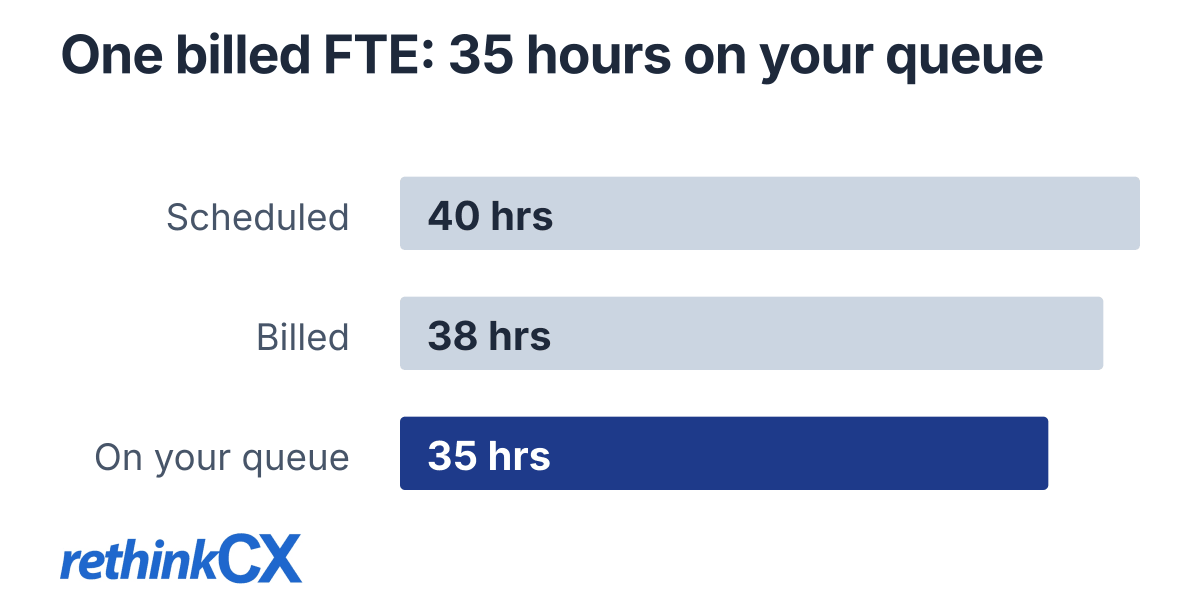
The coaching and QA hours are the part buyers most often push back on, and I think they shouldn't. Those hours are what keep the 35 on-queue hours at the quality you contracted; cutting them saves about 8% of the bill and usually costs more than that in rework and repeat contacts. Absence doesn't appear here at all, because the vendor owes you the 40 hours regardless of who is sick.
The idle time inside those 35 hours is a different matter. Under FTE billing, the minutes an agent spends waiting between contacts are yours, which is why per-FTE pricing suits steady volume and punishes a quiet week. What a billed FTE costs, and how that compares to hourly or per-ticket pricing, depends on country and model; the per-agent costs by country in the BPO Cost Index are a starting point.
What the contract decides
Almost everything in this article is a contract term, not an industry rule. Vendors define billable hours, premium roles and training costs differently, and two quotes at the same FTE rate can buy noticeably different things. These are the terms I'd want written down.
What counts as a billable hour
The contract should state how many hours one billed FTE contains, whether paid breaks are billable, whether coaching, QA sessions, team meetings and training are billable, and what happens to the bill when the vendor delivers fewer hours than contracted. If the proposal just says "FTE" with a monthly rate, ask for the hours definition in writing before you compare it with anything.
Premium roles: supervisors, multilingual and VIP agents
Supervisors and team leads are usually on the bill as FTEs, at a premium. As an example, a supervisor might bill at 1.5 times a regular agent's rate. The same logic applies to multilingual agents and to a tiered setup, such as a VIP or tier-2 line where you want more experienced agents and pay a higher rate for them. None of these premiums is standard across vendors, so list every premium role, its rate and its ratio to agents in the contract.
Who pays for training: growth hires vs backfill
New-hire training splits on one question: whose decision created the hire. If you ask the vendor to add 100 agents for peak season, or even just five more agents because volume grew, the training for those agents is on your dime. You're not paying for the vendor's recruiting team to find and interview them, but you are paying for the weeks they spend learning your product before they take contacts.
If an agent quits and the vendor has to backfill the role, the vendor pays for the replacement's recruiting and training. Attrition never costs the client money directly under a normal FTE contract.
Where attrition is priced
Attrition still costs you, though, just not as a line item. It's priced into the rate. Say an agent is paid $12 an hour and the bill rate to the client is $18. That $6 spread covers the vendor's margin, facilities, management, and the cost of replacing the people who leave. Think of it as insurance: on a stable program the vendor keeps most of it, and on a program going through heavy turnover it can shrink to zero margin on that account.
Turnover is heavy in this industry. Insignia Resource's 2026 benchmarks put outsourced call centre attrition at 49-53% a year, against 33-39% for in-house teams. That's the risk the spread is insuring, and it's why a vendor that quotes well below the market rate usually recovers the difference through cheaper hiring, thinner training or pooled agents you didn't expect.
What I'd do differently
If I were writing an FTE contract from scratch today, three things would go in on day one rather than after the first surprise.
Define the billable hour in the first draft. Hours per FTE, breaks, coaching, QA and training, and what happens to the invoice when delivered hours fall short. Every vendor counts billable hours a little differently, and that's where two identical-looking FTE rates stop being identical.
Decide dedicated vs pooled per queue, not per contract. Pool the simple, high-volume queues and let the vendor schedule freely. Name dedicated agents on the complex queues, with a notice period before any of them is moved. Asking for dedicated agents everywhere raises the price and rarely improves the simple work.
Write the training split down. Growth hires on the client, backfills on the vendor, with the ramp period for growth hires priced and time-boxed. Peak season is when this gets tested, and it takes one paragraph to settle in advance.
The FTE count on your invoice will never match the number of people on your program, and it doesn't need to. What it needs is a definition both sides agreed to before the first invoice. If you're still deciding whether to outsource at all, the in-house vs outsourced comparison is the place to start, and the BPO cost calculator converts coverage hours into a monthly cost by country.