
Customer service outsourcing to the Philippines means hiring a Philippine business process outsourcing provider to run your phone, email, and chat support, usually at $8 to $15 an hour fully loaded, a 30 to 60 percent cut versus onshore. The country's real edge isn't the price. It's that call-center work is a respected career there, so the talent wants the job, and the employee data shows it.
The cheap-and-good-English line is true and close to useless. It's the sentence a vendor would write, and it explains nothing about whether the quality lasts, or how to tell a provider that will hold it from one that will quietly let it slide. That gap is the whole job of choosing well, and it's the part the price comparison can't help you with.
So here is the part that matters, plainly: the country is rarely the risk. The provider tier is. The Philippine industry is not a side hustle. It earned $40 billion and employed 1.9 million people in 2025, per the industry association IBPAP, making it the country's largest export earner. The depth is real. Whether your program works comes down to which operator you pick and what you write into the contract, and that is what the rest of this covers.
What outsourcing customer service to the Philippines actually covers
The scope is wider than "answering phones," and getting specific about it is the first thing that separates a clean RFP from a vague one. A Philippine provider can run inbound voice, outbound, live chat, email, social, and back-office processing, usually across a 24/7 footprint because the time-zone gap forces night-shift coverage anyway. Contact-center outsourcing in the Philippines usually bundles the agents, the workspace, the tooling, and the frontline management into a single per-hour or per-seat rate. You're buying a managed service, not building an offshore office. The provider employs the agents and carries the local HR, facilities, and compliance load; you contract for output and own the quality bar. That's the line between outsourcing and standing up your own captive operation, which is a far heavier lift.
Before you outsource any of it, get honest about whether you should outsource at all. There's a real case for keeping a small in-house core and sending overflow or after-hours volume offshore, and the build-versus-buy math is its own decision, covered here before you commit. The Philippines is strongest for English-language voice and blended support. For pure non-voice work, India often prices lower, and for North American voice where accent and time zone matter most, nearshore can be worth the premium.
Why the talent actually wants these jobs
The cheap-and-good-English summary misses the thing that actually explains the quality. In North America, call-center work carries a stigma and gets treated as a stopgap. In the Philippines, it runs the other way. BPO is a respected, aspirational career, and that single cultural fact is why quality and retention hold up better than the rate would predict.
The reason is economic, not sentimental. An entry-level call-center role pays roughly ₱18,000 to ₱25,000 a month, which salary data puts well above the national minimum wage of around ₱13,000 to ₱15,000. Add comprehensive HMO health coverage that often extends to dependents, a structured promotion ladder into team-lead and operations roles paying ₱55,000 and up, and you have a job people build careers in rather than pass through. Families have multiple generations in the industry. Teleperformance runs multiple sites in a single city, which only works when the local labor pool is deep and willing.
This is where the independent data earns its place, because employee sentiment is measurable. BPOdb ranks Philippine providers on employee reviews drawn from Glassdoor and Indeed-style sources, where the people doing the work rate it. The top operators score in the 80s and 90s out of 100. A high score isn't a popularity contest; it's a retention signal, and retention is what keeps the agents who know your product on your account in month nine instead of month two. The English helps too, and it's better than passable. The Philippines ranks 2nd in Asia and in the "high proficiency" band on the 2025 EF English Proficiency Index, with a cultural fluency from decades of US media exposure that matters more on a voice call than a test score does. For how that stacks up against other destinations, see how the Philippines compares to other BPO locations.
What it actually costs, and why the rate is the wrong number
A single hourly range is the easy part of this, and on its own it tells you almost nothing. Fully loaded, Philippine voice support runs $8 to $15 an hour, a figure our BPO cost calculator lets you pressure-test against your own spec. External 2026 rate guides land in the same place, with statutory employer contributions (SSS, PhilHealth, Pag-IBIG, 13th-month pay) adding 18 to 22 percent on top of base wages. Against a tier-1 US metro at $28 to $45 an hour, that gap is why anyone outsources here in the first place. Some providers report Metro Manila running 10 to 20 percent above Cebu or Davao, so location inside the country moves the number too.
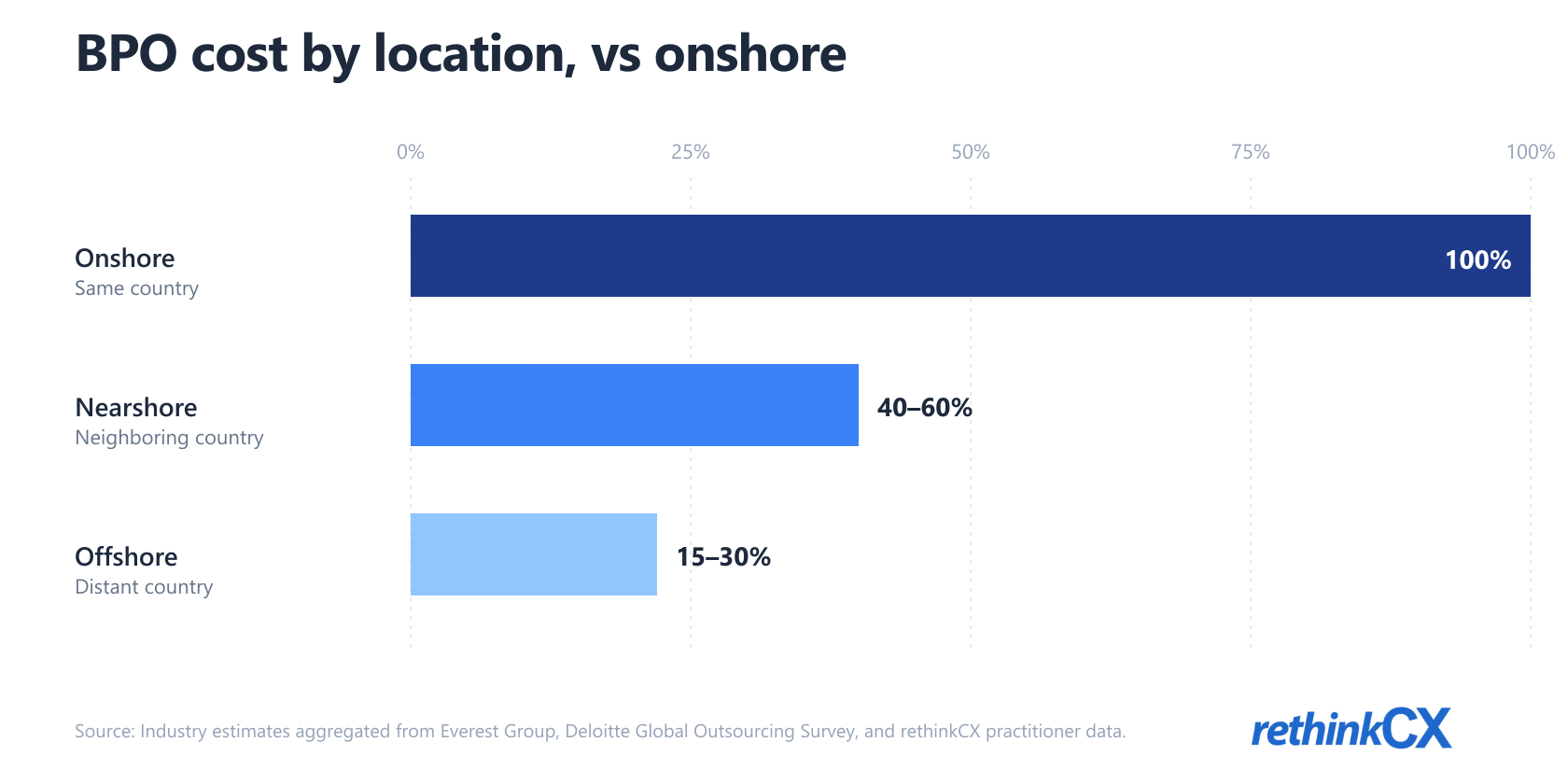
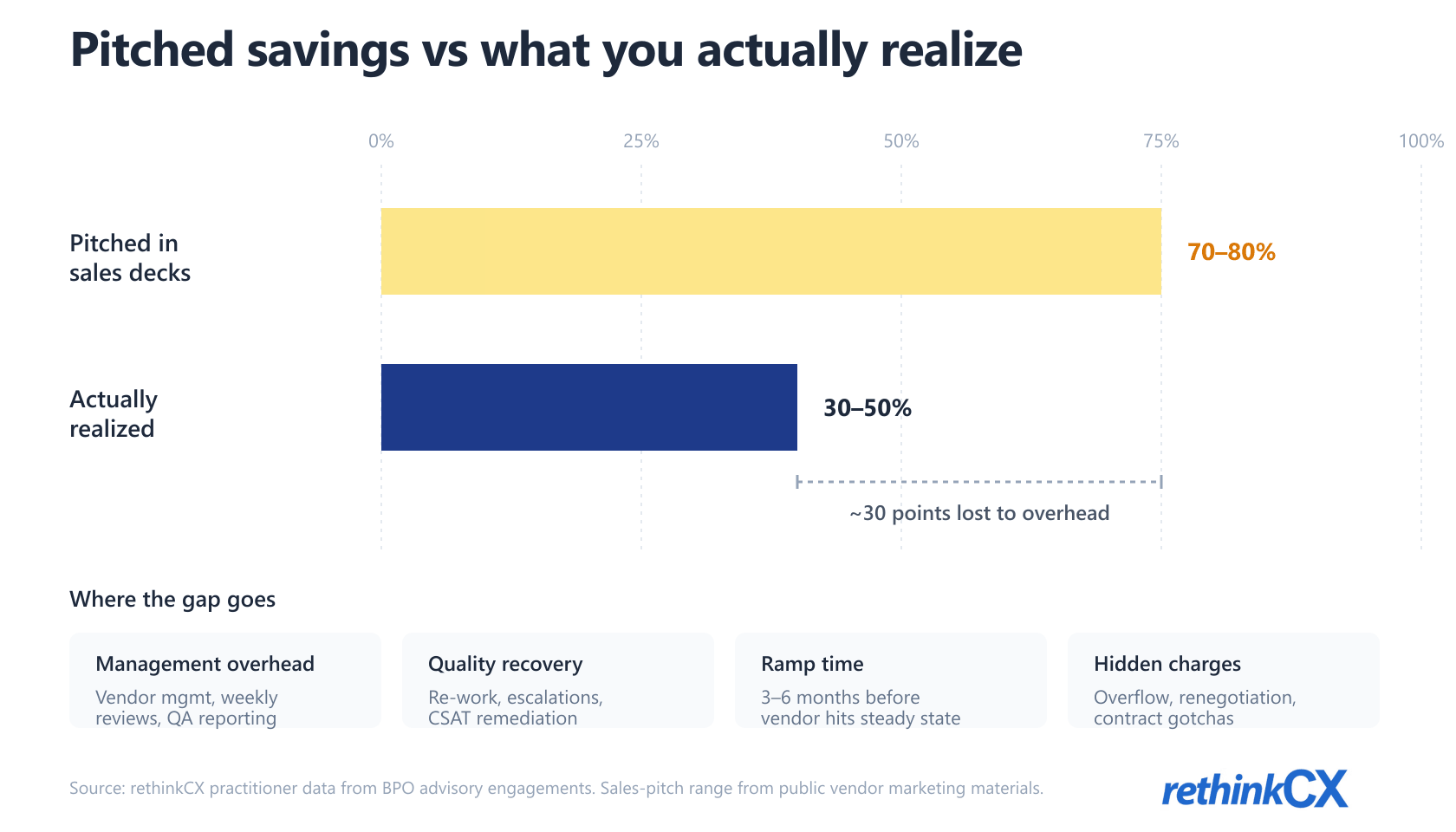
The rate is also the least useful number in the decision. Two things matter more. First, what unit you're buying: an hourly seat, an FTE block, or a per-resolved-ticket price normalize very differently, and comparing headline rates across different BPO pricing models is comparing labels, not prices. Second, the cost the rate hides. A $9 seat on a team churning 40 percent a year, re-ramping fresh agents into your product every few months, costs more in blown resolutions and CSAT than a stable $13 one. A call center outsourcing setup in the Philippines chosen purely on the lowest quote is the one you end up revisiting within a year. If you're weighing offshore economics against same-time-zone coverage, the nearshore outsourcing tradeoff is the next thing to price.
Where AI fits in 2026, and why it isn't gutting the model
The fair question in 2026 isn't whether the Philippines is still cheap. It's whether you should be hiring human agents at all while AI quietly absorbs the routine tickets. The honest answer is that AI is reshaping this work, not erasing it, and the Philippine industry is backing that distinction with real money.
The numbers don't describe a model in retreat. The same industry that cleared $40 billion in 2025 is targeting $42 billion and nearly 2 million jobs in 2026, growth on top of growth. The official posture is "human-led, AI-powered," and the industry is putting roughly $25 million a year into retraining agents for AI-assisted and higher-value work rather than letting automation thin the ranks. The job is shifting from answering every call to supervising AI on the repetitive volume and owning the cases it can't handle.
For a buyer, that shift is a selection signal, not a reason to wait. The gap between a provider whose agents actually run AI assist and a body shop that bolted "AI" onto its deck is widening fast. So add one question to the vetting list: is this provider deploying AI to its agents today, or just naming it in the pitch? The ones doing it for real resolve more per head, which is the only AI benefit that reaches your P&L.
The best Philippine BPO providers, ranked by their own employees
There's a structural catch in how Philippine BPOs get ranked. When a provider publishes its own "top providers" list, it puts itself at number one. When a directory ranks them, placement can often be paid for. Either way, the one question you came to answer, which provider is actually good, gets answered by the party with the most to gain from the answer.
So here is an independent cut, ranked on what the providers' own employees say rather than on who paid for the slot. The data is from BPOdb's Philippine ranking, source: BPOdb.
| Rank | Provider | Score /100 | Rating | Reviews |
|---|---|---|---|---|
| 1 | Everise | 96.0 | 4.8 | 4,131 |
| 2 | Teleperformance | 91.2 | 4.6 | 8,368 |
| 3 | Foundever | 83.6 | 4.5 | 2,788 |
| 4 | TaskUs | 81.3 | 4.1 | 7,418 |
| 5 | Concentrix | 78.9 | 4.2 | 5,094 |
Notice who leads. Everise tops the list not because it's the cheapest but because its people rate it that highly, and that sentiment tracks the retention you want on your account. Teleperformance scales to more than 8,000 reviewed staff and still holds a 4.6, which is the volume tradeoff visible in data. The self-ranking vendors who put themselves at number one mostly aren't here at the top. That gap, between who claims the top spot and who the employee data puts there, is the whole reason to look at a measured source. The full ranking covers 33 providers; the complete employee-rated ranking of Philippine BPOs is worth a scan before you build a shortlist.
How to choose a provider without getting sold
A good selection process is boring and repeatable, and it leans on the workforce signal more than the sales deck. Here's the sequence I'd run.
-
Define the work and the volume. Write down the channels, the complexity tier, the operating hours, and the seat count before you talk to a single vendor. The scope sets the rate band and rules half the providers in or out. A vague brief produces vague quotes you can't compare.
-
Issue a tight RFP to a short list. Send the same specific brief to five or six providers and ask for an all-in cost breakdown, not a headline rate. Clarify in writing who pays for recruitment, training, tooling, replacements, overtime, and compliance. The gap between headline and all-in is where the surprises hide.
-
Shortlist on attrition and employee-sentiment data. Rank candidates on how their own agents rate them, using independent employee-review data as the proxy. Low attrition and high employee scores predict the agents who'll still know your product in month nine. This is the step the vendor lists are built to skip.
-
Vet the SLA and the all-in cost. Confirm service levels, data-security standards, reporting cadence, and escalation rules in writing, and write replacement cost and attrition pass-through into the contract so the vendor absorbs the churn. An SLA with no named consequence for missing it is decoration.
-
Run a paid pilot on real tickets. Spend 60 to 90 days on a live slice of your volume and measure first-call resolution, CSAT, and handle time against your in-house baseline. A pilot surfaces accent fit, ramp speed, and management quality that no deck reveals.
-
Monitor weekly through the ramp. The first 90 days are net-negative while the team ramps; watch FCR and CSAT weekly so you catch a bad fit early. Steady-state quality and savings land around month 12.
If you want the deeper version of this with scorecards, a full BPO vendor-selection framework walks through each gate. And the reason I trust this sequence over a vendor's pitch is structural: rethinkCX makes its money through vendor-neutral BPO matching where the provider pays the fee, so the incentive is the fit, not the sale. One tell worth weighing on its own: across the BPO sales teams I've talked to, the ones who push the Philippines over other locations describe it as cheaper and higher quality. When a salesperson steers you toward the lower-margin option, that's a signal worth trusting.
The risks vendors won't quantify for you
Every benefit here has a cost the sales call understates, and naming them is how you price them into the contract. Three are worth your attention.
Attrition is the first. The Philippine contact-center industry runs roughly 30 to 40 percent annual attrition, high but declining as the sector matures and hybrid work takes hold, per 2026 Philippine BPO industry data. The declining trend is real and a good sign, but the absolute level still means a meaningful share of the agents trained on your product this year won't be there next year. Write replacement cost into the SLA.
The second is the time zone. The 12 to 13 hour gap with the US East Coast is what enables 24/7 coverage, but it also means your agents work a permanent night shift, which is the single biggest driver behind that attrition number.
The third is data security, and it's the one buyers wave through with a "we take security seriously." Don't. The Philippines has a real framework: the Data Privacy Act of 2012 (RA 10173), enforced by the National Privacy Commission, which requires processors to appoint a Data Protection Officer, run privacy impact assessments, and report breaches within 72 hours, with penalties up to ₱5 million or 3 percent of gross income per violation. Make the provider name how it complies. Require a signed data processing agreement, ISO 27001 certification, and whatever your industry adds on top, like PCI-DSS if you handle card data or a HIPAA business-associate agreement for US health information. Put the specifics in the contract, not the assurances on the call.
None of these three sink the case for the Philippines. They just need to be in the contract, not discovered in month four.
Three things I'd do differently if I were choosing today
Most of the regret in these programs traces back to the same few decisions. If I were standing up a Philippine support operation from scratch, here's what I'd change from the default playbook.
Shortlist on the workforce, not the rate card. The instinct is to sort the quotes low to high and start at the top of the list. I'd sort on employee sentiment and attrition first, then look at price within the survivors. The cheapest seat on a high-churn team is the most expensive option you can buy.
Write the churn into the contract. Most buyers treat attrition as the vendor's problem until it becomes their CSAT problem. Put replacement cost and a minimum-tenure or backfill-speed clause in the SLA, so the provider has skin in keeping your trained agents.
Pilot before you scale, every time. A paid 60-to-90-day pilot on real tickets is the cheapest insurance in this entire process. It catches the accent-fit, ramp, and management problems that a reference call never will, and it costs a fraction of unwinding a full program that went sideways in month six.
The country gives you a deep, willing, well-rated talent pool at a third of the onshore cost. What it can't do is pick the right provider for you. Do that part on measured data, write the contract like the churn is real, and the rest of the math works.