
Nearshore outsourcing is contracting work to a provider in a nearby country, usually within one to four time zones of your own. For a US company, that means Latin America and the Caribbean. It's one location strategy within the wider business process outsourcing category, alongside onshore and offshore. You trade away some of offshore's cost savings, and get back time-zone overlap, easier travel, and tighter cultural alignment. That's the textbook answer, and it's where most guides on the topic stop.
Here's the part those guides skip. Most are written by companies that sell nearshore, so they won't tell you it isn't automatically the right answer. I've run both nearshore and offshore programs, and I don't default to either. The real nearshore advantage isn't the time-zone overlap everyone repeats. It's that you're close enough to actually show up. And the part no vendor will admit: nearshore costs more, and its agents churn faster than the pitch suggests.
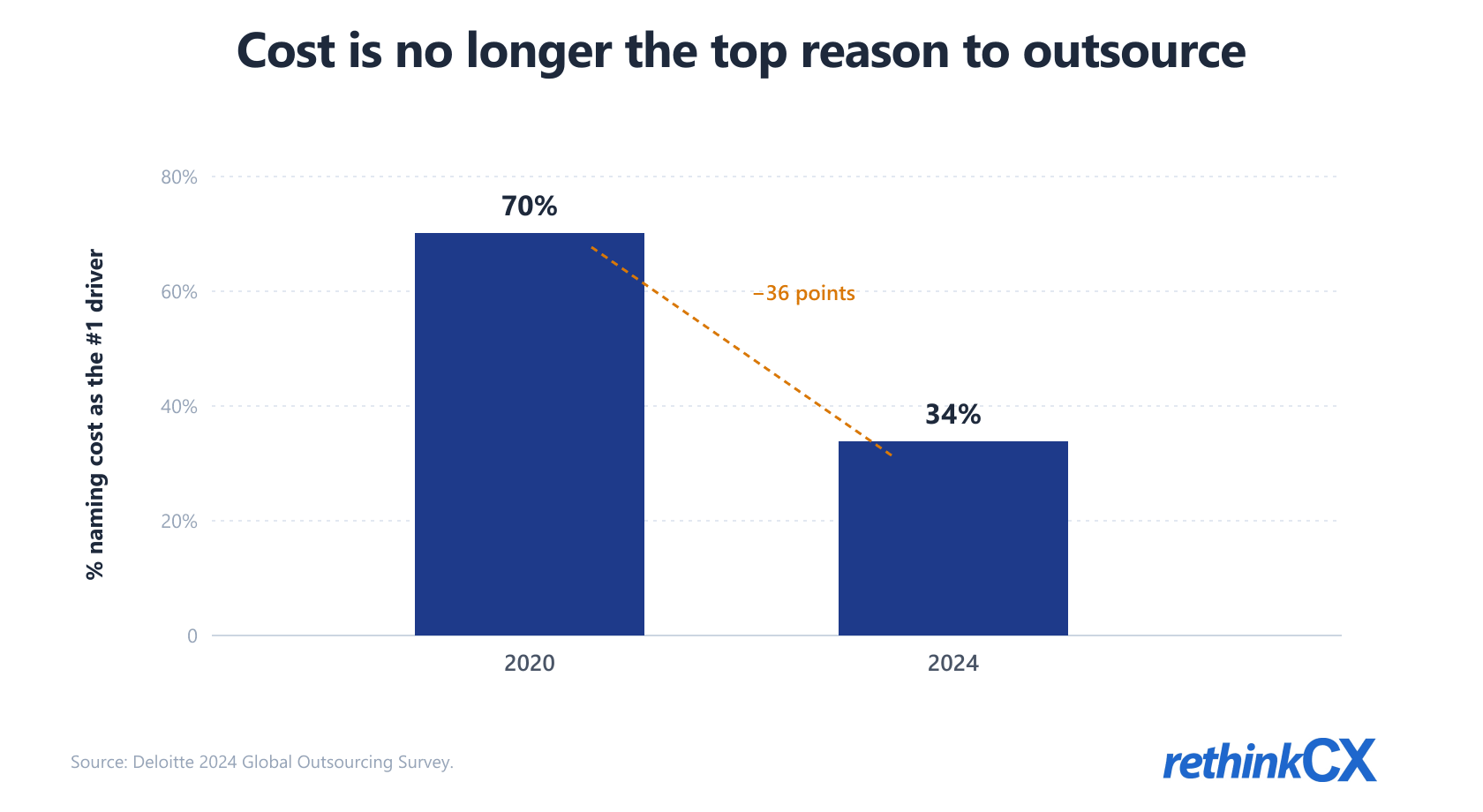
This guide is the vendor-neutral version: what nearshore actually is, why the headline hourly rate is the wrong number to decide on, when nearshore genuinely wins, when offshore still beats it, and a five-step way to make the call. The frame for all of it comes from Deloitte's 2024 Global Outsourcing Survey, which found cost reduction has fallen from the primary outsourcing driver for 70% of companies in 2020 to just 34% in 2024. The reason you outsource has changed. The way you choose where should change with it.
Nearshore, offshore, onshore: the distinction that actually matters
The three-way split is usually drawn on a map. Onshore is your own country, offshore is far away, nearshore is the middle. That's accurate and not very useful, because the map isn't the decision. The decision is how much distance you're willing to trade for how much saving, and distance means more than miles.
| Model | Where (US buyer) | Cost | Time-zone overlap | Best-fit work |
|---|---|---|---|---|
| Onshore | United States, Canada | Highest | Full | Brand-defining, regulated, escalation-heavy |
| Nearshore | Latin America, Caribbean | Medium | High | Real-time, judgment-led, presence-sensitive |
| Offshore | Asia, Africa | Lowest | Low | Standardized, high-volume, latency-tolerant |
Nearshore is the hedge between the two extremes. You're paying for proximity: real-time conversations, a travel day instead of two, fewer cultural translation losses. The question this guide answers is whether that proximity is worth the premium for your work, because it isn't a free upgrade. You pay for it, and on a lot of work you don't get your money back.
Why the headline hourly rate is the wrong number
The single most expensive mistake I see buyers make is deciding on the quoted rate. Two vendors can quote the same fifty-agent program at wildly different numbers, and most of that gap is geography plus whatever each vendor folds into the rate. The quote is a starting point, not the cost.
The cost is fully loaded. Attrition runs around 40% a year in this industry, and each replacement costs roughly $10,000 to $15,000 once you count lost productivity. Recruiting runs about $4,683 per hire. Agent tooling (the CCaaS stack, workforce management, QA, knowledge base) lands near $200 per seat per month. Supervision and QA add roughly another 20% on top of base labor. (Those are the benchmarks behind our own calculator, drawn from SHRM turnover research and frontline call-center data.) None of that shows up in the headline rate, and all of it is real.
This is why outsourcing stopped being a pure cost play. When outsourcing was mostly about cutting cost, the cheapest quote won by default. Now that talent access and agility drive the decision for most buyers, the cheapest quote is often the most expensive program. An offshore rate that looks 60% lower can converge toward nearshore once attrition, re-handling, and supervision are loaded in, a gap the Philippine economics make concrete.
I'm not going to print a static rate table here, for two reasons. The numbers move every quarter, and a guide that hardcodes them goes stale the day a currency shifts. More importantly, we already maintain those numbers properly. Rather than trust a single quote or a frozen table, model your own spec in the BPO cost calculator. It carries fully-loaded rates across 18 countries and layers in exactly the hidden costs above, so you can see where a quote is fair and where it's hiding something. That's the right way to compare the different BPO pricing models on a single axis, and it's the same math behind the in-house versus outsourced decision.
When nearshore wins
The standard pitch for nearshore is time-zone overlap, and it's true as far as it goes. Real-time collaboration beats a 12-hour lag, and faster feedback loops beat overnight handoffs. But that's the surface benefit, and it's not the one that has changed outcomes in the programs I've watched.
The real advantage is presence. Distance decides how often a client actually visits its own outsourced operation, and that cadence decides almost everything downstream. I've seen large companies visit a far-flung BPO once a year, because the flights, the time away, and the budget make anything more feel indulgent. When the site is a few hours away, there's no excuse not to be on the floor regularly, and the teams that show up monthly get a different operation than the ones that show up annually.
Being present changes the relationship in ways that don't show up on a scorecard until you need them. Agents can ask the client questions directly instead of guessing. They get comfortable enough to give honest feedback, which is some of the most valuable signal you'll ever get and almost impossible to extract from a distance. You meet the floor managers face to face. So when something goes wrong, and it always does (a volume spike, a wave of attrition, a product change nobody briefed), you're solving it with people you know rather than with a vendor you email. That accumulated familiarity is what holds a program together under stress.
The other genuine wins are narrower but real. Local language depth matters when accent and idiom affect the customer experience, and bilingual Spanish-English voice talent in Latin America is deep. Control is tighter when the operation is close: it's easier to embed your own people, run joint calibration sessions, and keep the vendor's culture aligned with yours. If your customers are nearby, the cultural reference points line up. These are the advantages of nearshore outsourcing worth paying for, but notice they all assume you'll use the proximity. If you're going to treat a nearby vendor like a far one and never visit, you're paying a premium for a benefit you've decided not to collect.
When offshore still wins
Here's where I part company with most of what's written on this topic. I've run both models, and I'll say the thing the nearshore vendors won't: I don't default to nearshore, and I've watched it underperform offshore more than once.
Two reasons. The first is cost, and it's straightforward: nearshore is expensive, and on a lot of work the premium buys nothing the work actually needed. The second is the one nobody talks about: retention, where the conventional wisdom is backwards. The assumption is that nearshore agents, being closer and more aligned, are more engaged and stickier. That's not what I've seen. A lot of nearshore agents are paid near the local-market floor, which means they can leave for the same money almost anywhere. The work is hard and often thankless, so there's no economic reason to stay and plenty of reason to go. Engagement and retention suffer, and you feel it in quality and in constant re-ramping.
Offshore, in the programs I've run, has often been the opposite of its reputation. I've worked with offshore agents who were genuinely well educated and who chose contact-center work because, relative to their local market, it paid well and the employer treated them well. When the job is a good job by local standards, people stay, they invest in getting good at it, and engagement runs high. The lazy assumption that offshore means lower quality has not held up in my experience. Sometimes the most engaged, lowest-attrition floor I've seen was the offshore one.
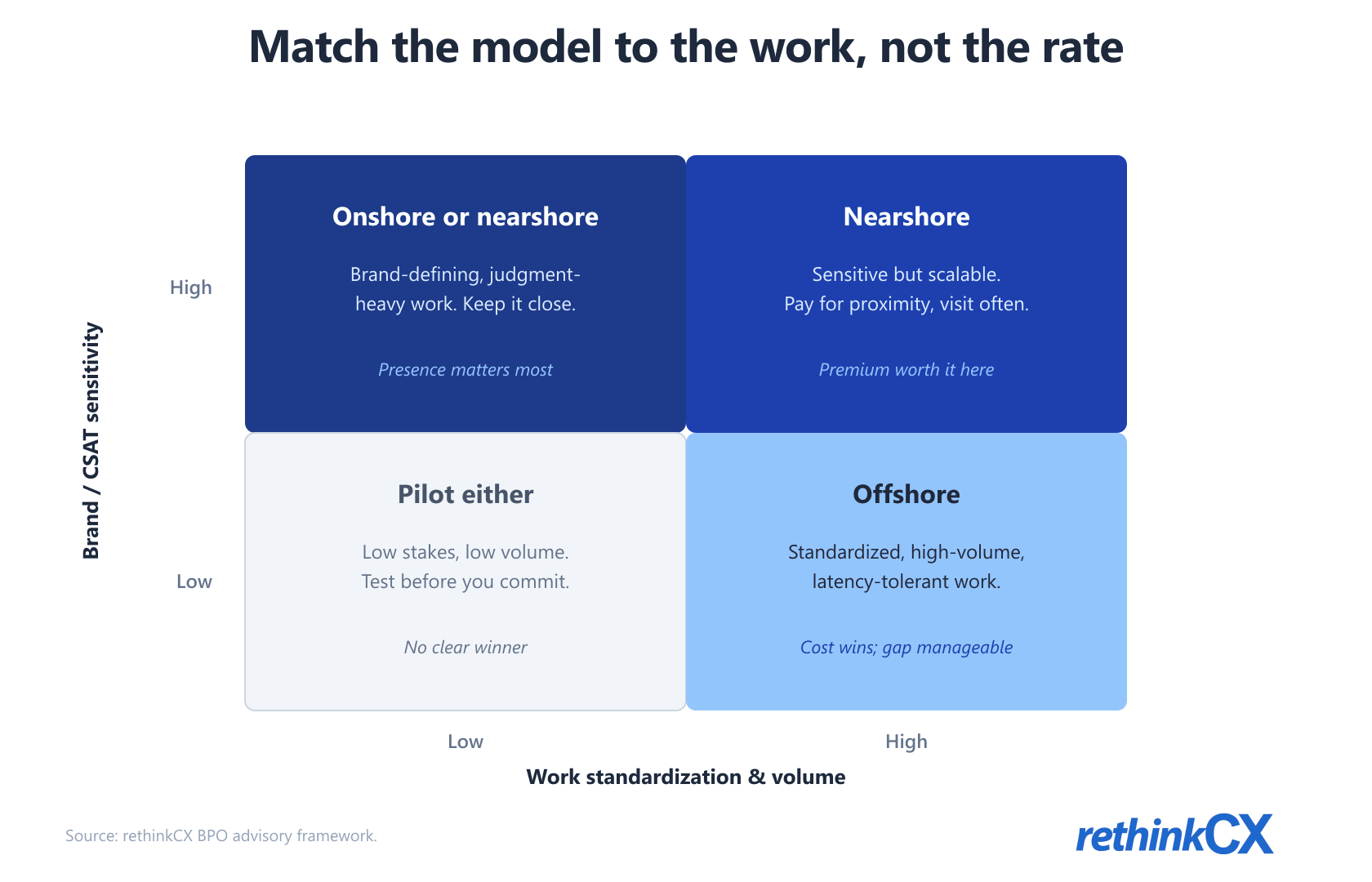
So offshore still wins on a specific and common profile of work: standardized, high-volume, latency-tolerant, where a few CSAT points either way don't move revenue. Tier-one support, back-office processing, overflow capacity, anything scripted and measurable. On that work the cost saving is real, the quality gap is manageable or nonexistent, and paying the nearshore premium is just lighting money on fire. The macro tailwind doesn't change that: Mexico overtaking China as the largest source of US imports and 57% of companies telling QIMA nearshoring is central to their strategy are tariff and logistics stories about physical goods, and they say nothing about whether your support queue belongs in Bogotá or Manila.
Nearshore outsourcing benefits and disadvantages
The benefits of nearshore outsourcing are presence, time-zone overlap, language depth and control; the disadvantages are cost and retention. Presence is the one that has actually changed outcomes in the programs I've watched, not the time-zone overlap everyone cites: a site a few hours away gets visited monthly, and a site twelve hours away gets visited annually. The headline disadvantage is the premium, and the one nobody prices is churn. The two sections above are the long version of both, and neither side of that ledger settles the question on its own. They argue for classifying the work first, which is what the five steps below do.
What nearshore outsourcing costs
Nearshore outsourcing costs more per hour than offshore and less than onshore, but the headline rate is the wrong number to decide on, because the fully-loaded cost is what you actually pay. The four line items that sit outside almost every quote (attrition, recruiting, agent tooling, and supervision) are priced out in the section above, and loaded in that way, an offshore rate that looks 60% lower converges toward nearshore. The gap that decides the question is usually attrition rather than rate. I'm not printing a static rate card here, for the reasons given above: model your own spec by country in the cost calculator rather than trusting a single quote.
Where the nearshore work actually is
Nearshore is relative to where you sit, so the map depends on the buyer. I'll keep this to the shape of it rather than a country-by-country cost breakdown, which lives in the calculator and in our BPO locations comparison.
For a US buyer, the center of gravity is Latin America and the Caribbean. Mexico and Colombia are the bilingual voice workhorses, with strong US time-zone alignment and deep talent pools. Costa Rica skews premium, with higher education levels, political stability, and a price to match. The Dominican Republic and Jamaica anchor the Caribbean cluster, with native or near-native English and the lowest rates in the nearshore band. For a European buyer, the nearshore map is entirely different: Eastern Europe and the Iberian peninsula, where Romania, Bulgaria, Poland, and Portugal offer EU alignment and serious multilingual depth. For French-language work, North Africa (Morocco and Tunisia) is the established nearshore answer. Same logic everywhere: pick on language fit, time-zone overlap, and the work type, not on a leaderboard.
How to actually make the call
Five steps, in order. The discipline is to run them in this sequence, because almost every bad outsourcing decision I've seen came from doing step two first.
Classify the work before you classify the country. Sort it by how brand-sensitive and how standardized it is. Judgment-heavy, brand-defining interactions belong close to you; scripted, high-volume work can sit anywhere. Decide what the work demands before you look at a single rate.
Price the total cost, not the hourly rate. Load attrition, recruiting, tooling, and supervision into every quote. Offshore's cheaper rate narrows once they're in; nearshore's premium sometimes pays for itself. Model it in the cost calculator instead of comparing raw quotes built on different assumptions.
Weight quality risk against the revenue it touches. A few CSAT points lost on a renewal-sensitive book can erase the rate saving entirely; on transactional volume the same dip costs nothing. Put a revenue number against the risk. That's what tells you how much proximity is worth.
Run a paid pilot before you migrate. Send a one-page spec to two or three vendors, compare against your modeled range, then run a 90-day pilot with the finalist. That window is long enough to see whether quality holds through a real ramp and a real volume swing. A weighted vendor scorecard keeps the evaluation honest.
Budget for presence from day one. If you go nearshore, the premium only pays off if you use the proximity. Put site visits in the budget before launch. The teams that get the most from a nearshore BPO are on the floor monthly, and that's true whether you run it yourself or bring in vendor-neutral BPO matching to source and manage it.
Three things I'd do differently
If I were standing up an outsourcing program from scratch tomorrow, knowing what both models have cost me, three things would change.
I'd stop letting procurement lead on rate. The cheapest quote has lost me more money than any premium ever did, through attrition, re-ramping, and quality misses that hit revenue. The rate is the easiest number to compare and the least predictive of how the program actually performs. I'd put total cost and quality risk in front of the per-hour figure every time.
I'd budget for presence before launch, not after the first fire. Every nearshore program I've seen pay off had a client who was physically there often. Every one that disappointed treated the nearby vendor like a far one. The proximity is the whole reason to pay the premium, so I'd commit the travel budget on day one instead of discovering its value during a crisis.
I'd take the offshore option more seriously, earlier. I spent years carrying the assumption that closer meant better, and it cost me good options. I'd judge each program on cost, attrition, engagement and quality against the revenue at stake, and let the location fall out of that rather than starting from a map and a bias.