

The call center trends reshaping CX in 2026 converge on one theme: autonomous AI is taking more of the routine work, and humans are taking more of the hard work. The five that actually change operations are agentic AI voice agents, real-time agent assist, voice biometrics and fraud defense, finance-led AI governance, and the unified data layer underneath all of it.
Most trends lists are written by vendors selling the tools, so they read like product launches. Here's the operator version: where each trend actually pays back, and where the demo and the production numbers diverge. I've watched a vendor demo a 90% containment rate and then watched the same bot clear barely half that once it hit real customers and real backend systems. The gap between those two numbers is the whole story of 2026. If you're pricing any of this, the fully-loaded BPO cost model sizes the per-seat impact before you sign a vendor.
Trend 1: Agentic AI Voice Agents
Agentic AI voice agents resolve a contact end to end, verifying identity, updating an account, or processing a refund inside defined approval boundaries, rather than just answering a question. In 2026 they're the headline trend and the most over-promised one.
The demo numbers and the production numbers are different animals. Vendors show 85-90% resolution; in the deployments I've seen, a well-integrated agentic agent reliably clears 40-60% of tier-1 and tier-2 contacts, the rules-based work it can connect to a backend system, and falls apart on anything requiring judgment or sitting behind a system it can't reach. The binding constraint is almost never the model. It's whether the agent has real, governed access to the systems where the work actually happens. Buy agentic AI for the 40-60% it can own, instrument it for the contacts it quietly fails, and keep a human path one click away. The teams that get burned are the ones that believed the containment slide and removed the human path too early. How conversational AI and human agents divide the queue is the deeper version of where that line sits.
Trend 2: Real-Time Agent Assist
Real-time agent assist puts AI alongside the human, with live suggestions, knowledge surfacing, and automated after-call summaries, instead of replacing them. It's the least glamorous AI trend and the one with the most evidence behind it.
Brynjolfsson, Li, and Raymond's study of more than 5,000 support agents found assist lifted resolved issues per hour by 14% on average, and 34% for novice agents, with minimal gains for experts. That skew is the useful part: assist compresses ramp time for new hires, which is exactly where high-attrition operations bleed the most.
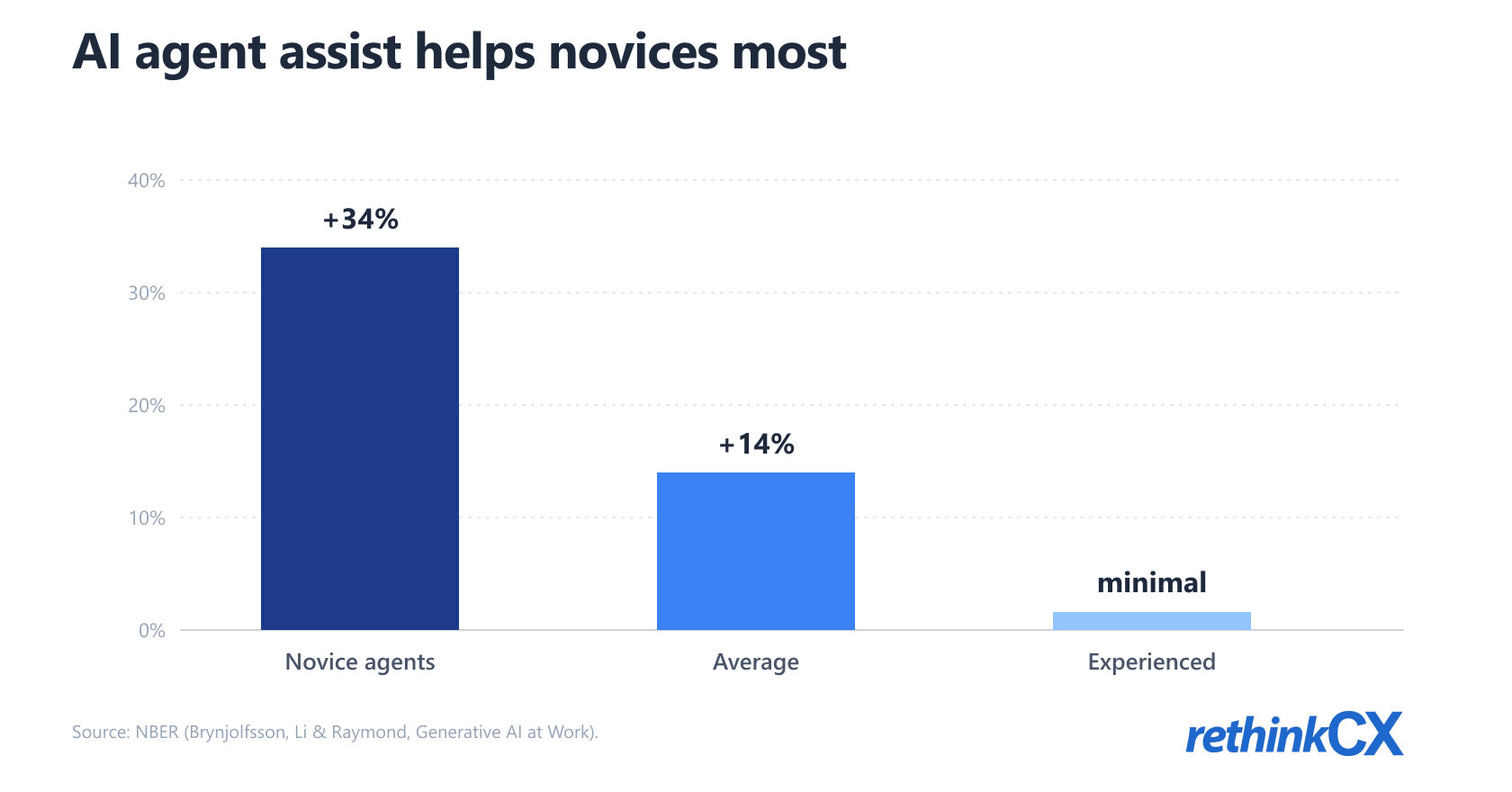 The contrarian read on 2026 is that budgets are chasing autonomy while the demonstrated return sits with assist. If I had one AI dollar to spend on a contact center, it would go here first, because the payback is fast and the downside is small.
Trend 3: Voice Biometrics and Fraud Defense
Voice biometrics authenticate callers passively by voiceprint, cutting verification time and fraud, and in 2026 they arrive paired with deepfake detection. The reason is blunt: voice cloning has made knowledge-based authentication, the mother's-maiden-name and last-four-digits ritual, genuinely unsafe.
This is the trend most operations are under-weighting. The same generative AI powering your voice bot is powering the fraud calls hitting your IVR, and cloned-voice attacks defeat both human agents and naive voice authentication. The 2026 move is passive voice authentication plus active deepfake detection at the platform layer, where NICE, Verint, and Pindrop are the names that come up. If you handle anything financial or health-related, treat this as a security requirement, not a CX nicety. The operations that skip it are one convincing cloned voice away from a breach that no amount of agent training prevents.
Trend 4: Finance-Led AI Governance
AI governance moved from the innovation team to finance in 2026. The pattern across the industry is consistent: AI projects that can't demonstrate payback inside 12 to 18 months are being deprioritized or killed, and spend now runs through ROI gates instead of innovation budgets.
This is the healthiest trend on the list, and the one vendors won't put on a slide. The 2023-2024 era of buying AI because it was AI is over. The operations that win in 2026 treat every AI deployment like a capacity investment: a defined success metric, a control group, a payback window, and the discipline to turn it off if it doesn't clear the bar. The reason most AI pilots disappointed wasn't the technology. It was funding them with no accountability and no baseline to measure against, so nobody could say afterward whether they worked. Govern the spend the way you'd govern opening a new site.
Trend 5: The Unified Data Layer
The unglamorous trend underneath the other four is unifying the customer-data layer. Agentic resolution, routing, sentiment analysis, and personalization all degrade on fragmented data, which means the data foundation, not the AI tool, is what decides whether any of it works.
Every operation I've watched buy AI and see no metric move had the same root cause: they layered intelligence on top of siloed systems and got confident, wrong, and expensive automation. The order of operations is fixed. Unify the data, govern the spend, then automate. Do it in that order and everything on this list compounds. Skip it and you've bought a sophisticated way to fail faster. Our CX technology advisory covers the integration work that makes the rest of this real instead of cosmetic.
What I'd do if I were planning AI spend for 2026
Three moves, in order. Fund agent assist before autonomy, because the evidence is there and the ramp-time payback is fast. Treat agentic AI as owning the 40-60% it can actually close, not the 90% in the demo, and instrument the failures so you find them before customers do. And put every dollar through a payback gate, because the cheapest AI mistake in 2026 is the project nobody measured.
The trend underneath all the trends is boring and correct: unify the data, govern the spend, augment the humans. The vendors will sell you replacement; the operators who win are buying augmentation. Most of these capabilities land in your operation through the customer service software platforms you already run, which is why platform selection quietly decides how much of this list you can actually adopt. For the category context underneath modern call centers, see our complete BPO guide, and to sequence the spend for your own operation, our call center strategy work covers it.