
NPS software collects Net Promoter Score surveys, sorts respondents into promoters, passives, and detractors, and reports a single number: the share of promoters minus the share of detractors. In 2026, almost every tool on the market does that part well. What separates them is what happens after the score lands. The score is easy. Acting on it is the job.
So we ranked these twelve tools by one criterion: how well each one turns NPS into action and closes the loop, not by how many survey templates it ships with. That ordering is deliberate. A tool that blasts beautiful surveys and leaves the results in a dashboard nobody opens is worth less than a plainer tool that routes a detractor to the right person within the hour. The best NPS software is the one that shortens the distance between a low score and someone doing something about it.
A quick reality check before the list, because the marketing around this category oversells the surveys and undersells the hard part. Response rates are lower than vendors imply. CustomerGauge's B2B benchmarks put the average NPS response rate at 12.4%, with a range from 4.5% to 39.3%. Most teams I've watched live closer to the bottom of that band than the top. That single fact reorders the whole buying decision: if only one in ten customers responds, how a tool collects feedback (in-app at the right moment, embedded in a support reply, triggered by an event) matters far more than how many chart types it offers.
What NPS software actually does (and the four tiers)
Strip away the positioning and every NPS tool is doing the same three things: asking the 0–10 question, bucketing the answers, and showing you the math. The differences live in distribution, analysis, and what the tool does with a detractor once it finds one. If you're still deciding whether NPS is even the right metric, how NPS compares to CSAT and CES is the better starting point — and if your bottleneck is making sense of the feedback you already collect rather than collecting more, that's a voice of customer analytics problem, not a survey-tool problem. This guide assumes you've already settled on NPS and need the software.
The market splits into four tiers, and knowing which one you're shopping in saves weeks:
| Tier | What it's for | Representative tools | Starting price | Free tier? |
|---|---|---|---|---|
| Analysis & action layer | Turning collected feedback into action without a data team | Genuics | Free to start | Yes |
| Dedicated NPS specialists | Fast, focused NPS with follow-up logic | AskNicely, Retently, Refiner, Nicereply | ~$59–199/mo | Limited |
| Multi-channel feedback suites | NPS plus CSAT/CES across channels | Survicate, SurveySparrow, Zonka, SurveySensum | ~$49/mo+ | Yes |
| Enterprise CX platforms | Org-wide programs, governance, integration | Qualtrics, Medallia, CustomerGauge | Quote-only (often 6 figures) | No |
Net promoter score software gets sold as if more features equal more insight. They don't. The same holds whether you're shopping for lightweight NPS survey software or a full enterprise NPS platform: a survey suite with forty question types and no detractor routing will lose to a focused tool that does one loop well.
How we ranked these tools (what actually matters)
We ranked by closed-loop capability first, accessibility second, and survey polish last. That order is the whole argument of this piece. An NPS tool earns its keep in the gap between a score arriving and a human acting on it, so the tools that automate detector alerts, route cases, and track whether the follow-up worked rank above the ones that stop at a pretty dashboard. The same logic underpins the customer service KPIs that matter: a number you don't act on is overhead, not insight.
Three things moved a tool up or down the list:
Does it close the loop, or just measure? Routing a detractor to an owner, triggering follow-up, and recording the outcome is the feature that changes retention. Most tools claim it; fewer do it well.
Does collection fit how your customers actually respond? With response rates in the 5–15% range for most teams, the channel and timing matter more than the survey builder. In-app and transactional triggers beat a quarterly email blast.
Is the real cost honest? A license is the small number. The big one is the weeks of setup and the workflow you wrap around it. Tools that hide pricing usually hide implementation cost too.
The 12 best NPS tools, ranked
Ranked by how well each turns a score into action. Pricing is "starts around" and moves; confirm current numbers with each vendor.
Genuics

Best for: turning NPS data you already collect into action without a data team.
Genuics tops this list because it's built for the part everyone else treats as an afterthought: what you do with the feedback. It's a self-serve analytics layer that ingests survey data from the tools you already use (SurveyMonkey, Typeform, Google Forms, or a direct API feed), then lets a CX lead or ops manager build NPS dashboards, drill from a chart straight into the underlying responses, and route flagged accounts into case workflows with its Cases and Automation modules. No SQL, no analyst queue. For a team drowning in survey data it can't operationalize, that's the bottleneck solved.
The honest caveat: Genuics isn't a survey-collection tool. You bring your own survey source and point Genuics at it. If you want a single product that both sends the survey and closes the loop, a dedicated specialist below is simpler. If your problem is that the scores already exist and nobody acts on them, this is the fix. Pricing is free to start, no credit card, with paid tiers on the pricing page.
AskNicely

Best for: frontline service teams that want NPS in the workflow, not the boardroom.
AskNicely is the strongest pure-play for action at the frontline. Leaders get a daily NPS pulse, agents see their own scores in real time, and Salesforce stays current without manual entry. It's genuinely good at making feedback a daily habit rather than a quarterly review. The limitation is price and focus: plans run from roughly $199 to $375 per month with enterprise on quote, and it's NPS-centric, so if you want CSAT and CES in the same tool you'll feel the edges.
Retently

Best for: SaaS and ecommerce teams that want automation without enterprise weight.
Retently hits a sweet spot: quick to deploy, multi-channel (email, in-app, Intercom), with AI-powered feedback classification and genuinely useful automation around follow-up. It supports NPS, CSAT, and CES, so it flexes beyond one metric. Pricing starts around $99 per month, with an ecommerce tier from $49. It's lighter on the governance and access controls a large enterprise program needs, which is exactly why mid-market teams like it.
SurveySensum

Best for: mid-market teams that want enterprise-style closed-loop action at a published price.
SurveySensum is the value pick for teams that want real closed-loop action management, AI text analytics, and omnichannel collection without a six-figure contract. Plans start around $3,600 per year, and crucially the pricing is public, which tells you something about how the rest of the buying experience goes. The tradeoff is ecosystem: it's a smaller brand than the enterprise incumbents, so your integration edge cases may need more hands-on setup.
Refiner

Best for: SaaS teams that want behavior-triggered NPS inside the product.
Refiner is purpose-built for in-app NPS. Behavior-triggered surveys, segment-based targeting, and customizable widgets mean you ask the right user at the right moment, which is the single biggest lever on response rate for a product-led business. Pricing starts around $99 per month. It's deliberately SaaS-shaped, so if you need offline, kiosk, or retail collection, it's the wrong tool.
Survicate

Best for: digital teams that want easy multi-channel feedback with strong CRM sync.
Survicate is the easy-to-live-with option. Reviewers consistently praise the interface and the clean HubSpot and Salesforce integrations, and its AI auto-tagging does real work categorizing open-text responses so you're not reading them one by one. It carries a solid 4.4 on G2 across 200-plus reviews. Two knocks surface repeatedly: advanced survey logic has limits, and the pricing feels steep for an early-stage startup.
Nicereply

Best for: support teams on Zendesk, Intercom, or Freshdesk.
Nicereply is the obvious pick if your main customer touchpoint is a support queue. It embeds NPS and CSAT ratings directly into ticket resolutions and agent email signatures, so the customer rates the interaction in one click while it's fresh. That's transactional NPS done right. Pricing runs roughly $39 to $359 per month. The common gripes: survey design customization is limited, and removing Nicereply branding pushes you up a tier or into a support request.
SurveySparrow

Best for: teams that want higher completion through a conversational survey feel.
SurveySparrow's bet is engagement: its chat-style surveys lift completion meaningfully over static forms, which directly attacks the response-rate problem. It handles NPS with automated follow-ups by promoter, passive, or detractor, plus trend tracking. Two practical notes: native integrations are thin, so anything complex routes through Zapier, and billing is quarterly or annual, with no month-to-month option.
Zonka Feedback

Best for: teams that need omnichannel collection, including offline and kiosk.
Zonka is the broadest collector on this list. Web, email, SMS, in-app, plus offline and kiosk capture, with AI feedback intelligence and native Salesforce and HubSpot integrations. It's a genuine favorite for retail and multi-location operations, carrying around 4.6 on G2 and Capterra. Pricing starts near $49 per month, though smaller retailers sometimes find the upper tiers pricey for the volume they need.
CustomerGauge

Best for: B2B teams that want to tie NPS to account revenue.
CustomerGauge is the specialist for account-based, B2B NPS with revenue attribution baked in, so you can connect a score to dollars at risk. That focus is its strength and its ceiling. It's quote-only, and reviewers flag limited flexibility, complicated user management, and a reliance on CustomerGauge's support to set up new surveys. It's also so NPS-centric that CSAT and CES are largely locked out, which is fine if NPS is your one metric and frustrating if it isn't.
Qualtrics

Best for: large organizations with a mature CX program and the resources to run it.
Qualtrics is the most powerful platform here, and for an enterprise running a serious experience-management program it's a defensible choice. The honesty it doesn't volunteer: pricing is custom and typically starts around six figures, the platform spans three suites (CX, EX, Strategy & Research) when most teams need one, and contracts commonly carry auto-renewal with 5–10% annual escalation. It's the right tool for organizations with dedicated CX resources, and overkill for everyone else.
Medallia
Best for: enterprises capturing signals across many channels at scale.
Medallia is Qualtrics's main enterprise rival, strong at pulling experience signals across web, contact center, and digital at scale. Same enterprise caveats apply, plus one specific to Medallia: onboarding is notoriously heavy, with teams reporting months before the platform delivers actionable insight. Under a ranking that values speed-to-action, that lag is exactly why it sits where it does. Pricing is quote-only and lands in six figures.
Best NPS software by use case
The ranking above is ordered by closed-loop capability, which is the right general answer and the wrong specific one. What you should buy depends less on which tool is best overall than on how your customers reach you, so here is the same twelve mapped to the situation each one actually fits.
| If this is your situation | Start with |
|---|---|
| The scores already exist and nobody acts on them | Genuics |
| Frontline service teams, NPS in the daily workflow | AskNicely |
| SaaS or ecommerce wanting automation without enterprise weight | Retently |
| Mid-market wanting closed-loop action at a published price | SurveySensum |
| SaaS and product teams measuring in-product experience, behavior-triggered | Refiner |
| Digital teams that live in HubSpot or Salesforce | Survicate |
| Support-led teams on Zendesk, Intercom or Freshdesk | Nicereply |
| Chasing completion rate with conversational surveys | SurveySparrow |
| Retail and multi-location, including offline and kiosk | Zonka Feedback |
| Account-based B2B tying NPS to account revenue | CustomerGauge |
| A large enterprise program with dedicated CX resources | Qualtrics |
| Enterprise signal capture across many channels at scale | Medallia |
| A small team that just wants a first read on the score | Survicate, Zonka or SurveySparrow free tier |
One caution on the last row: free tiers cap volume and ship no closed-loop automation, so you outgrow them the moment you want to route detractors and track the follow-up.
NPS tracking across multiple locations
For NPS across hundreds of locations, the binding requirements are collection that reaches customers while they are physically in a location and reporting that rolls up by site. Zonka Feedback is the pick on this list for that shape, because it captures web, email, SMS, in-app, offline and kiosk, and syncs natively to Salesforce and HubSpot. What separates a working multi-location program from a dashboard is per-location segmentation with a named owner at each site, which is the same closed-loop test the ranking above is built on, and it is the thing free tiers cannot carry.
What NPS software actually costs in 2026
Published prices in this category span three orders of magnitude, and the license is the small number either way. The big one is the weeks of setup and the workflow you wrap around it, which is why the quote-only vendors tend to be the expensive ones twice over.
| Tool | Starting price |
|---|---|
| Genuics | Free to start, paid tiers published |
| Nicereply | ~$39–359/mo |
| Zonka Feedback | From ~$49/mo |
| Retently | From ~$99/mo (ecommerce tier from $49) |
| Refiner | ~$99/mo |
| AskNicely | ~$199–375/mo, enterprise on quote |
| Survicate | Published tiers; steep for early-stage |
| SurveySparrow | Published tiers; quarterly or annual billing only |
| SurveySensum | From ~$3,600/yr, publicly listed |
| CustomerGauge | Quote-only |
| Qualtrics | Custom, typically six figures, 5–10% annual escalation |
| Medallia | Quote-only, six figures |
Prices are "starts around" and they move; confirm current numbers with each vendor before you build a business case on one.
What counts as a good NPS score in 2026
A good NPS score is relative to your industry, which is what the NPS benchmarks below show and what the threshold everyone repeats ignores. The line that gets parroted across the category, that anything above 50 is strong and above 70 is exceptional, is an absolute rule applied to a metric that swings wildly by industry. The benchmark data makes that obvious.
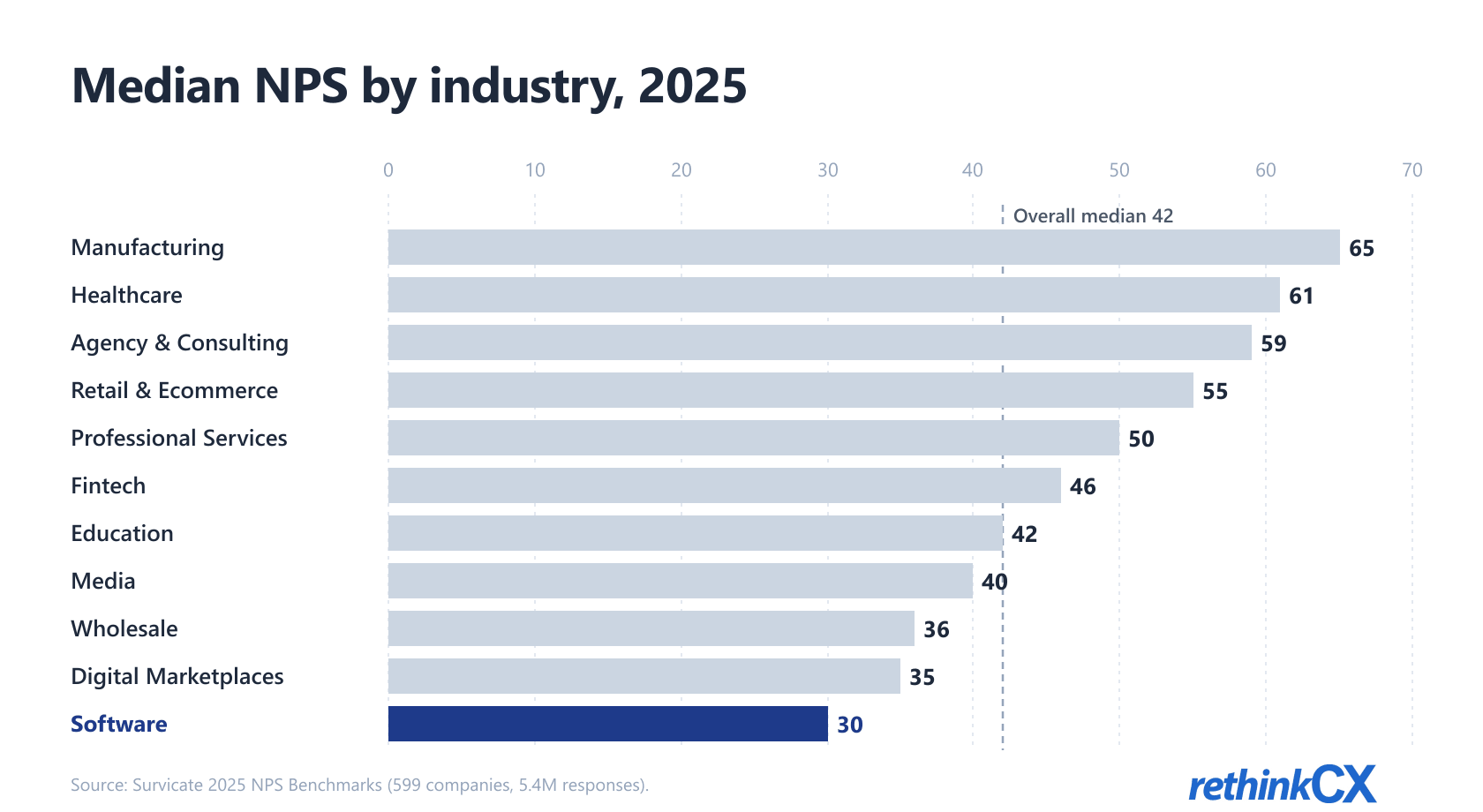
Survicate's 2025 NPS benchmarks, drawn from 599 companies and 5.4 million responses, put the overall median at 42 but show software sitting near 30 while manufacturing runs near 65. That spread is the point: a 45 is below average in fintech and genuinely strong in software. Survicate's own guidance is to "treat industry benchmarks as reference points, not absolute goals," which is the right instinct. Chasing a universal 70 will either flatter a manufacturer or demoralize a SaaS team for no reason.
The more useful question isn't "is my score good" but "is my score improving against my own trend and my direct competitors." That's the loyalty signal the number is really standing in for, and what actually drives that loyalty matters more than the digit on the dashboard.
When you don't need dedicated NPS software
Here's the advice no NPS vendor will give you: plenty of teams shouldn't buy dedicated NPS software at all. If your CRM or survey suite already runs NPS and you genuinely act on the results, a separate tool is mostly redundant cost. Dedicated tooling earns its place when you're closing the loop at scale, routing detractors, triggering follow-up, and tracking whether the intervention worked. Without that workflow, a shinier survey tool just produces a number faster. Whether you have it is a maturity question rather than a tooling one, and it is what the CX maturity assessment scores under measure-and-act.
There's a deeper caution worth stating plainly: the score is easy to game, and more surveys rarely mean better data. Even Fred Reichheld, who created the metric, has acknowledged the problem. In Bain's Net Promoter 3.0, he and his co-authors concede that self-reported scores have "sown confusion and diminished its credibility," citing outright "pleading, bribery, and manipulation" of responses, which is why Bain moved to an audited earned-growth metric instead. A tool that maximizes survey volume can make your number climb while the underlying truth degrades. That's worth remembering before you optimize for response count.
One practical note, because the landscape shifted in 2026: Delighted, long a default recommendation for simple NPS, is sunsetting on June 30, 2026. If you're on it, treat migration as urgent and use the tiers above to pick a replacement that fits how you collect.
A falling NPS, especially a cluster of detractors, is one of the earliest signals you'll get that accounts are at risk. That's where detractors turn into churn, and catching it early is most of the value. If you want the broader frame, we go deeper on what CX measurement should capture elsewhere.
How to choose, in one paragraph
Match the tool to how you collect and what you'll do with the result, not to the longest feature list. If the scores already exist and nobody acts on them, start with the analysis-and-action layer. SaaS measuring in-product experience wants Refiner or Retently. A support-led team wants Nicereply. Frontline service operations want AskNicely. Retail and multi-location want Zonka. A B2B team tying NPS to revenue wants CustomerGauge. A large, well-resourced enterprise program wants Qualtrics or Medallia, with eyes open about cost and time-to-value. And a mid-market team that wants closed-loop action at a public price should look hard at SurveySensum.
Whatever you pick, build the action workflow before you fall in love with the dashboards. If I were standing up an NPS program from scratch today, I'd do two things differently from how most teams start: choose the collection method before the brand (because response rate, not feature count, decides whether the data is usable), and stand up the detractor-routing workflow before sending a single survey. The tool is the easy part. The loop is the work.
For teams that want help wiring that loop into how the business actually runs, our CX strategy advisory is built around it.