The most direct cause of customer loyalty is the moment a customer expected a corporation and got a human instead. When a brand's response to a personal moment is so disproportionate to the transaction that no profit calculation could justify it, the customer stops experiencing the company as a vendor and starts experiencing it as something closer to a friend who happens to be in business.
Two opposing operating models get a brand to that point. Path A: show up disproportionately in the moments that matter. Path B: eliminate the moments that require fighting at all.
The standard answer to this question names the bucket and stops there. "Consistently positive customer experience." "Trust, value, ease, recognition." All true, all useless. Those phrases describe the symptom of loyalty without naming the mechanism that creates it. The mechanism is more specific and more uncomfortable, because it requires a company to choose the customer over the policy at the exact moment most company processes are designed to choose the policy.
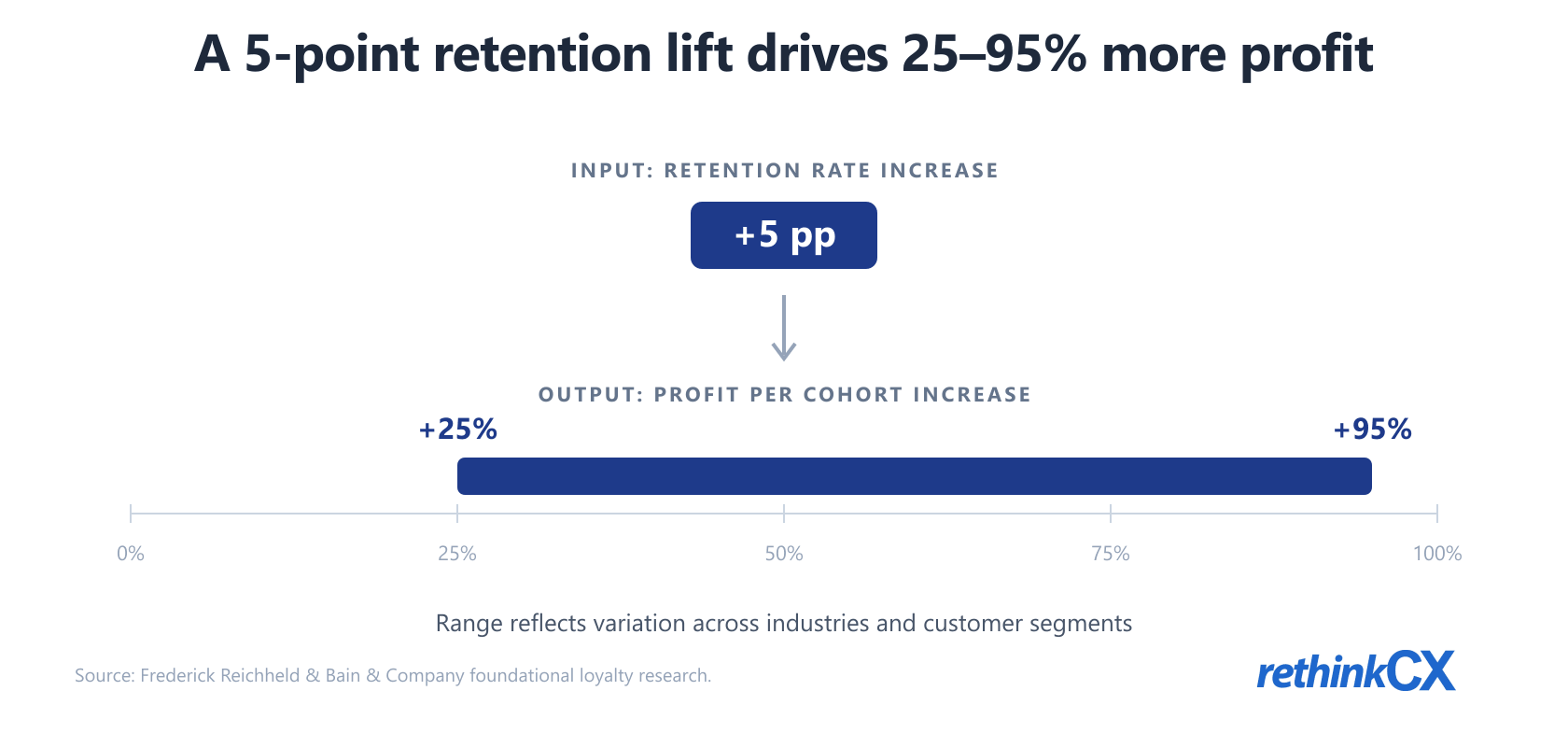
This post covers what actually causes loyalty in 2026, the two operating paths that get there, and what the loyalty research says about why competent brands keep losing customers anyway. Frederick Reichheld's foundational Bain research, summarized in HBR, found that increasing customer retention rates by 5% raises profits by 25 to 95%. That number is the financial reason the soft stuff matters.
The direct answer: when a customer expected a corporation and got a human
The Chewy flowers story is now famous enough to function as shorthand. A customer cancels her pet food subscription because her dog died. She expects a brisk transactional response: form filled out, money refunded in 5 to 10 business days. Instead, Chewy refunds her in full, asks her to donate the unopened food to a local shelter rather than ship it back, and sends flowers to her home with a handwritten card signed by the service rep she spoke with. She tweets about it. The tweet goes viral. Fortune later confirmed the pattern is systematic, with Chewy doing this since "the very early days."
That moment is the most direct cause of customer loyalty. Not "consistently positive customer experience." A specific, namable instance where the company recognized a personal moment in the customer's life and responded with a gesture that had zero ROI on the transaction. The flowers cost Chewy maybe $80. The customer told the story to thousands of people. Her next dog will be a Chewy customer for life, and so will several of her friends.
The mechanism has three properties. Stakes are asymmetric: the moment matters enormously to the customer and is statistically trivial to the company. The response has no transactional logic: sending flowers, paying out a generous warranty, or refunding without questions is a deliberate choice to leave money on the table. The story is told: the customer doesn't keep the moment to themselves, and the asymmetry is what makes it shareable. Most companies design their processes to eliminate exactly these moments because the cost is immediate and the loyalty payoff doesn't land in next quarter's P&L.
Two paths to loyalty: show up disproportionately, or get out of the way entirely
There's a second mechanism that produces the same emotional outcome through opposite means. Uber doesn't send flowers when something goes wrong with an order. Uber doesn't call you. Uber doesn't make you call them. The item is missing, the refund just appears in the app. The customer never has to fight, never has to talk to a contact center, never has to be transferred or escalated or "let me get my manager." The friction is removed before it happens.
Both mechanisms create loyalty because both demonstrate that the brand is structurally on the customer's side without making the customer prove it. The two paths split on whether the brand shows up in the moment or removes the moment entirely: emotion versus effort, two of the three dimensions of customer experience.
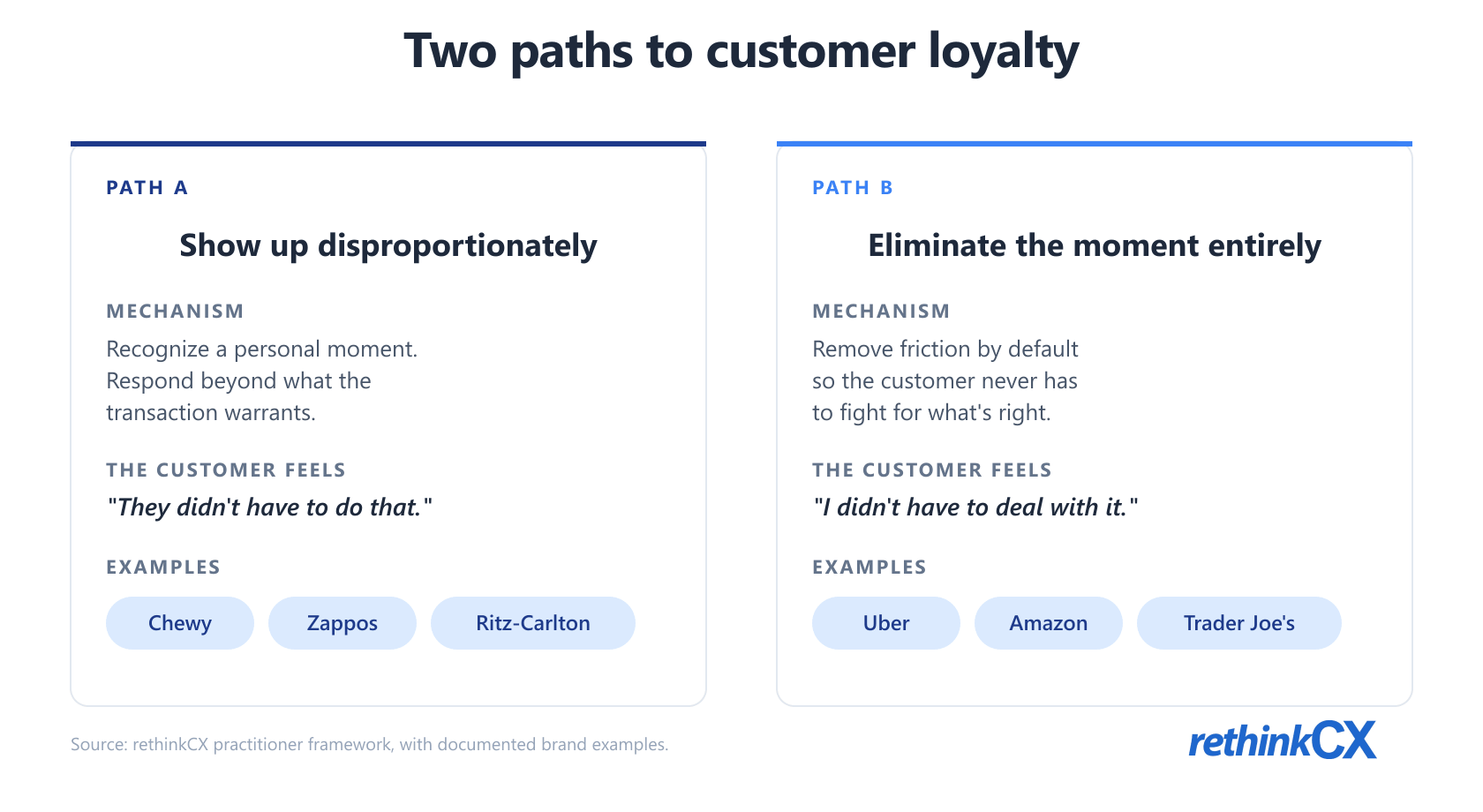
Path A fits categories with high emotional valence (pets, hospitality, luxury, apparel) where the personal stakes are visible and the gesture lands. Its failure mode is inconsistency: when the gesture happens for some customers and not others, it reads as random rather than systematic. Path B fits categories with high transaction volume and low per-transaction stakes (rides, marketplace, grocery) where removing friction is the whole game. Its failure mode is inhuman: the frictionless flow works perfectly until something needs a human, and there's nobody. Staffing that exception path is expensive precisely because it is rare, which is the situation where outsourced coverage tends to beat an in-house rota nobody can justify at full time.
The third operating model, where most companies sit, does neither. They route the cancellation to a churn form, the refund to a 14-day window, the missing item to a support queue with a 48-hour response SLA. That's commodity-supplier syndrome. It's also the most expensive operating model of the three, because it carries the cost of friction without any of the loyalty upside.
The data: why being competent isn't enough
The honest version of what the loyalty research now says is that competence is the floor, not the ceiling. There's a wide and well-documented gap between why executives think customers leave (price, competitor offers) and what customers actually cite (feeling uncared for, the relationship feeling too transactional). Morning Consult's 2025 loyalty report put the current shape of it bluntly: cost-driven switching is at multi-year highs, but the deeper read of the same data is that the emotional bond wasn't strong enough to override the price decision. Strong bonds hold through pricing changes. Weak bonds don't.
Steven Van Belleghem has been making the same argument from a different angle for years. As digitization makes every industry more transparent, every industry is being commoditized at a record pace. The way out is not more competence. The way out is the moment where a customer experiences the company as something other than a vendor. He calls it the rational/emotional gap, and the data on closing it lines up with the psychology of customer loyalty work we've covered separately. Both point at the same finding from different starting points.
The financial mechanism behind all of it is Frederick Reichheld's foundational research at Bain. A 5 percentage point retention lift drives 25 to 95% more profit per cohort, because loyal customers cost less to serve, refer more, and tolerate price changes that send price-sensitive customers shopping. Reichheld later operationalized the upstream signal into the Net Promoter Score measurement framework. The score itself isn't the point. The point is that the same moments that drive promoter behavior also drive the financial outcome, and most CX programs measure the score while underinvesting in the moments. Loyalty and the churn-side of the same equation are the same lever read from opposite ends. A customer staying loyal is a customer who didn't churn, and the operational triggers are the same in both directions.
Three stories that made the pattern famous (and one from inside)
The named examples are documented enough to anchor the article. Each one passes the asymmetric-stakes test, and each one became a story the customer told.
Chewy. Beyond the flowers case, Chewy commissions hand-painted portraits of customers' pets and ships them as surprise gifts. The "donate to a shelter rather than return" routing for unopened food serves as both a logistics shortcut (return shipping on a 30-pound food bag costs more than the food) and a goodwill gesture the customer experiences as generosity. Since 2012 the company has donated more than $183M in product to shelters and rescues, proving the pattern is a system with a budget line, not anecdotal heroics.
Zappos. The funeral slippers story is the most-cited. A woman ordered slippers for her husband; he died in a car crash before they arrived. She called Zappos for the refund. The rep refunded her and sent flowers. She told the story at his funeral. Tony Hsieh later told the story in talks, and at one of those talks a seminar attendee named Lauren stood up and said the same thing had happened to her after her father died. (Insight Partners and NPR's Hsieh remembrance both reference the story.) The operational signal is in the call-length data. Zappos reps are authorized to stay on a call as long as the customer needs. The record is 10 hours and 43 minutes. Returning-customer rate: 75%.
Ritz-Carlton. A family vacationing at the Amelia Island Ritz left their son's stuffed giraffe (Joshie) behind. The father told the son a small lie about Joshie taking an extra vacation. He called the hotel asking for a photo to back up the story. Ritz sent the giraffe home in a package that included a binder of photos: Joshie wearing shades by the pool, getting a spa treatment, driving a golf cart, wearing a Ritz security badge as honorary Loss Prevention. Per HuffPost, the story has been retold in hospitality CX presentations for over a decade.
Canada Goose, from inside the operation. This one I lived through, so I'll frame it as the intent of the program rather than a marketing claim. We ran a buyback program for old jackets and kept an archive that collected jackets with significant customer histories. I'll never forget reviewing a letter from a customer who'd been in a serious accident — EMTs had to cut him out of his jacket on the side of the road, and the EMT later told him the jacket was the reason he survived. The customer wrote in not to complain, but to ask if we'd ever want the cut jacket back for our archives. That kind of attachment is not something a marketing campaign creates. It's what happens when a product earns its place in someone's life. Our job, when we got those letters, was to honor that attachment rather than route it to a return queue. The buyback program existed because somebody on the inside understood those moments were the most important thing the brand had.
The public record on Canada Goose's warranty is mixed; real customers have run into the limits of the formal program, and we're not going to pretend the system was perfect. The point is the operating intent at its best: a willingness to treat the personal moments as the asset they are.
How to build for it: four levers, mapped to the two paths
The levers split clean across the two paths. Pick the two that match your path, and ignore the other two. Half-built combinations are how the worst CX gets shipped.
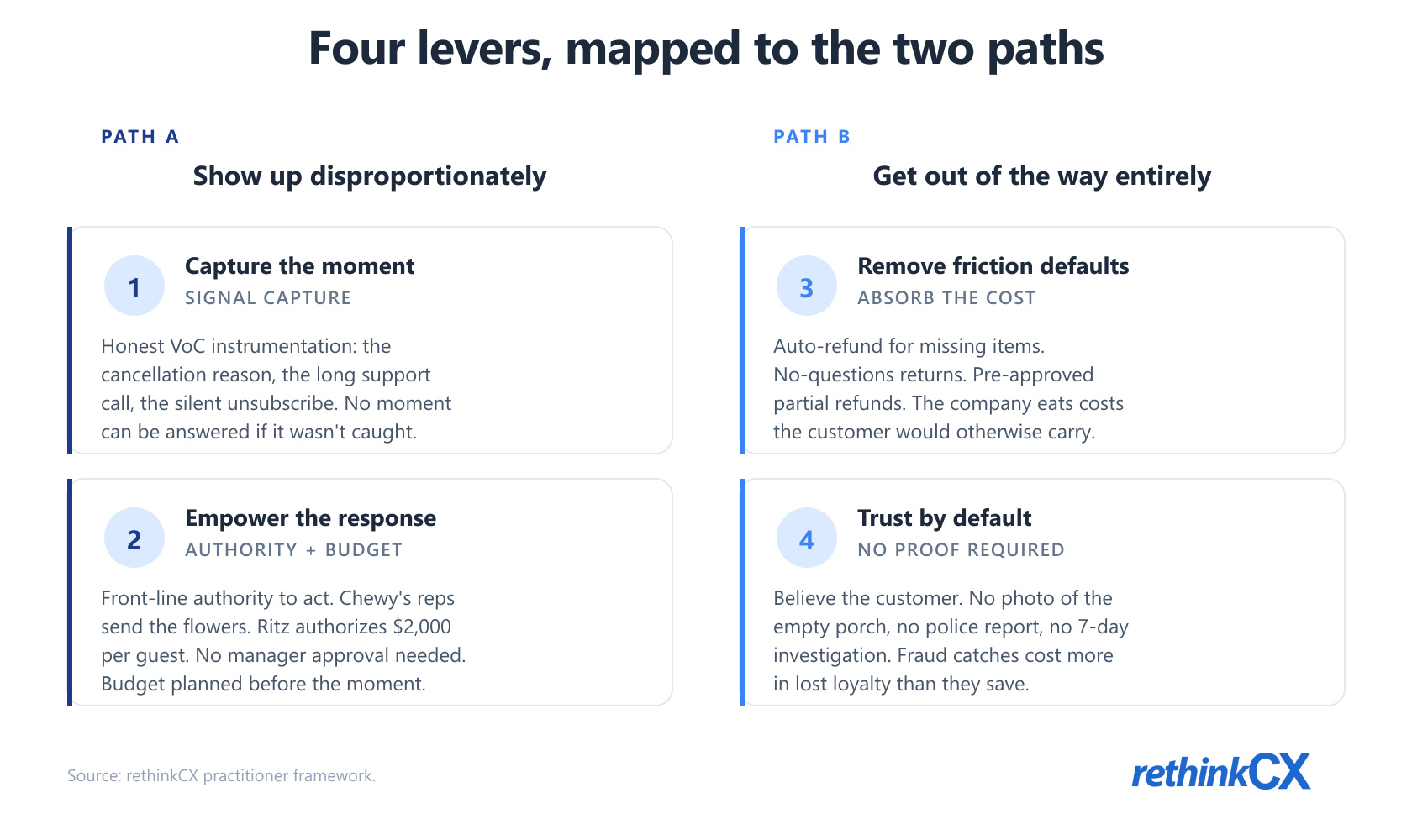
Path A, Lever 1: Capture the moment. You can't respond disproportionately to a moment you didn't catch. Honest voice of customer programs catch the early signals: the cancelled subscription with a reason field filled in, the long support call, the social media mention. Most companies have the signals and discard them at the form level. The Chewy flowers don't happen if the cancellation reason field is a dropdown without "my pet died" as an option, or if the rep on the call has no path to escalate.
Path A, Lever 2: Empower the response. A captured signal that hits a $25 spending cap or requires manager approval becomes a process moment instead of a human moment. Chewy's reps have explicit authority to make the gesture. Zappos' reps have no cap on call length. Ritz-Carlton famously authorizes every employee to spend up to $2,000 per guest, per incident, without approval. The lever is authority and budget at the front line, designed before the moment happens.
Path B, Lever 3: Remove the friction defaults. Path B requires the company to take on costs that, on paper, the customer should carry. Auto-refund for missing items. No-questions returns. Pre-approved partial refunds before the customer even complains. These are deliberate choices to absorb cost in exchange for the absence of friction. The subscription retention playbook version of this lever is a one-click cancel that doesn't make the customer talk to a save team, paired with a one-click "actually no, keep my subscription" the customer can hit later because the goodbye was clean.
Path B, Lever 4: Trust by default. The customer says the package didn't arrive. You believe them. You don't ask for a photo of the empty porch, you don't make them file a police report, you don't put them through a 7-day investigation. Most fraud-prevention machinery costs more in lost loyalty than the fraud it catches. The exceptions are real but rare, and the operating posture is "trust the customer until pattern evidence says otherwise."
This is the work our CX strategy advisory focuses on: designing the operational triggers that make the chosen path systematic rather than heroic, so the loyalty moments don't depend on a particularly empathetic individual showing up that day. For teams that want to benchmark where their loyalty operating model sits today, the CX maturity assessment scores how the operation behaves when something goes wrong, which is the asymmetry this whole post turns on, and Path A or Path B capability fits inside the broader CX strategy playbook.
Food handler exam answer (a brief detour)
If you arrived here from a Texas Food Handlers certification exam, the accepted answer on that test is friendly staff. That's correct for the exam, and it isn't wrong for the broader question either. It's the Path A mechanism in a restaurant context, where the personal moment is small (someone is hungry, possibly stressed, possibly with kids) and the disproportionate response is being treated warmly instead of as a transaction. The exam version of the question and the business version of the question point at the same thing. The stakes scale up in other industries.
Three things I'd do differently if I were starting today
The honest retrospective. I've seen each of these mistakes made by competent teams operating in good faith, including teams I've been on.
Hire for empathy, not script adherence. Path A only works when the front-line rep is allowed to be a human. The hiring filter that produces a 95% script-compliance rate also produces a 0% Chewy-flowers rate. Pick which one you want and build the hiring loop around it. Most contact-center hiring is still optimized for the wrong filter because it's the easier one to measure.
Treat the budget for "no-ROI gestures" as a line item, not an exception. Chewy plans for the flowers. Ritz plans for the $2,000-per-guest authorization. Zappos plans for the 10-hour calls. The companies famous for these moments don't treat them as exceptions to be approved one at a time. They treat them as a category of spend with a budget, and they trust the people closest to the customer to use it. If your CX gestures all require a special exception, you're not building the muscle.
Decide explicitly which path you're playing. Path A and Path B require opposite operating models. Path A is high-touch, high-empowerment, high-cost-per-interaction. Path B is low-touch, high-automation, low-cost-per-interaction. The worst CX in the world is the half-built combination: a contact center designed for Path B (cost minimization, low authority) trying to deliver Path A moments (high authority, generous gestures) when the customer hits a hard moment. Pick. Then build everything to support the pick.
Underneath all three, the strategic point that should be obvious but mostly isn't: customer experience is a competitive moat, not a sales expense. Most organizations still treat CX as a necessary evil of having a sales function, a cost to be minimized and a metric to be hit and forgotten. The companies that take CX seriously top-down, where the CEO actually believes the operating model has to change, end up with something competitors can't easily copy. It's an underutilized moat in 2026, and that's exactly why building one is still available as a strategy.